A room with a double bed, a television, a refrigerator and a few chairs are all that serve as shelter for a southern Lebanese family living on the outskirts of Beirut.
Elie Jamal, 34, his pregnant wife and his mother have adapted to their living situation in Nabaa, where rents are more affordable than in Beirut, and Hezbollah banners hang above the streets.
“We come from a calm village,” says Mr. Jamal, an Orthodox Christian. “Here, at night, we cannot sleep because there is so much noise. Residents frequently shoot in the air whenever someone dies or gets married.”
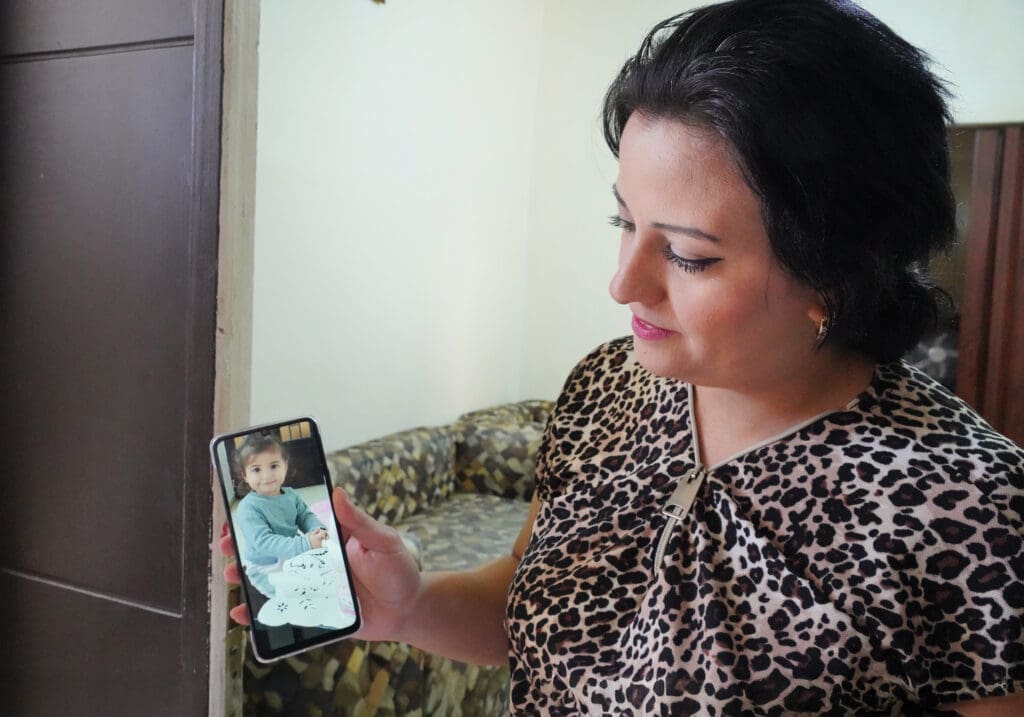
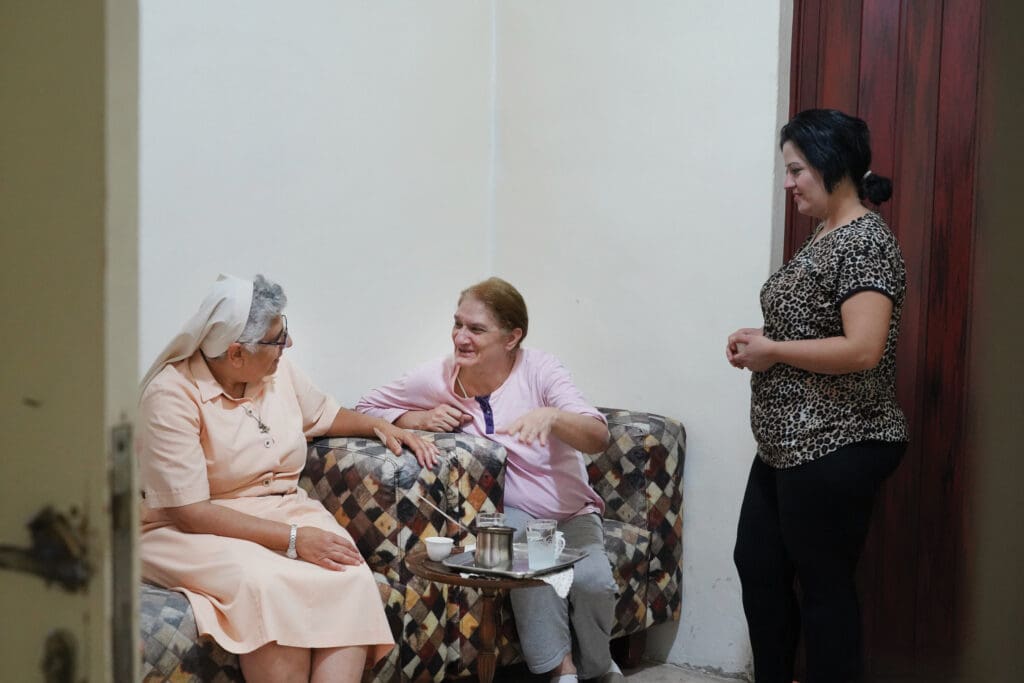
On a mid-October morning, his mother takes coffee to Manal Chahine, their neighbor, who — with her husband, three children and six relatives — also found refuge from the Israel-Hezbollah war. The Jamals and Chahines were living in their Lebanese villages of Qlayaa and Ebel el-Saqi respectively.
On 8 October 2023, Hezbollah, a Lebanese political party and Shiite militia, launched air attacks on Israel in support of Hamas, after Israel began bombing Gaza in retaliation for Hamas attacks on Israel on 7 October.
When Israeli military first responded with a bombardment campaign and drone attacks limited to the south of Lebanon and the Bekaa region, the two families were able to remain in their villages. However, the drastic escalation of the war in September 2024 led the Jamals, the Chahines and hundreds of thousands of other families to flee.
“The children were panicking, I was scared for my family and my relatives,” says Ms. Chahine.
The Lebanese Ministry of Public Health says up to one million people were internally displaced and more than 4,000 people were killed in Lebanon between 8 October 2023 and 22 July 2025. Israel and Hezbollah agreed to a ceasefire 27 November 2024.
However, in mid-October, the United Nations Office of the High Commissioner for Human Rights reported the Israeli military remained in five positions along the border and violated the ceasefire daily, killing 108 civilians since the ceasefire.
The Jamals and the Chahines were among more than 82,000 people in mid-October who were still displaced within Lebanon due to the war.
“We hope for peace, we are exhausted.”
“The war is not over,” says Mr. Jamal about his decision to stay in Nabaa. The bombardments blew out the windows and doors of his house in Qlayaa. “No one lives in our village: There is no electricity, no water, and the roads are frequently closed.”
However, living in the relative safety of Nabaa has cost these two families their financial stability. Mr. Jamal has been unable to find work, and Ms. Chahine’s husband is a day laborer. He earns between $200-$250 per month, but rent is $550, and the generator costs $125 monthly.
The Lebanese government cannot offer any support for internally displaced people, and those in need rely on local and international nongovernmental organizations, political parties, faith-based organizations and personal connections to help cover their shortfall.
The Jamals and Chahines are among 40 Christian families to receive support from the Sisters of Charity of St. Jeanne-Antide Thouret.
“The church helped us to furnish the flat,” Ms. Chahine says. “They also provide us with food relief, school supplies and clothes.”
Maronite Archbishop Charbel Abdallah of Tyre in southern Lebanon says almost two-thirds of the 14,000 families attending the 18 parishes in his eparchy were displaced in autumn 2024.
“Those who are still displaced represent a minority who have often lost their houses,” he says. “In the border villages, the situation is critical, with many houses being completely destroyed. Other parishes farther away from the demarcation line are also badly affected.”
Melkite Greek Catholic Archbishop Georges Iskandar of Tyre, whose eparchy includes 1,700 families across 12 parishes, says the homes of 28 percent of his parishioners were completely or partially destroyed by the war.
“Unemployment and poverty are reaching record-high levels, and many families are dependent on foreign aid,” he says.
In this context, with little to no support from the state and inaction from Hezbollah’s publicized compensation system, reconstruction efforts are based on personal means or private initiatives and stalled by daily Israeli attacks.
In Derdghaya, an Israeli airstrike destroyed the Melkite Greek Catholic church and parish hall that sheltered displaced people. However, Doha Chalhoub’s house still stands. Ms. Chalhoub shared her security and economic concerns with ONE in March 2024. Six months later, when the war escalated, she and her family fled.
The Israeli army “targeted the village right next to ours, we could hear the sound of the missiles,” she says. The family “left with nothing, except for our two birds that our daughters refused to leave behind.”
Ms. Chalhoub’s family returned to Derdghaya after the ceasefire and found cracks in the walls of their home and other damage.
“We have water infiltration, we repaired one broken window, but four others allow for water to get in,” she says. “We had to replace our hot water solar heating system, as rocks fell on it during one bombardment.”
Derdghaya is located at an altitude of 1,350 feet and, at the time of publication, residents were preparing for winter with the meager resources on hand.
“Pontifical Mission helped us to buy some mazut to heat our home,” Ms. Chalhoub says. However, security remains her main concern.
“The drones are constantly above our heads,” she says. “Every time we see one, we wonder if Israel will hit. We often hear the missiles and the bombing. We drive our daughters to school in the morning, hoping that nothing will happen that day.”
Tarek Mazraani, an architect from the border town of Houla, coordinates the Gathering of Residents of Southern Border Villages, an informal organization that reaches out to government ministries and relevant stakeholders to voice the concerns and needs of residents.
“The question of reconstruction is crucial but, immediately, people must be able to resume their lives,” he says. “Our first request is to receive compensation for the rent we need to pay, but also for health care expenses and tuition fees. It is urgent.”
The war worsened Lebanon’s already fragile economy. According to the World Bank, the economic cost of the war for the country reached “$14 billion, with damage to physical structures amounting to $6.8 billion and economic losses from reduced productivity, foregone revenues and operating costs reaching $7.2 billion.”
The economy in southern Lebanon, which relies on agriculture, especially on its olive and citrus groves and tobacco farms, has been unable to recover. “Many olive trees have been uprooted by the Israeli army, and, for the third consecutive year, we have not been able to harvest the rest, due to bombardment and drought,” Mr. Mazraani says.
The Food and Agriculture Organization reports more than 2,000 acres of olive groves and nearly 1,600 acres of citrus groves were destroyed by the Israeli army.
According to local media reports, 39 Israeli attacks also targeted “engineering and construction vehicles operating in south Lebanon” since the start of 2025. Twenty-two prefabricated municipal and residential buildings also were bombed in what has been coined “the war on reconstruction.” On 11 October, an Israeli military strike destroyed 300 bulldozers and other reconstruction vehicles in Msayleh.
“They aim at bulldozers clearing the debris. They have destroyed schools, municipality buildings, pharmacies, gas stations, and have damaged the roads,” Mr. Mazraani says.
In October, the father of three, who is a Shiite Muslim, was also the target of an Israeli incitement campaign for demanding the right to return to the border villages. An Israeli military quadcopter flew above the village where he was taking shelter and broadcast a message over a loudspeaker to discredit him, calling him “a land dealer” and urging residents to “drive him out.”
“Before this war, we used to live in our beautiful region, with our agriculture, our good schools, and all of this has now disappeared,” Mr. Mazraani says, calling for domestic and foreign government support to “rebuild our livelihood and our heritage.”
“The church helped us to furnish the flat … They also provide us with food relief, school supplies and clothes.”
One aspect of this heritage, he says, is religious coexistence: “We all live together — the Christians, the Sunni, the Shiite. We share the same history and the land is ours.”
The Christian community in southern Lebanon suffered significant losses. Fifteen churches across 10 villages were damaged by the war, along with rectories and church halls.
Israeli military airstrikes in Yaroun, a border village deeply impacted by the war, destroyed St. George Melkite Greek Catholic Church. A solar system was installed to generate electricity for the parish hall, where liturgies will be held until the church roof and walls can be rebuilt.
“The south is part of a holy land where Christ himself preached,” Archbishop Abdallah says. “Staying in the south is a testament to our friendship with our Muslim brothers.”
While securing funding for reconstruction will be challenging “as long as the situation is not calm enough, as long as there is no peace,” he says, “we need to rebuild as soon as we receive funding.”
“It signals to the Christians and also to other communities that we will continue living in this village and on this holy land.”
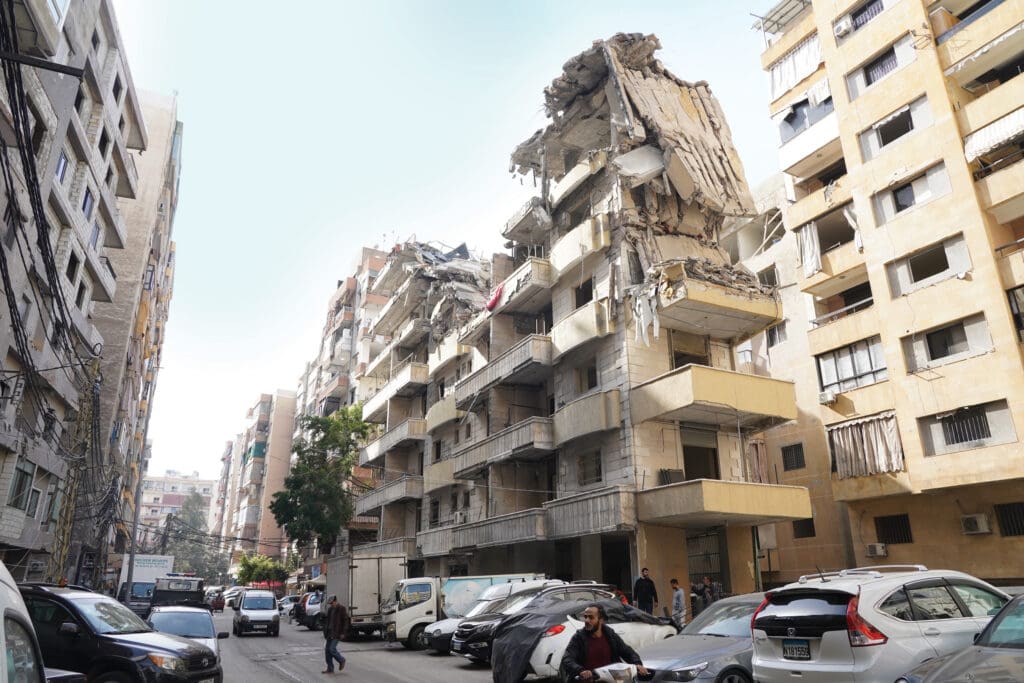
The rebuilding and renovation concerns are not limited to southern Lebanon. According to the World Bank, approximately 10 percent of housing units across Lebanon were impacted by the war to some degree.
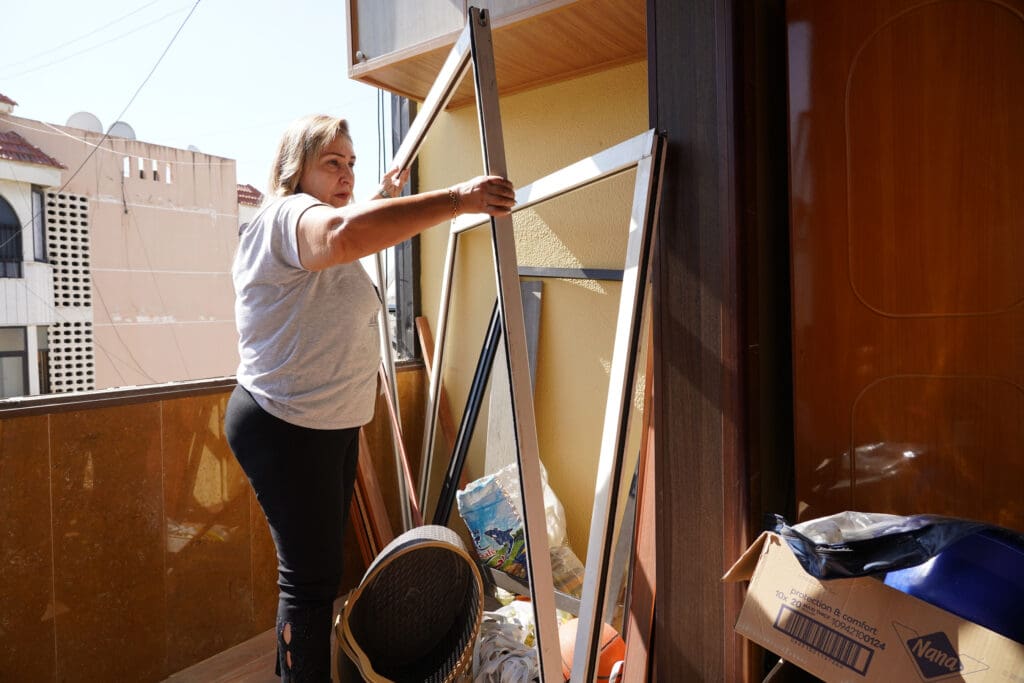
In Hadath, a town located in the southern suburbs of Beirut, André and Andy Eid’s apartment had suffered only minor damage throughout the 2024 escalation, when the Israeli army pounded the area. But in June 2025, a bombardment targeted the building opposite theirs, destroying their doors, cabinets and windows.
Their home is part of a Maronite social housing program in an area where the presence of the Shiite community has gradually expanded since the end of the Civil War in 1990 and where the presence of Hezbollah is strong. Their balcony overlooks at least four different buildings that were reduced to rubble by the Israeli military.
Two workers have come to take the measurements of their balcony and windows. “We are starting to be cold in the mornings, as autumn has begun now,” Ms. Eid says.
The minimal repairs are financed by the church; both husband and wife lost their jobs during the COVID-19 pandemic and rely on the church and on relatives to cover their needs, including those of their autistic son.
“We assisted the families that reached out to us with medicines and food, but our parish does not have the financial means to help rebuild all the houses,” says Cosette Nakhle, head of the social needs committee at Our Lady of Hadat Maronite Church in Hadath. To her knowledge, 10-15 households are still affected by the damage in the area.
“We are doing these renovations but are we going to be able to stay at home, or is a new war going to start?” Mr. Eid says. “We hope for peace. We are exhausted.”
The CNEWA Connection
Since the Israel-Hezbollah war began in 2023, CNEWA-Pontifical Mission has worked with the Maronite and Melkite Greek archeparchies of Tyre, some 50 miles south of Beirut. As of October 2025, the agency has allocated about $1 million in food and essential packages, cash assistance and other necessities for families impacted by the war, including mattresses and infant formula, as well as fuel stipends across six villages, amounting to $74,000. CNEWA-Pontifical Mission has secured an additional $500,000 for the rehabilitation of churches and church buildings destroyed by the war.
To support CNEWA’s work in stabilizing Lebanon, call 1-866-322-4441 (Canada) or 1-800-442-6392 (United States) or visit cnewa.org/donate.
Read this article in our digital print format here.