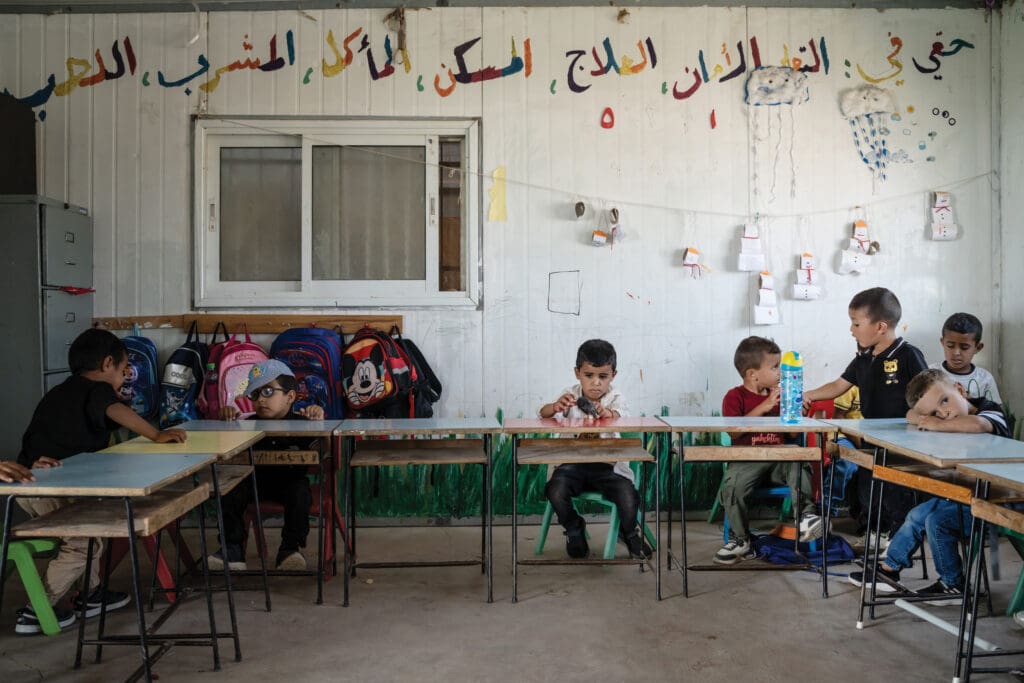
In Abu Nuwar, five miles east of Jerusalem, the voices of children playing outside spill into the small kindergarten classroom of 40-year-old teacher Jihan Frehat. Just beyond the schoolyard, the red roofs of Ma’ale Adumim extend farther across the hilltop each year.
Ma’ale Adumim, with a population of 38,000, is an Israeli settlement built on expropriated Palestinian land. It is one of four settlements, including a nearby military base deemed illegal under international law, that encircle the Palestinian hamlet in the West Bank.
Born and raised in the 900-member Bedouin community of Abu Nuwar, Ms. Frehat runs through the daily pressures: Israeli military raids, home demolitions, settler incursions, blocked farmland and road closures that touch every aspect of life.
Ms. Frehat, who taught previously in private West Bank schools and with the Norwegian Refugee Council, co-founded the kindergarten in 2011; it currently serves 23 children. The kindergarten is under an Israeli demolition order, as is the middle school next door, which serves about 75 students. The latter was already demolished by Israeli forces five times. Each time, residents have rebuilt with help from local and international organizations.
“The ones who suffer most are our kids,” says Ms. Frehat. “When we were their age, we didn’t think about displacement or annexation. Today, they do.”
In contrast, Ma’ale Adumim looms over Abu Nuwar with “all the advantages of a city,” including a diverse education system, transit, health care, cultural and sports centers, parks and a lake, according to the website of Nefesh B’Nefesh, which partners with the Israeli government to recruit new residents for the settlement.
“Look at how much the settlements have grown, look at their schools and universities,” says Ms. Frehat, gesturing toward the expansive gated community.
“Now, look at us. Maybe they will close our schools, this is the policy of making us illiterate,” she says. “All I want is a safe, secure, peaceful future for my children. I still have hope.”
The skyline heralds Israel’s E1 settlement expansion plan to connect Ma’ale Adumim to Jerusalem with a continuous settlement bloc in what Israel calls the E1 corridor, short for East 1. The plan had advanced and stalled under international pressure since 2005, but it was approved for rollout by the Israeli government in August 2025.
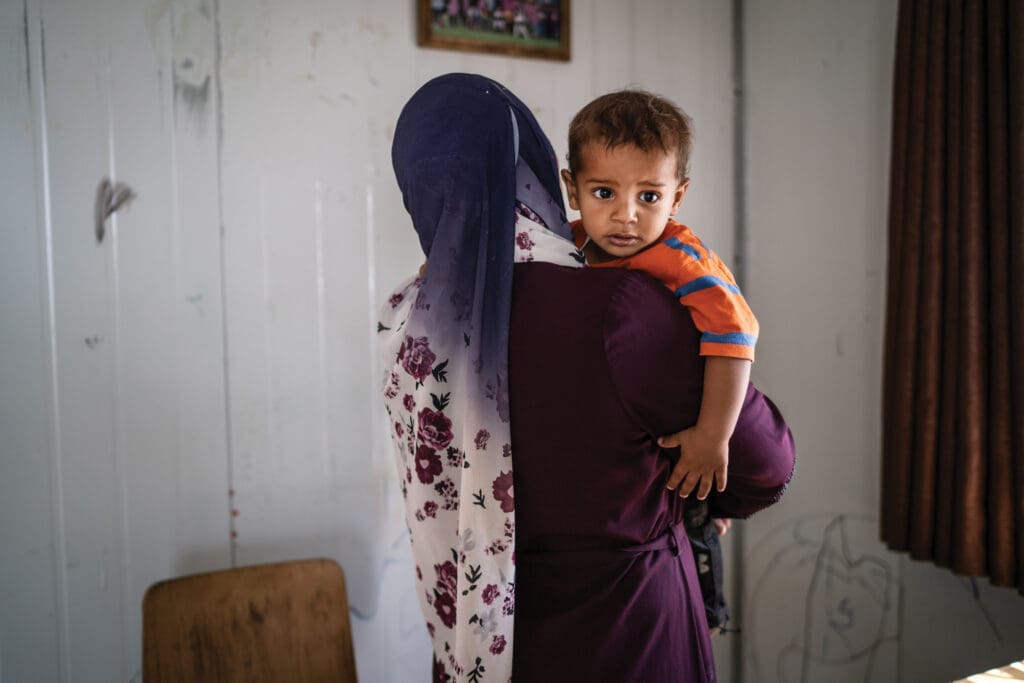
A month later, Israel’s government approved a $900-million plan to build 7,600 new housing units in Ma’ale Adumim; settlement monitors estimate roughly 3,400 of those units will be built inside the settlement corridor.
Situated in the Israeli-occupied West Bank — representing 60 percent of the territory, also known as Area C, under the terms of the 1995 Oslo II Accord — the 4.6-square-mile corridor includes about 7,000 Palestinian residents across 22 Bedouin communities, including Abu Nuwar. These communities are at risk of forcible transfer to clear space for settlement expansion.
Ms. Frehat recalls the 1990s, when settlements were in an early stage, far from the chokehold she describes now.
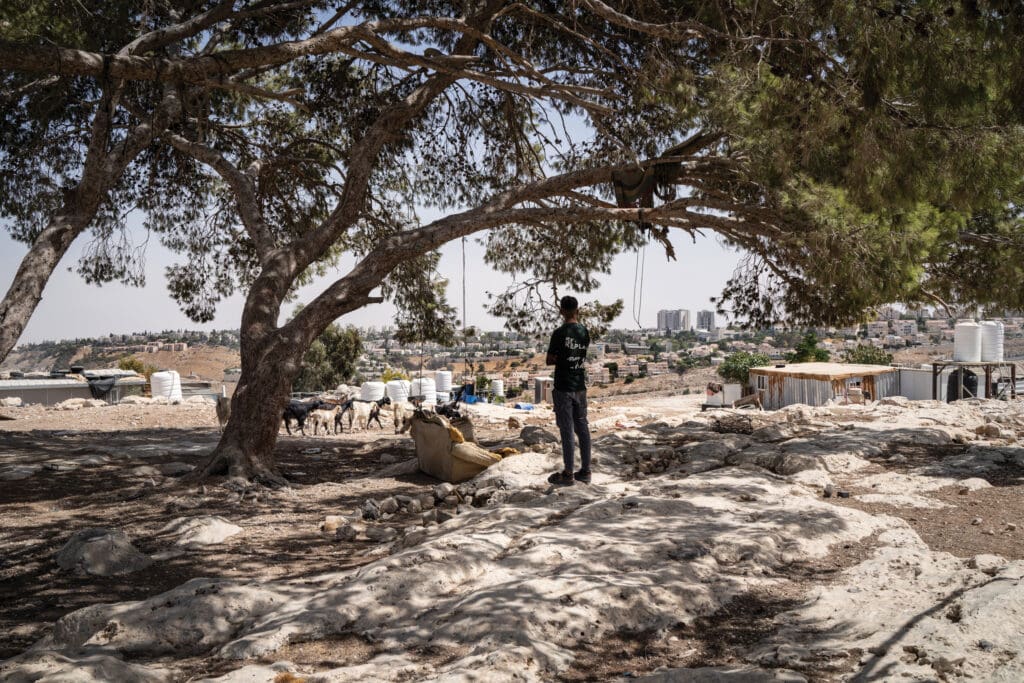
“We’re living on the edge now,” she says. “At any moment I could receive a demolition order and be forced from my home. Honestly, we know nothing but fear. We fear annexation and our unknown future.”
“The questions that we ask are: What will happen to us? Where do we go?”
“It is our duty to stay steadfast on our land and to hold onto it until our last breath.”
Advancing the settlement plan would have broad implications across Palestinian territory and further “Israel’s unlawful policy of annexing, de facto, the Palestinian territory and prevent the viability and contiguity of a Palestinian state, violating the Palestinian people’s right to self-determination,” says the International Commission of Jurists.
In Bethlehem, the Rev. Mitri Raheb, Lutheran pastor, theologian and founder of Dar al-Kalima University, says the E1 expansion plan would “fully” sever the West Bank’s north from its south, “erasing the territorial continuity.”
The Israeli government’s plans intend to “make sure that no Palestinian state will ever be created,” he says.
Israeli Finance Minister Bezalel Smotrich indicated as much in a statement in mid-August, saying the plan was “a significant step that practically erases the two-state delusion and consolidates the Jewish people’s hold on the heart of the land of Israel.”
On the borders of Jabal al-Baba, or Pope’s Hill, a few miles from Abu Nuwar, Palestinians are familiar with Israel’s policy of forced displacement.
Palestinian communities inside the E1 corridor face the risk of forced displacement, driven by state-backed settler violence, military action and planning policies. Settler violence has increased since the start of Israel’s war on Gaza in October 2023, along with military raids, checkpoints and job losses in Palestinian cities and towns across the West Bank.
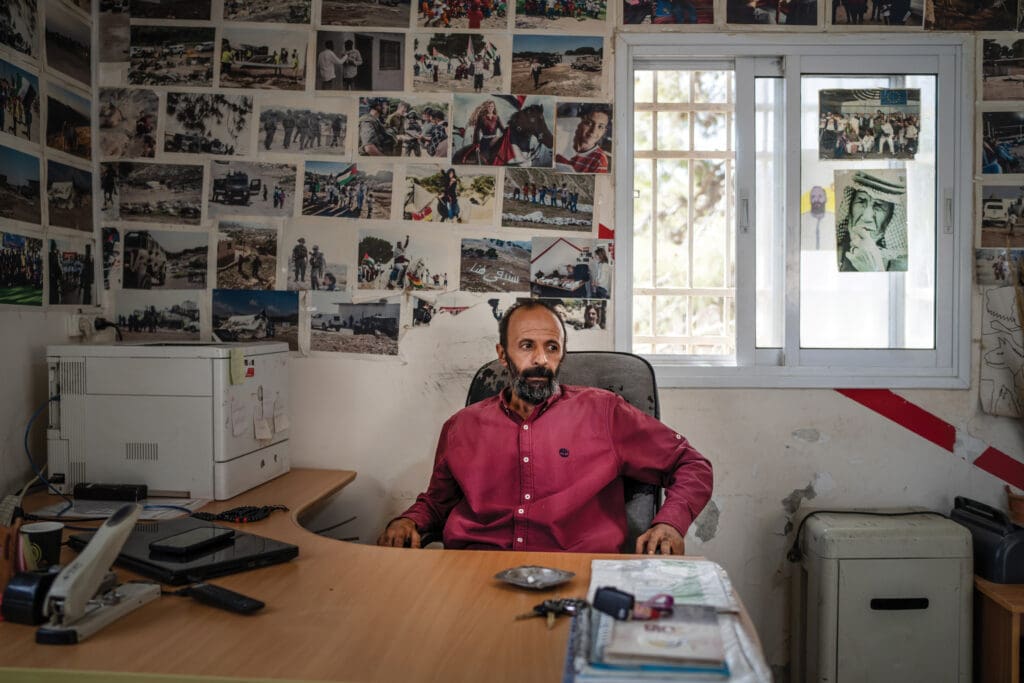
“Every time we rebuild, they come with new decisions,” says Atallah Mazaar’a, the spokesman for the hilltop community.
Mr. Mazaar’a is located within the Bedouin community residing on the borders of the Vatican’s Jabal Al-Baba Hill, a gift from the late King Hussein of Jordan to Pope Paul VI during his historic visit to Jordan and the Holy Land.
The pressure has been measurable: The U.N. Office for the Coordination of Humanitarian Affairs (OCHA) reports that, in August, Israeli authorities issued demolition orders for 20 structures in the community, housing 450 people.
Cumulatively since 2009, more than 500 Palestinian-owned structures in E1 communities have been demolished, displacing more than 900 people. The average monthly demolitions this year, from January to mid-October, was eight.
Meanwhile, settlement expansion has accelerated. As of August, more than 23,000 Israeli housing units had advanced, putting Israel on pace to approve over 50,000 by the end of the year, more than the previous five years combined, according to the Israel Policy Forum.
Within the broader settlement network, there are some 370 settlements and outposts across the West Bank, including East Jerusalem, housing more than 737,000 settlers. Many function as cities and are integrated into Israel’s road network, allowing settlers to travel freely between Israel and the West Bank.
According to the Israeli human rights group B’Tselem, Israeli building policies are “aimed at preventing Palestinian development and dispossessing Palestinians of their land,” as part of a broader political agenda to “maximize the use of West Bank resources for Israeli needs, while minimizing the land reserves available to Palestinians.”
Mr. Mazaar’a frames the pressure as demographic engineering: “to change the demographics according to their aspirations … making settlers outnumber Palestinians in Jerusalem, extending all the way to the Dead Sea.”
“We want to develop and build,” Mr. Mazaar’a says. “Our existence as Bedouins is for nature, and complementary to it, through our livestock and the land we preserve. We are part of the Palestinian national fabric.”
“For us, this land is our oxygen.”
Mr. Mazaar’a says pushing back against the Israeli occupation used to be easier, but the Israeli military has grown significantly more brutal in the West Bank since Israel’s war on Gaza began and peaceful protest has become increasingly dangerous.
“They used to break up protests with tear gas or sound bombs,” Mr. Mazaar’a says. “Nowadays, they are willing to destroy and even kill.”
Since October 2023, Israeli forces have killed 1,001 Palestinians in the West Bank, including East Jerusalem — about one in five of them children — accounting for 43 percent of all Palestinians killed in the West Bank over the past two decades. As well, 7,500 military raids were recorded across the West Bank from January to October 2025, a 37 percent increase over the same period in 2024, according to OCHA.
Fearful for their lives, activists have stopped their activities, and many Palestinians believe their only remaining defense is to stay put and refuse removal, in some cases even declining the incentives of “huge amounts of money, pieces of land” elsewhere, Mr. Mazaar’a says.
Palestinians refuse to accept this “new Nakba,” he adds, referring to the Israeli expulsion of hundreds of thousands of Palestinians from the Negev in 1948.
“The occupation displaced me and my family in 1948. We still have our keys and the deeds to our land,” he said. “I would never accept leaving unless it is to return to my land in Bir es-Seba,” since renamed Beersheba.
Mr. Mazaar’a’s position is grounded in his Muslim faith as much as in political principles.
“We are on holy land,” he says. “It is our duty to stay steadfast on our land and to hold onto it until our last breath.”
“At any moment I could receive a demolition order and be forced from my home.”
The E1 expansion intends to reorganize the West Bank through a split road system that would reserve the main corridor for Israeli-plated vehicles, and shift Palestinian traffic to a peripheral bypass, increasing Israeli connectivity while further isolating Palestinian communities.
While The Times of Israel has reported that the Israeli prime minister has called the planned road a “strategic transportation corridor,” connecting Jerusalem to Israeli settlements, human rights groups have dubbed it “the apartheid road.” Palestinians are routed through underpasses and tunnels “like rats,” Rev. Raheb says, as settler-only bypass roads link Israeli hilltop communities overhead. He says a gate would be installed on the new road “so that Israel can close it at any time,” as with other separation roads in the area built on the same model.
He says the goal is to confine Palestinians to reservations — akin to those created for Indigenous communities in North America — while exclusive Israeli settlements expand around them, turning freedom of movement from a right into a privilege.
Rev. Raheb says the Israeli government is moving to annex more than 80 percent of the West Bank, confining Palestinians to about 18 percent of the territory, fragmented into densely populated, noncontiguous enclaves, such as Ramallah, Bethlehem, Hebron and Nablus, each ringed by dozens of Israeli automated gates.
Over time, severed Palestinian regions will develop different needs, even identities, similar to “what happened when Gaza was cut off,” he says. Without territorial continuity, authorities can manage isolated pockets through local “chiefs,” restrict access to resources, and let those areas slowly dry out, further entrenching the separation and isolation underway.
Ancient Christian pilgrimage routes linking Jericho, Jerusalem and Bethlehem have been threaded between Israeli military checkpoints and the separation wall for decades. Palestinian passage often hinges on Israeli permits and arbitrary checkpoint openings and closures.
Life under Israeli occupation has caused many Palestinians to flee, including from the already dwindling Christian population. Since the start of Israel’s war on Gaza, around 147 Christian families have left Bethlehem, says Rev. Raheb, who added that if current conditions persist, he expects more families will leave, and the churches risk emptying of their local congregations.
“Palestine is the cradle of Christianity,” he says, “not a theme park.”
The CNEWA Connection
Since 2002, the Israeli separation wall has isolated Palestinian West Bank communities and key religious sites, separated religious congregations from the communities they serve, and restricted freedom of movement for locals and pilgrims. The Israeli government’s plans for the E1 corridor, approved in August, would worsen these conditions, says Joseph Hazboun, CNEWA’s regional director for Palestine and Israel.
“The E1 project threatens to close the only remaining road connecting Eizariya to Jerusalem, leaving these religious communities and local residents uncertain about their future,” he said. “Without this vital link, how will the Comboni Sisters, for instance, continue their mission of providing education and medical aid to Bedouin communities?”
He said this development also “raises serious concerns about the preservation of these sacred sites and the communities that sustain them.”
To support CNEWA’s work in the Holy Land, call 1-866-322-4441 (Canada) or 1-800-442-6392 (United States) or visit cnewa.org/donate.
Read this article in our digital print format here.