Despite a two-month ceasefire in Gaza and increased aid flowing into the territory, humanitarian crises continue to rise.
In the current harsh winter conditions, hundreds of thousands of displaced families have faced flooding, collapsing shelters and freezing temperatures. Many are living in tents or with little protection from the elements. Heavy rainfall over recent days has inundated and destroyed makeshift housing, turning displacement sites into pools of cold water, deepening an already catastrophic humanitarian crisis.
Om Haitham Ouda and her family are struggling to manage in these conditions. Ms. Ouda lived in a five-story residential building in the Zeitoun neighborhood of Gaza City. However, her home became uninhabitable during the two-year war between Israel and Hamas, and she and her family now shelter in a partially destroyed and waterlogged structure.
“We absolutely can’t live here because of the rain,” she told CNEWA’s ONE magazine in an interview “The water comes inside day and night. We gather in one corner and spend the whole night holding squeegees, wiping water off ourselves and our children. We don’t sleep — not in the day, not at night.”
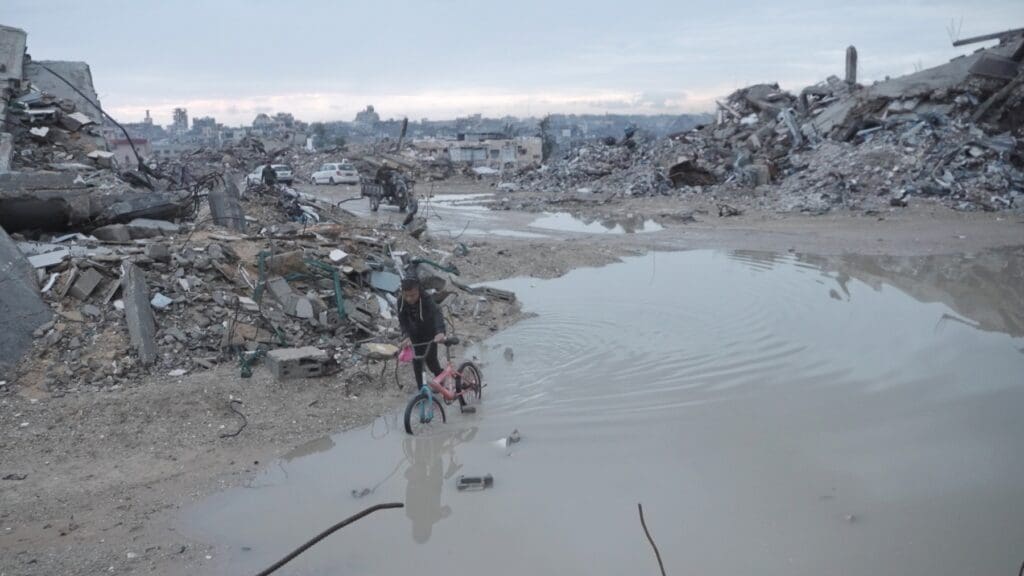
Ms. Ouda recalled how her family was forced to flee her home after being told to evacuate the area by the Israeli military.
“As soon as we walked barely 100 meters, they brought the whole area down,” she said. “They slaughtered us, made us go crazy — and then winter came.”
Her family’s suffering has intensified with the cold. A daughter-in-law gave birth by cesarean section earlier this week in the flooded shelter.
“We are afraid to light a fire near her,” Ms. Ouda said. “We light it under the rain, and even then, it doesn’t ignite.”
Ms. Ouda said her entire family — some of whom are doctors and lawyers — is scattered across tents and unsafe shelters.
“My son called me at 2 a.m. and said his daughter has hypothermia because of the rain in the tent,” she said. “He asked me, ‘Where should I go, Mother?’ What answer do I have?”
“The cold and wind are killing us,” she said. “Whoever gets sick dies. What can I do?”
The United Nations estimates 92 percent of homes across the Gaza Strip were damaged or destroyed during the war, leaving families with no safe place to return before winter. The widespread damage pushed displaced communities into overcrowded shelters, ruins and tents that offer little protection against harsh weather.
The Palestinian Civil Defense in Gaza said the impact of the recent storms has killed 17 people, including four children, collapsed 17 residential buildings and flooded 90 percent of the shelters across the Gaza Strip. Another 90 buildings partially collapsed. Civil Defense teams reported receiving more than 5,000 emergency calls since the storms began, many from families trapped in flooded homes or exposed shelters.
Mahmoud Basal, the Civil Defense spokesman, said all the tents for the displaced in various areas have been damaged, leaving families without even temporary protection. Mattresses, blankets, clothing and basic household items have been soaked or destroyed.
“Tents have proven completely ineffective in the Gaza Strip,” Mr. Basal said, calling on international organizations to halt the importation of tents and instead begin urgent reconstruction efforts.
“We demand the immediate start of reconstruction and the provision of safe housing that preserves human dignity and protects lives,” Mr. Basal said.
The Israeli agency responsible for coordinating government activities in Gaza said on 16 December that humanitarian aid was getting into Gaza.
UNICEF spokeswoman Rosalia Bollen reported the flow of humanitarian aid into Gaza has increased by 260 percent compared with before the ceasefire agreement, but that it is still not enough to meet the needs of the Gazan population, especially the displaced.
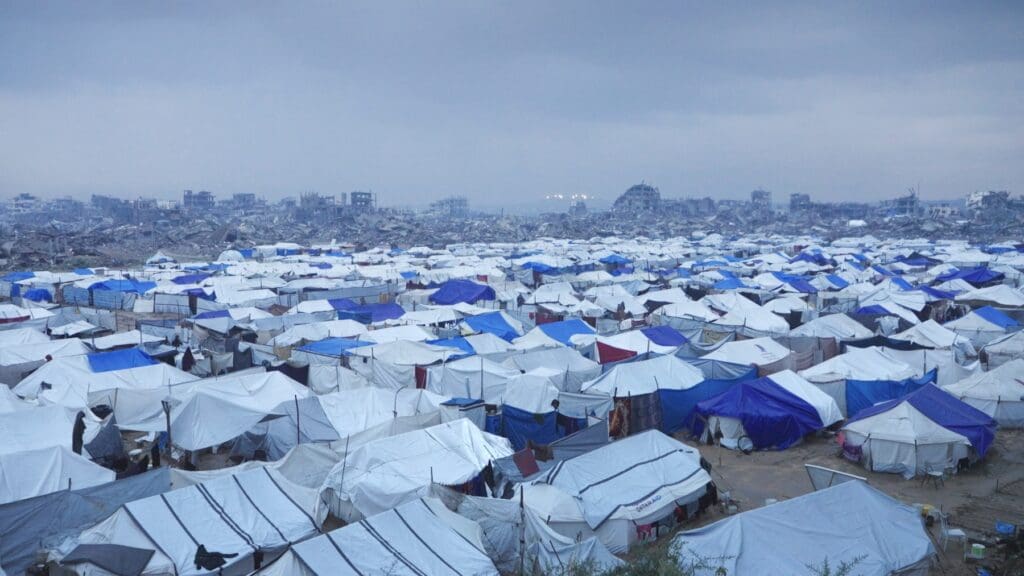
Numerous aid groups have warned that the current assistance is insufficient to address the vast needs, particularly for winterized shelter, medical supplies and reconstruction materials. With roads flooded and infrastructure shattered, reaching vulnerable families has become increasingly difficult.
Joseph Hazboun, CNEWA-Pontifical Mission’s regional director in Jerusalem, said humanitarian efforts in Gaza are “severely constrained and face systemic denials, making large-scale intervention virtually impossible.”
“While critical aid like food and fuel is being distributed, essential items such as electric generators and ready-made clinics are often denied entry,” he said. “Israel’s restrictions continue to block major reconstruction and rehabilitation efforts, though limited repairs, such as to communication lines, are ongoing. The tragedy continues, with aid access facing operational challenges and critical resources far short of what is needed.
He said CNEWA-Pontifical Mission is working with partners in Gaza to provide food, water, medicine, hygiene kits and psychosocial support.
“We also encourage our partners on the ground to think creatively, exploring whether any small-scale private interventions might improve conditions,” he said.
“We are confident in the talent and creativity of Gaza’s youth and hope they can develop ideas to transform the tons of waste and rubble into something useful,” he added. “Spreading hope in a hopeless land is a profound challenge, but we will never tire.”