In the Middle East — particularly in Lebanon — Christians, whose numbers have steadily declined, often describe themselves as “the salt of the earth” or “the yeast that helps the dough rise.” For years, I believed this was simply a comforting metaphor; words meant to ease the anxiety of a shrinking community.
But over the past few days — from 27 to 30 March — I witnessed something that changed my understanding completely. What I saw in South Lebanon was not a metaphor. It was a living, undeniable truth.
Today, in South Lebanon, a small Christian community — no more than 5,344 families spread across 22 villages, some inhabited by as few as 15 people — remains the only visible sign of life in a region now overwhelmed by devastation.
Since early March, more than one million people, mostly from Shiite communities, have been forced to flee their homes, following the escalation of hostilities between Hezbollah and Israel after the Israeli-U.S. war on Iran. Entire towns and villages now stand empty. During my visit to the city of Tyre, its surrounds, and the eastern sector of the region, I encountered scenes difficult to put into words: homes reduced to rubble, towns bulldozed into silence, infrastructure shattered, and fields once full of life rendered barren.
Even ancient olive trees — witnesses to centuries of history, resilient through empires and wars — have been uprooted. The land itself has been scarred, polluted and stripped of its fertility.
And yet, amid this overwhelming destruction, a small Christian presence endures.
Maronite, Greek Melkite, Orthodox and Evangelical Christian families — who once made up less than 3 percent of the population in the south — have made a courageous and deeply human choice: They have refused to leave. Their message is simple and powerful:
“We have nothing to do with this war. We want to remain in our homes and protect what is ours.”
Their presence has come at a high cost. Lives have been lost. Families have been shattered.
- Father Pierre El Rai was killed by shelling in his parish in the village of Kleyaa.
- Three young men were killed in Ain Ebel while repairing internet lines on the roof of their home.
- A father and his son lost their lives on the road between Rmeich and Debel as they tried to bring bread to their community.
- The brother of a parish priest in Alma el-Shaab was killed in an airstrike.
These are not just statistics. These are human lives — stories of courage, sacrifice and love for one’s land and people.
Despite fear, loss and uncertainty, these families remain. They are not driven by politics or ideology, but by dignity, belonging and the hope of preserving their communities.
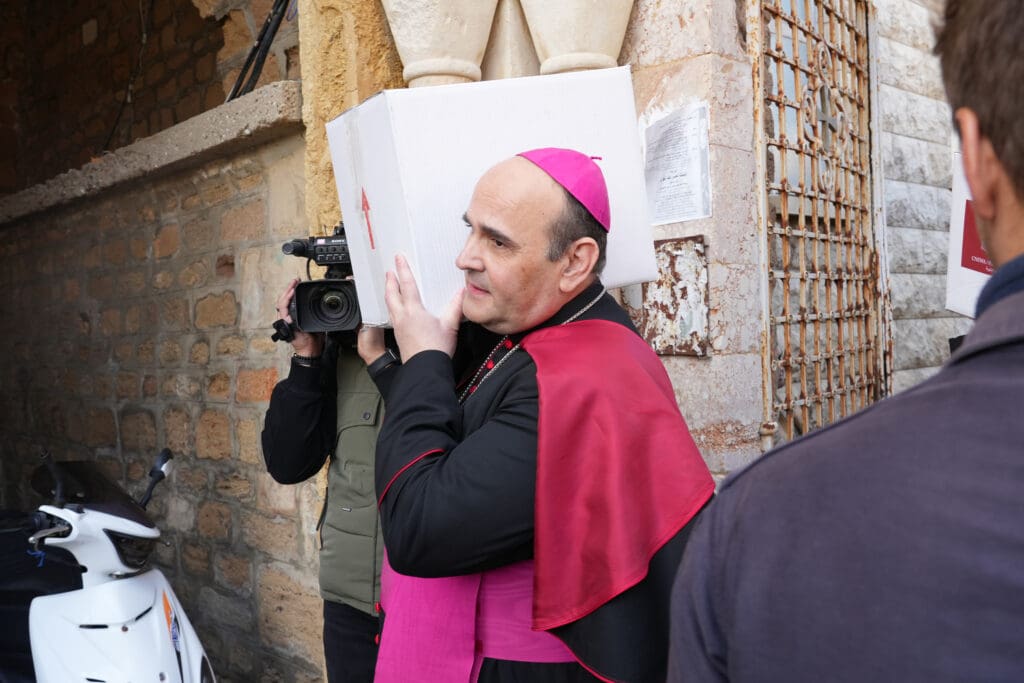
Standing beside them is the apostolic nuncio to Lebanon, Archbishop Paolo Borgia, who has chosen to be present with the people from the very beginning. Week after week, he has visited these villages, offering not only humanitarian support, but something equally vital: solidarity, encouragement and hope. His presence reminds these communities they are not forgotten.
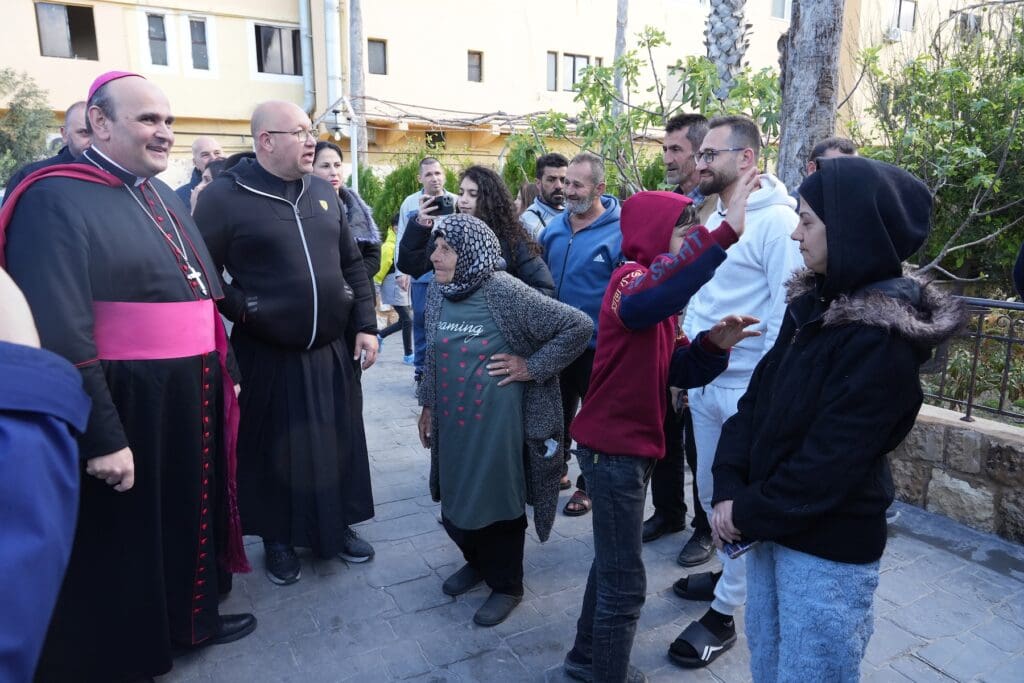
From the first days of the crisis, CNEWA/Pontifical Mission for Palestine in Beirut launched an emergency response to assist those most affected. Today, our efforts focus on three urgent priorities:
- Supporting families who remain in the south
We are assisting over 5,344 families — primarily Christian, along with several Muslim families who sought refuge among them — by providing essential food supplies and fuel to help them survive under extremely difficult conditions. - Helping displaced families in Beirut and Mount Lebanon
More than 1,200 families, now displaced, are living in temporary shelters, in church facilities or with host families. We provide them with food vouchers to help meet their daily needs with dignity. - Assisting displaced families in Deir el-Ahmar, Bekaa Valley
Around 500 families, mostly Muslim and displaced from heavily affected areas, have found refuge among Christian communities. Through the church’s network, we are delivering food assistance to support both the displaced and the families hosting them.
A Call to Solidarity
In a land marked by destruction and displacement, these small, resilient communities are holding on — not only for themselves, but for the future of a diverse and shared Lebanon.
They are a sign of life where life seems to have disappeared. Today, they need more than admiration, they need support.
And this is where I appeal to you for your help. Help us provide food, warmth and hope to families who have chosen to remain in their communities — families who resist despair— and to protect what little is left.
Together, we can ensure this fragile light of faith does not fade.