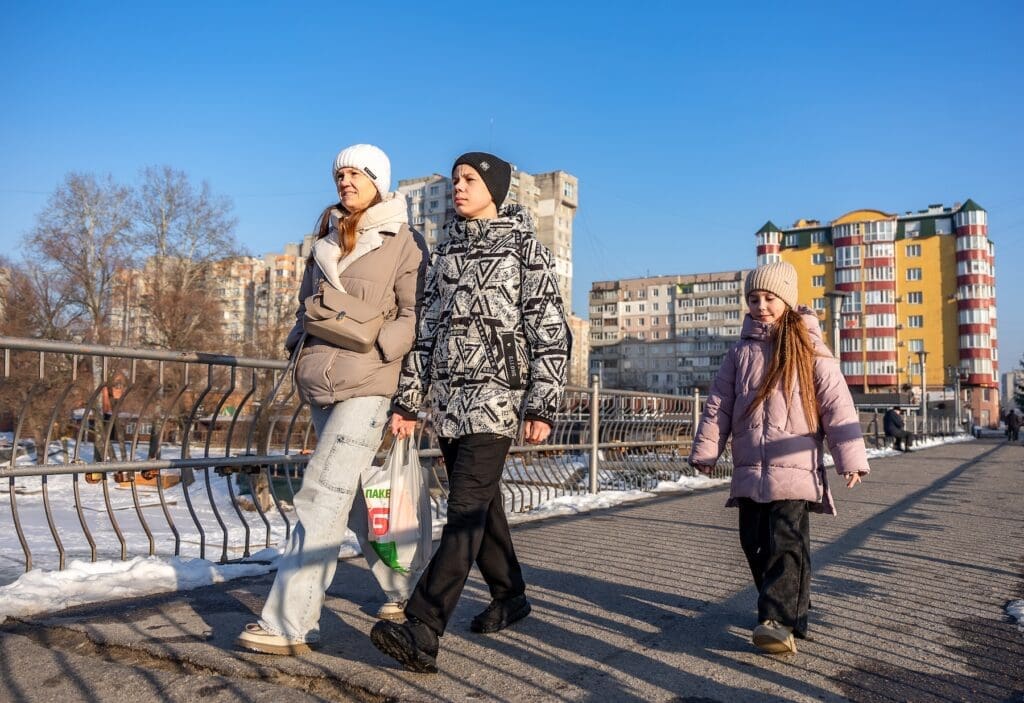
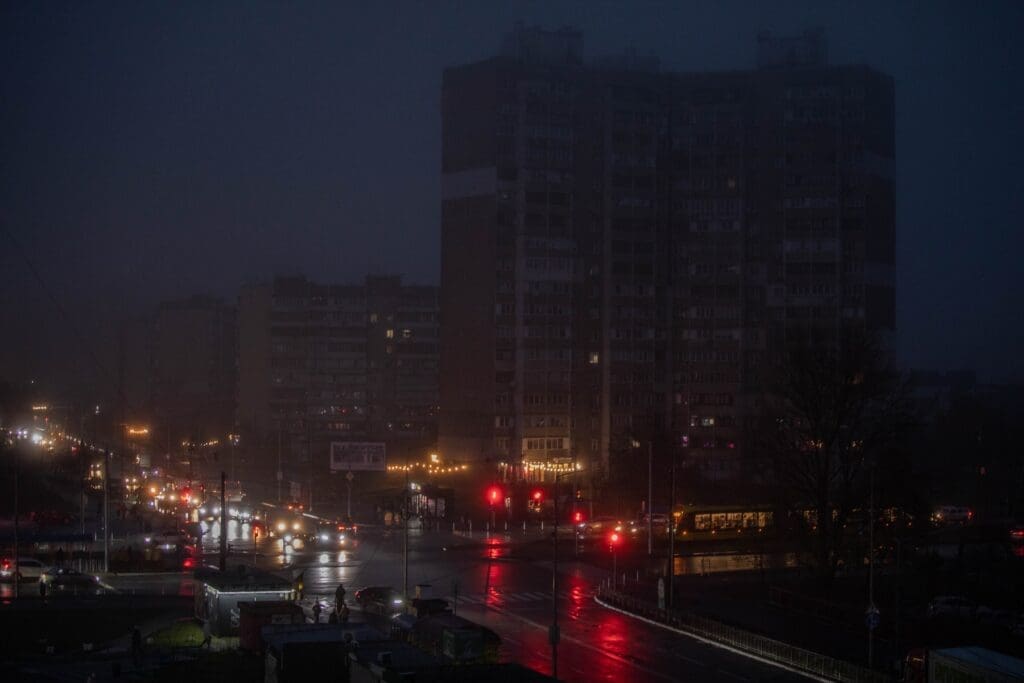
The rumble of generators and the noxious smell of gasoline surrounded Olha Maiboroda and her three children as she escorted them to their weekly dance lessons through the dark center of Sumy, northeastern Ukraine.
The sound of explosions and cannon fire were almost constant in the distance, and Russian drones flew overhead. Only the occasional streetlight worked in the city, situated about 11 miles from the frontline.
Mrs. Maiboroda lost her job at a local food packaging plant after it was destroyed by a Russian bomb — an attack in which some of her colleagues were killed. She has since found work in a clothing store. Her husband, Oleksandr, 41, works as an engineer at a poultry farm. He is rarely home, given the regular need to troubleshoot at the farm. When the electricity grid fails, the poultry farm runs on generators, and his work keeps the birds alive, production stable and the family’s income intact.
Despite few resources, the couple has refused to cut back on their children’s dance lessons.
“They already don’t get a normal childhood because of the war,” Mrs. Maiboroda said. “My mission as a mother is to do everything possible to secure their future.”
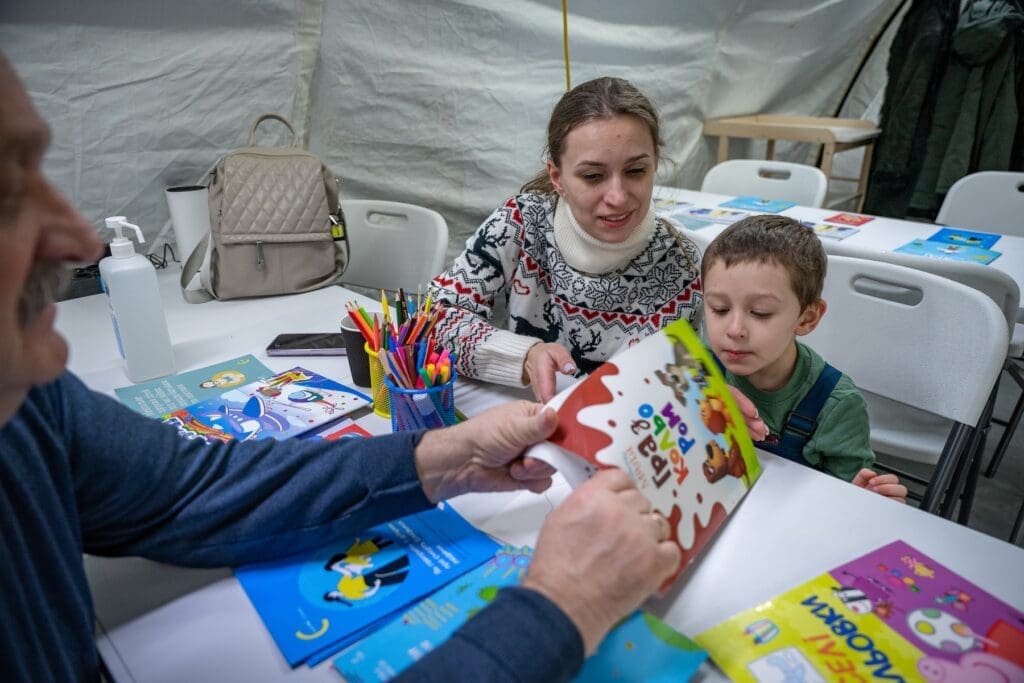
In Sumy, schools have operated mostly online for nearly six years, first due to the COVID-19 lockdowns and then because of the security threats and recurring power disruptions caused by Russia’s full-scale war against Ukraine, which entered its fifth year on 22 February. Many children know their classmates only as Zoom avatars.
With electricity to homes set on a strict schedule — two hours on, four hours off — basic household chores have become complicated tasks. For Mrs. Maiboroda, simple cooking has become a logistics exercise: timing the thawing, using the electric grinder without waking neighbors at night, and getting dinner on the table in short power windows between work and the children’s schedules.
This winter, Russia turned freezing temperatures in Ukraine into military strategy. As the thermometer dropped, Russian strikes hit energy infrastructure harder, causing an energy crisis that has continued now into spring.
Russia’s massive missile-and-drone strikes on critical infrastructure in January caused electricity shortages across the country. Emergency and stabilization blackouts became routine, and a sharp cold snap in January magnified every weak link in Ukraine’s energy grid, impacting the supply of heat and hot water.
According to Ukraine’s Ministry for Development of Communities and Territories, about 6,000 apartment buildings in Kyiv alone — home to roughly 1.7 million people — lost heating, and nearly 2 million consumers in the capital region were left without water. Services were restored in stages, with emergency repair crews brought in from across the country.
“We can’t restore normal life overnight, but we can bring warmth and remind people: You are not alone.”
In February, another strike on a combined heat-and-power plant left more than 1,100 buildings in Kyiv without heat during a three-week deep freeze; temperatures in central and northern Ukraine ranged from 5 to minus 15 degrees Fahrenheit.
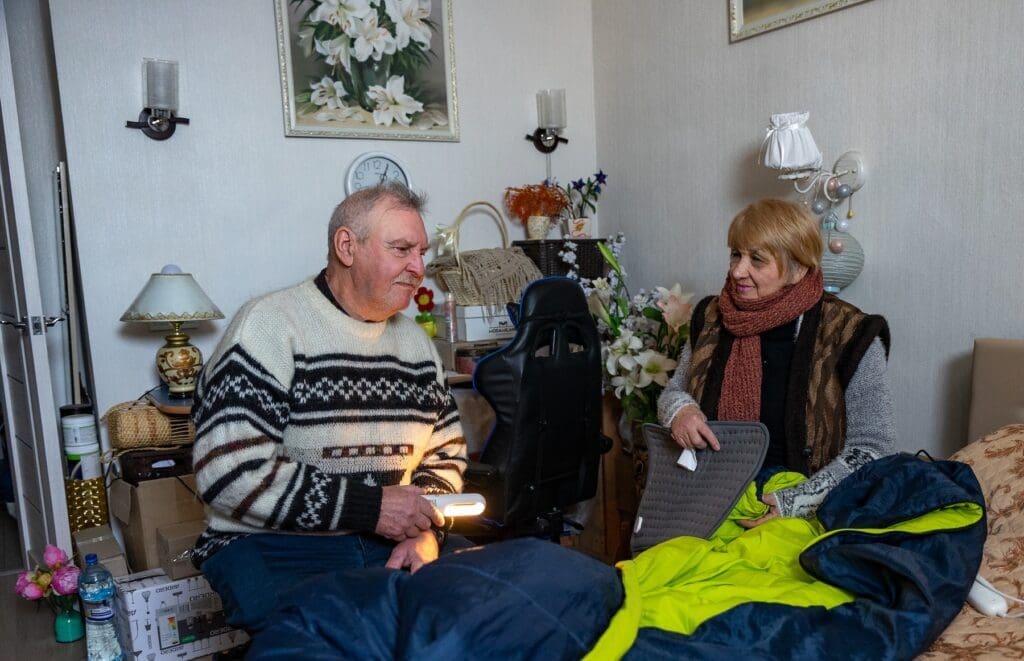
Zinaida Loskutova, 70, and her husband, Oleksandr, 71, sold their two-room apartment in Kyiv to reduce utility costs and purchased a smaller apartment on the 11th floor of a high-rise in the same neighborhood. They moved in last October, less than a month before a Russian missile exploded nearby, damaging high-rises across several blocks.
“When the explosion hit … the windows, with the frames, and even the kitchen door, were literally ripped out,” Mrs. Loskutova said.
Charity groups brought plywood to seal the openings, and the couple added Styrofoam boards and plastic sheeting for more insulation. In the intense winter cold, however, it was difficult to seal them tightly enough to hold in heat.
“For three weeks, the temperature in the apartment didn’t rise above 45 degrees Fahrenheit,” Mr. Loskutov said. “When it reached 50 degrees Fahrenheit, we joked that it was practically the tropics.”
Until the new frames and doors can be installed, and the power grid can be restored, the Loskutovs will keep climbing and descending 11 flights of stairs for groceries, errands or medical visits.
Mrs. Loskutova tries to keep her anxiety in check by attending a free program, aimed at improving quality of life and expanding access to education for people aged 60 and over.
“Recently, one woman from our group didn’t show up,” she said. “People say she died in a fire together with her elderly mother — after emergency outages.”
Many children know their classmates only as Zoom avatars.
Yuriy Sapozhnikov, a nuclear energy specialist and chairman of the board of Kyiv’s Scientific Research and Design Institute, “Energoproekt,” describes the strikes as an engineering assault on urban life. For decades, the institute has designed key energy nodes for the capital, including major combined heat-and-power plants that supply heat to vast residential districts.
He said high-rise vulnerability is decisive. In apartment buildings, electricity generates not only light, but heat, water, wastewater removal, pumps and boiler systems. Attacks on Ukraine’s energy system have been systematic since 2022, but a dangerous pattern emerged in 2026 with timing and intent, he said.
“We were lucky in 2023 and 2024, when winters were milder,” Mr. Sapozhnikov said. “But when a harsher winter came, the consequences became much heavier. … These are strikes designed to inflict maximum suffering on civilians, especially people in apartment buildings, who cannot afford autonomous solutions.”
“Any military unit can heat itself and power itself with mobile means,” he said. “The enemy understands that, too. So, the target is civilians, and the goal is maximum suffering.”
Emergency crews, utility workers and power engineers go out to what Mr. Sapozhnikov calls “another battlefield.” They clear rubble at hit sites at great personal risk, assess damage and work almost without pause to restore electricity, heat and water.
In the meantime, Kyiv’s cafés try to offer some warmth and an experience of ordinary life through cups of coffee.
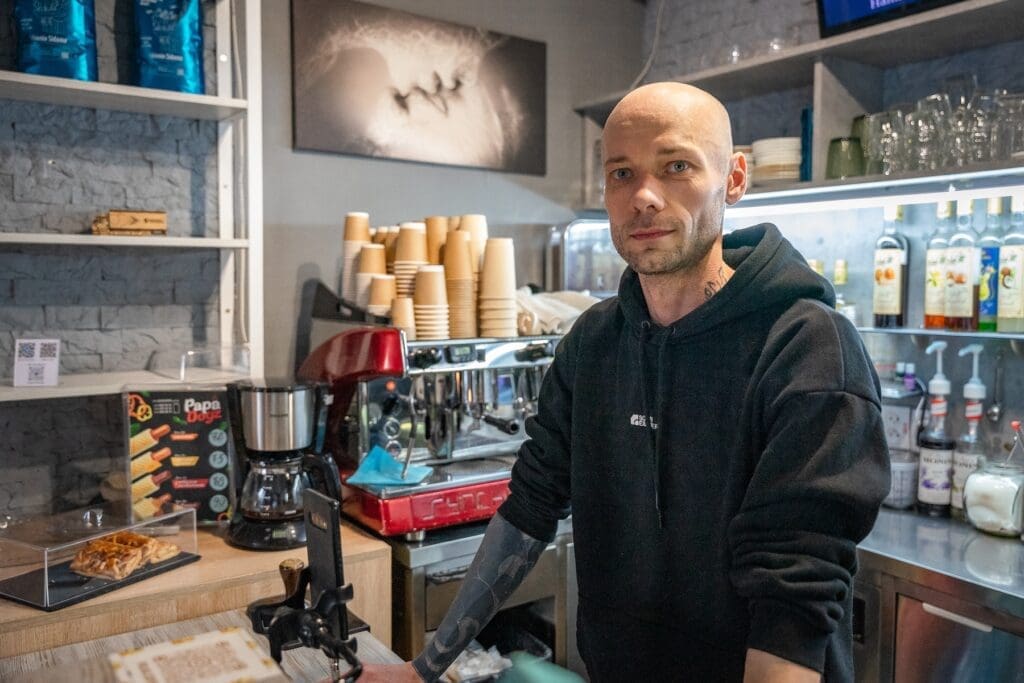
Viacheslav Rabeshko, 37, opened a small café in a residential neighborhood of Kyiv during the COVID-19 pandemic. At that time, he said he was betting “on one simple thing” — that “COVID would end.”
“But very quickly the full-scale invasion began,” he said. “Power outages and strikes on energy infrastructure have made running a small business extraordinarily difficult.”
He bought a diesel generator that costs about $900 a month to operate, which allows the café to stay open when the neighborhood goes dark. In January, electricity sometimes stopped for up to 28 hours straight, and people came for something hot, for Wi-Fi, to charge a phone, for conversation.
“My favorite guests are teachers,” Mr. Rabeshko said. “They hold lessons and lectures here on Zoom. I think this winter I improved my biology and English. All honor to them for finding any possible way to keep teaching children in such difficult conditions.”
“When the explosion hit … the windows, with the frames, and even the kitchen door, were literally ripped out.”
On a Tuesday afternoon, a few dozen people — mostly elderly — gathered in a small park beside one of Kyiv’s largest residential districts, hit hard by attacks on energy infrastructure and prolonged blackouts.
For years, even before the full-scale invasion, residents had come to this park, where the Kyiv branch of Caritas-Spes, the charitable arm of the Roman Catholic Church in Ukraine, has distributed hot meals twice a week. Many had been displaced from eastern Ukraine after fighting erupted in Donbas in 2014. Since 2022, their numbers have grown, and amid blackouts and freezing temperatures, the need for hot meals among the most vulnerable has surged.
Ten minutes before the van arrived at 2:30 p.m., the people quietly formed a line. When the Rev. Andriy Pedai stepped out of the van, he led the people in praying the “Our Father,” and the meal distribution began. Some people ate in the park, but most left to eat their meals in their cold apartments. Once the food was served, a second line of people seeking reassuring conversations formed next to the priest.
“The meals are always tasty, the portions are generous,” said Olena Demchenko, 86. “For me, it lasts two days.”
“Two weeks ago, they gave us really good blankets and flashlights,” said Lyudmyla Shmel, 70, displaced from the southern Kherson region. “Whatever they bring, we’re grateful.”
Father Pedai directs the branch of Caritas-Spes in the Diocese of Kyiv-Zhytomyr, and coordinates the preparation and delivery of hot meals and necessities across the city.
“Many people are getting by on very small pensions,” he said. “They need outside help to make it through.”
In the capital, where people are stranded for hours when attacks on the energy system halt electric public transit and air-raid alerts suspend subway service, Kyiv’s Points of Invincibility and warming centers have become lifelines.
As of early 2026, Kyiv had more than 1,400 such sites, which include tents set up by the State Emergency Service of Ukraine, where people warm up, charge a phone or fill a thermos.
On the Left Bank of Kyiv, entire tent complexes were erected, and some residents slept there for weeks. Among them was Vira Kurylenko, 74, whose ninth-floor apartment in a building without gas became a cold trap when the power failed.
“At first, I slept fully dressed, in a hat and gloves,” Ms. Kurylenko said of her cold apartment.
“For three weeks, the temperature in the apartment didn’t rise above 45 degrees Fahrenheit.”
She sought shelter in a tent, where she said she appreciates the presence and care of others. At night, during air-raid alerts, police waken those in the tents and lead them to the nearest shelter.
“We’ve become like family to each other,” she said.
Volunteers with the Orthodox Church of Ukraine arrived from St. Michael’s Golden-Domed Monastery with boxes of instant noodles and warm blankets. Archdeacon Vasyl Didora said their volunteers travel daily across Kyiv and nearby communities, offering food and essentials. At the request of Ukraine’s emergency service, they also deliver aid directly to seniors, people with disabilities, and others who cannot reach support points on their own.
“We can’t restore normal life overnight,” he said, “but we can bring warmth and remind people: You are not alone.”
The CNEWA Connection
After Ukraine declared independence from the Soviet Union in 1991, CNEWA began working on the ground to build relationships with the churches — many of which had been pushed underground under communism — and to support their works. Since Russia’s full-scale invasion of Ukraine in 2022, CNEWA’s support for pastoral and humanitarian development shifted primarily to emergency response, providing more than $10 million in aid to date to Ukraine’s church-led initiatives, supplying food, shelter, medical and psychosocial care, and generators for those displaced and adversely affected by the war. CNEWA continues its abiding support for seminaries and houses of religious formation, Ukrainian Catholic University, and the nationwide parish-based social ministries of Caritas Ukraine.
To help fund CNEWA’s work in Ukraine, call 1-866-322-4441 (Canada) or 1-800-442-6392 (United States) or visit cnewa.org/donate.