The village of Snaya, just 20 miles from Lebanon’s border with Israel, was “surrounded by Hezbollah positions,” said Mayor Rima Habib. That made the community, which is Christian, nervous.
“We are scared Hezbollah will launch missiles from the village and that, in response, the Israelis will strike the village,” she said. The villagers had cause for concern, as some residents have reported that had happened at least once before.
By late April, six weeks of war between Hezbollah and Israel had put the lives and livelihood of the villagers at risk, Ms. Habib said, adding, “Most of them are farmers, and they cannot tend to their land.”
The latest escalation of violence in Lebanon began 2 March, two days after the United States and Israel launched joint attacks against Iran. Hezbollah militants, who have been backed by Iran, fired rockets into Israel, which retaliated with a series of strikes on southern Lebanon, the Bekaa Valley and the southern suburbs of Beirut.
On 16 April, a 10-day aerial ceasefire officially ended the second escalation in a conflict that had begun between Israel and Hezbollah, after the Israeli-Hamas war started in October 2023. Across Lebanon, few people trusted the ceasefire — later extended to mid-May — would allow them to rebuild their homes and their lives. The Israeli government confirmed southern Lebanon would remain an active war zone and established a no-go zone that encompassed 62 villages south of the Litani River by early May. By the end of May, Israel had pushed beyond the buffer zone, thereby extending evacuation orders about six miles north to the Zahrani River, expanding its incursion to about one-fifth of the country.
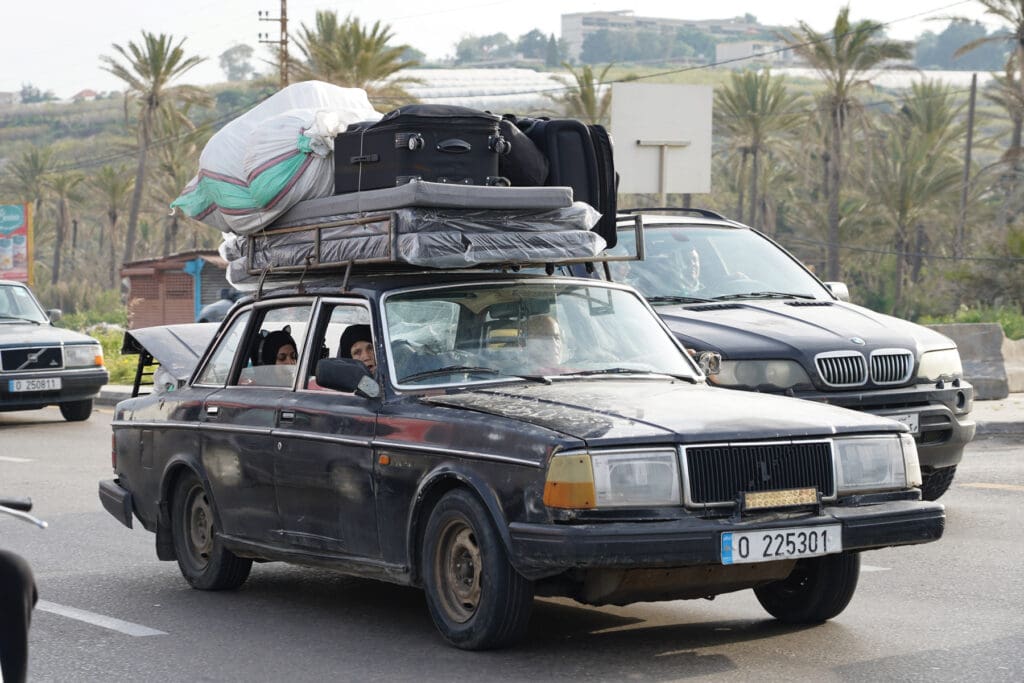
Although more than a million people from southern Lebanon, the Bekaa Valley and the southern suburbs of the capital have fled to Beirut and other areas deemed safer, about 4,000 Christian families, such as those in Snaya, have remained in their villages, hoping that they would be spared.
Up to 20 homes in Snaya were damaged when the conflict escalated between 2 March and the mid-April, Ms. Habib said. The windows and tiles of her home were broken by shrapnel two years earlier. Across Lebanon, 62,000 housing units were damaged or destroyed in the same period, according to the National Council for Scientific Research.
The Rev. Georges Awad of the Maronite Catholic parish in Snaya said parishioners were worried. “They ask whether we will continue living like this or get our life back. No one knows the answer, but we need to continue living,” he said.
On the first day of the April ceasefire, the roar of warplanes and buzzing of drones were silenced. However, Snaya residents hardly felt relieved.
“After the 2024 war, we did not go back to our normal life,” resident Mirna Boutros said, referring to the ceasefire brokered in November 2024, after 66 days of all-out war, intended to end the Israel-Hezbollah conflict.
“I had my suitcases packed” at all times “in case a war would happen again,” she said.
Ms. Boutros recounted how the “strikes, warplanes, drones and missiles” have impacted her mental health and shattered her home’s windows. She said she lives in a state of fear.
“When I drop my daughter off at school, I am scared,” she said.
She cares for elderly relatives and, on 2 March, stocked up on food supplies and “enough medicines for three to four months,” as Snaya only has a small convenience store. She said the security situation also has prevented her from seeking health care for her daughter, Angy, 14.
“I haven’t dared to take her to Beirut,” said Ms. Boutros, who fears military strikes on the roads as well as on the capital city.
In early May, the Lebanese health ministry reported that, since 2 March, the Israeli army killed more than 2,800 people, wounded more than 8,700 and displaced more than 1 million. More than 1.2 million people face varying degrees of food insecurity. Israel has reported 18 soldiers and two civilians were killed by Hezbollah in the same period.
“I was born during the Civil War. Today, Hezbollah is around the village [and] there are Israeli bombardments,” Ms. Boutros said. “I was hoping that my daughter would not live what I lived.”
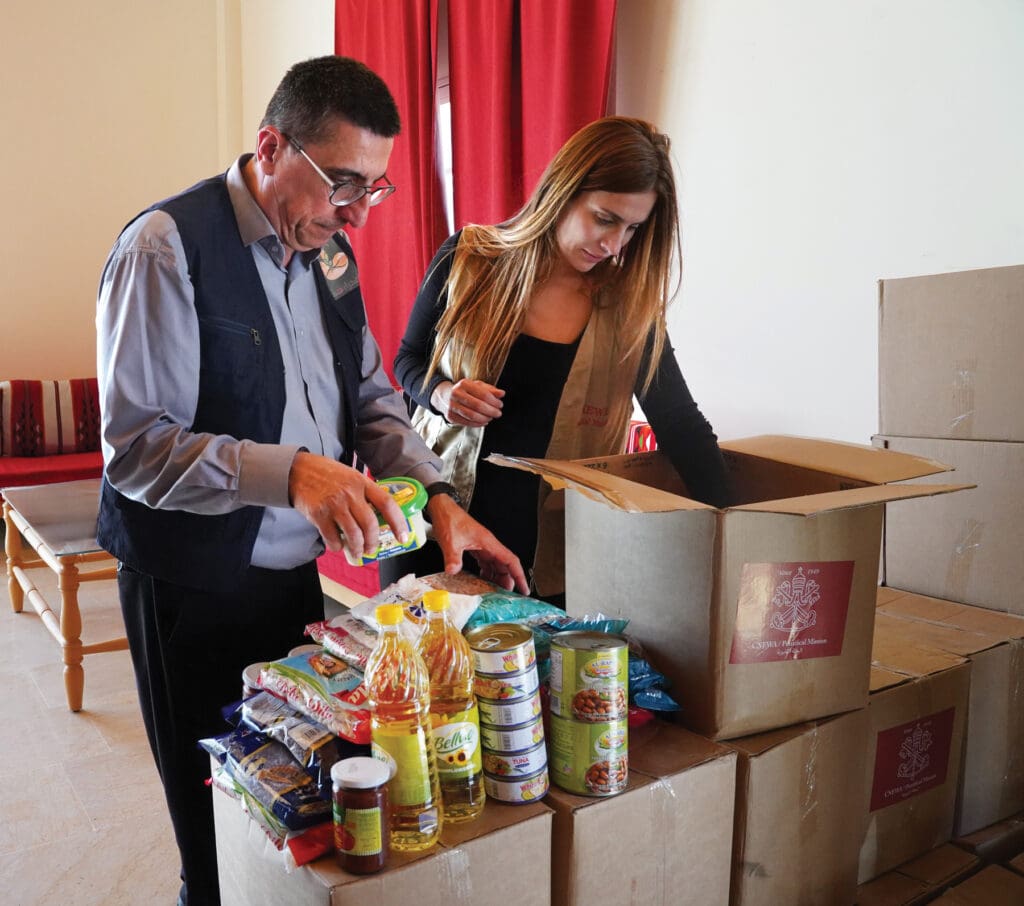
When the ceasefire was announced on 16 April, church groups moved quickly. The next day, a humanitarian convoy, spearheaded by Archbishop Paolo Borgia, apostolic nuncio to Lebanon, and Cardinal Bechara Rai, patriarch of Antioch of the Maronites, headed to the district of Jezzine, southern Lebanon.
Archbishop Borgia has led at least 14 convoys to the country’s south since 2 March, in coordination with the United Nations Interim Force in Lebanon (UNIFIL). Food aid has been provided by CNEWA-Pontifical Mission and its partners Caritas Lebanon and L’Oeuvre d’Orient.
This aid “is a sign of universal solidarity of the church,” Archbishop Borgia said as he greeted people in Qattine, a village that had welcome displaced people. “We must continue” to provide relief, and “be generous, as those who possess a lot must share with others.”
In Benwati, seven miles north of Snaya, CNEWA-Pontifical Mission partnered with a local organization, Fertile Desert, to distribute food parcels.
“This war has had a greater psychological impact on me than the previous one,” said 26-year-old Luna Daher, a Benwati resident. “I was hearing a lot of sonic booms, the war was really around the village. I had a panic attack, and I cried in abnormal ways.”
Her 8-year-old sister, Tia, said she is now “used to bombardments.”
Ms. Daher, who studied social sciences and education and is looking for work, rejoiced in the ceasefire, but was “very upset because we had many martyrs” in the war. She also harbored fears for the future of the country.
“I would like the whole of Lebanon and all its people, regardless of their faith, to live in safety,” she said. A member of the Sunni Muslim community, she noted the division among Sunnis, Shiites and Christians caused by the ongoing war, and the need for reconciliation.
During this war, Israeli military stirred up tensions by striking regions usually spared, allegedly targeting Hezbollah or Hamas members. On 6 April, for instance, the Israeli military targeted a Maronite social housing compound in Ain Saadeh, a village east of Beirut, killing the local leader of the Lebanese Forces party — a political opponent of Hezbollah — and two other civilians over Easter weekend.
“God sees everything that is happening,” Ms. Daher said.
In Ain Ebel, a Christian village within the “yellow line,” those who lived on the north side of the village have been displaced to the south side, said Maha Farah, a French teacher at the local school. The displacement occurred on 9 April, when the Israeli army launched its offensive to take control of Bint Jbeil, located less than a mile away.
“We thought the Israeli army would likely enter Ain Ebel,” Ms. Farah said. As she spoke, the walls of her house shook from the Israeli military activities in Bint Jbeil. Border villages were being systematically leveled, as the Israeli minister of defense referenced strategies used in Gaza. At least 11 villages had been destroyed entirely as of 7 May.
When the ceasefire was announced, residents from the north side of Ain Ebel returned to their homes to find around 20 houses had been occupied by the Israeli army and vandalized, with furniture thrown onto the street, Ms. Farah reported.
Five miles away, in the village of Dibl, an Israeli soldier destroyed a statue of the crucified Jesus, sparking international outrage. It was replaced by the Italian military days later. A statue of the Virgin Mary also was desecrated. In the village of Yaroun, a convent and a school belonging to the Melkite Greek Catholic congregation of the Sisters of the Divine Savior reportedly were bulldozed by the Israeli army.
“We are civilians. Why would they do this?” Ms. Farah asked.
Michel Constantin, CNEWA-Pontifical Mission’s regional director in Beirut, who joined some of the humanitarian convoys, said villages such as Ain Ebel and Dibl are “completely isolated” from the rest of the country.
“The Christian presence, even if it is very small, is the only sign of life” across these heavily destroyed areas, he said. He added that he was concerned that, if the war continued, it would become unsustainable for residents of these communities to remain on their land, as most residents would be unable to work and schools would not reopen.
Church representatives and residents from border villages met with the Maronite patriarch at his residence in Bkerke on 19 April and released a list of demands. These included opening “safe humanitarian corridors between villages,” setting up field hospitals, providing financial support to families who have remained, and preventing the destruction of border villages.
“We stay here so that other people are able to remain” on their land, Ms. Farah said.
In 2024, she was displaced to Ain Saadeh, about six miles east of Beirut, in the same compound that was targeted by an Israeli strike on 6 April. She had spent weeks teaching online, living with relatives.
“I am happy to have stayed [in Ain Ebel] this time,” she said. “When we go through very hard moments, I always keep the faith that the war will end. I have learned to let go and let God intervene.”
Ms. Farah said she and her retired husband feel supported in their choice to stay, thanks to Archbishop Borgia’s regular visits.
“We feel listened to,” she said. “The nuncio encouraged us to take life one day at a time.”
The CNEWA Connection
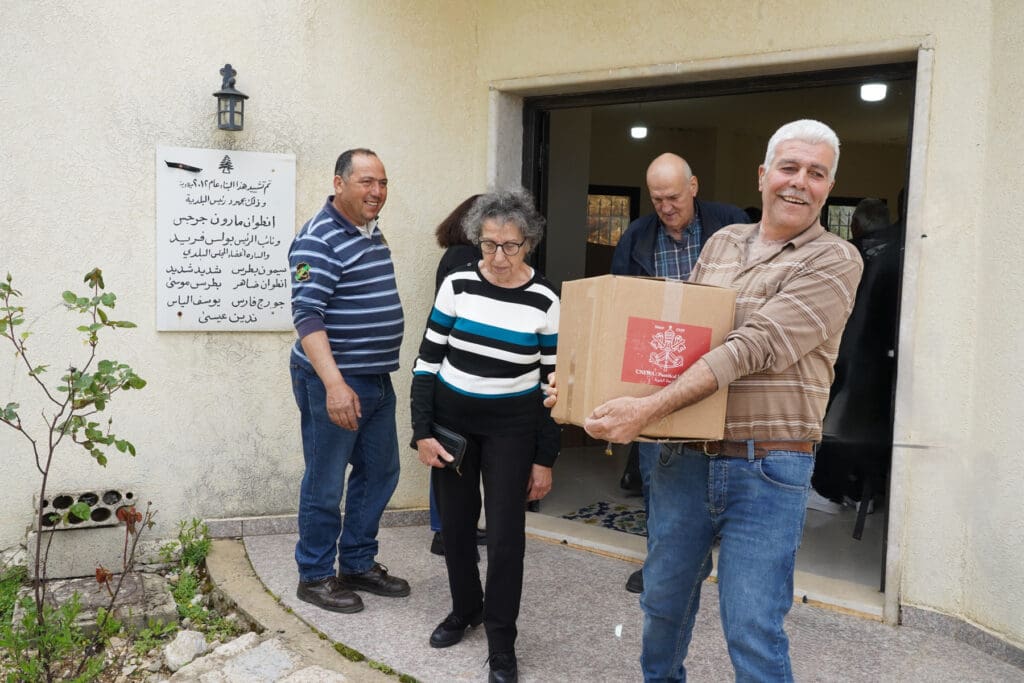
Since 2 March, CNEWA-Pontifical Mission joined the apostolic nunciature and other church-affiliated aid organizations in delivering food parcels to civilians stranded by fighting between Israel and Hezbollah. The aid convoys also carried essential supplies such as medicine and water.
With roughly 20 percent of Lebanese displaced by the war, CNEWA-Pontifical Mission also has distributed food coupons to people displaced in Beirut, Mount Lebanon, and the Dbayeh refugee camp, as well as to southern families seeking shelter in the Bekaa Valley.
To support CNEWA’s work in Lebanon, call 1-866-322-4441 (Canada) or 1-800-442-6392 (United States) or visit cnewa.org/donate.
Read this article in our digital print format here.