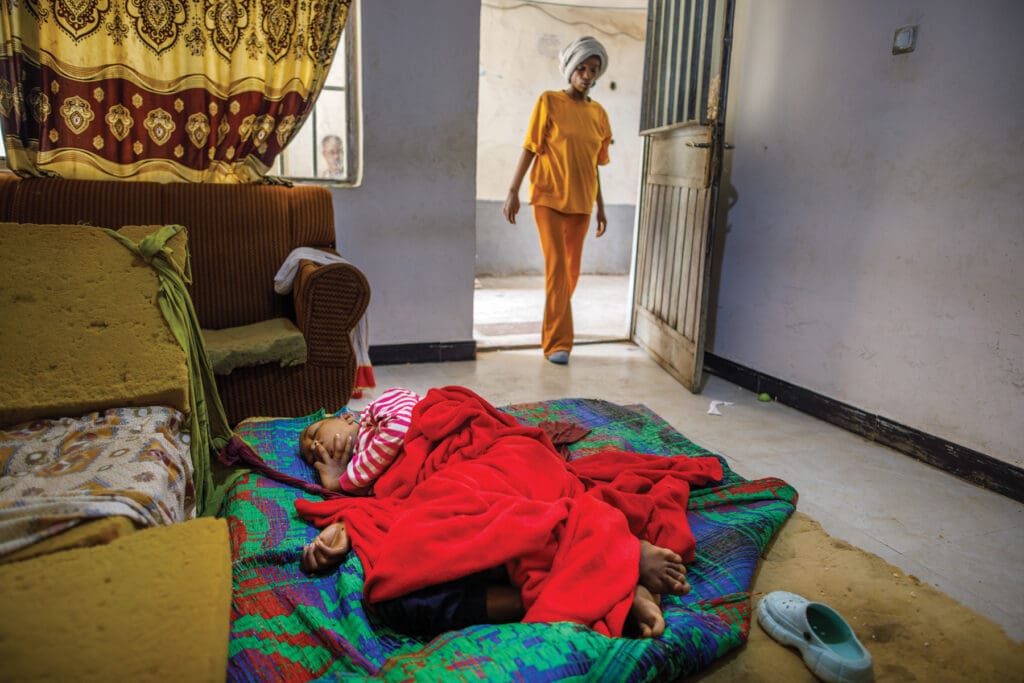
Feven Alem is at a breaking point. The single mother of three lives in a neglected rental unit in the suburbs of Addis Ababa, the Ethiopian capital. Two of her three children suffer from autism and need round-the-clock care.
As an Eritrean refugee, she lacks the legal status to work in Ethiopia. With little hope for employment, her immediate worry is the looming prospect of homelessness.
Ms. Alem’s mental well-being is strained. Support for children with autism is rare in Ethiopia. With little access to resources, and when neighbors are not available to help, she often chains her children to their bed for their own safety when she heads out on her own to scrounge for aid.
“My life has been going downhill. Food is becoming scarce, and my children are going to bed hungry, and there is little that I can do to help them,” she says as she waits inside the compound of Jesuit Refugee Service (J.R.S.) in Addis Ababa for the monthly financial support she receives.
She worries about how long she can sustain her family and wonders if she will be forced to abandon her children.
Frail yet determined, the 32-year-old prays and says fate has forced her to pause her ambition to go back to school and become a health practitioner, perhaps a nurse, to improve her family’s circumstances. But a lifetime of hardship has made that difficult.
The charity ecosystem in Ethiopia that once helped sustain Ms. Alem and her children has been spread thin since U.S. aid was abruptly frozen in January 2025. Many refugees from war-scarred nations, such as Sudan, South Sudan and Eritrea, who were supported previously by J.R.S., say the aid cutbacks have meant fewer people are getting the support they need.
That has meant less food on the table, less psychological support — especially for those who have experienced violence — less educational support for children, and less support staff to help refugees find affordable housing, resulting in considerable suffering.
In Mendida, about 96 miles north of Addis Ababa, the situation is no different. With larger Ethiopian cities overwhelmed by need, tens of thousands of vulnerable people have moved to remote villages or have returned to their villages of origin, desperately hoping for a miracle.
A nondescript rural hamlet with minimal infrastructure, Mendida has become a hotspot for people from different parts of the country fleeing ethnic and armed conflict or facing food insecurity and economic collapse.
In Mendida, those in need rely mostly on the tender care of the religious sisters of the Congregation of Divine Providence, who arrived 53 years ago.
Weinshet Gezaw, 30, a once-successful entrepreneur in the suburbs of Addis Ababa, was abandoned by her husband, a laborer, after their home in a neighborhood of illegal housing was marked for bulldozing to make way for paved roads, parks and skyscrapers.
Three months pregnant and in despair, she moved back to Mendida, her ancestral village, where an elderly family member gave her temporary shelter — a room without electricity or running water. In mid-May, she was still living in that room with her twin sons and relying daily on the local CNEWA-funded Medhanealem Medium Clinic, run by the Congregation of Divine Providence, to support her and her malnourished children.
“We are on the verge of starvation, and my story is no different than my neighbors’,” says Ms. Gezaw, who often retires to bed hungry. “We are desperate, and the little we eat to survive comes from the Catholic Church.
“What has made the situation even more difficult is the fact we can’t find jobs. The economy is in free fall, and our life’s goal is to try to stay alive, while the dream of self-sufficiency remains elusive,” she says.
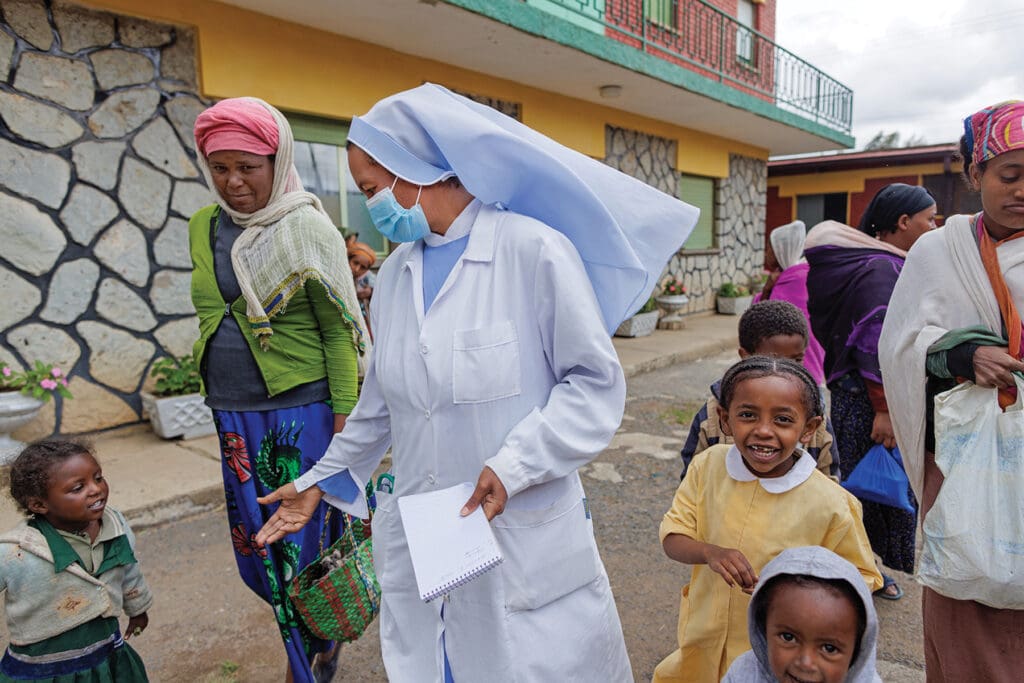
Sister Dinknesh Getachew, administrator of Medhanealem Medium Clinic, prays for more resources as the demand on the clinic has become overwhelming amid the influx of destitute people seeking help.
Most of the mothers and children who come to the clinic are malnourished. Sister Getachew explains that her community tries its best to cater to their needs. Available resources, however, do not match the growing demand for humanitarian assistance. Her work, she says, is heartbreaking.
“What we are beginning to see is the impact of lack of food,” she adds. “We are beginning to see children suffering from mental issues, such as anxiety, as a result, and acute hunger among many.
“There is a lot of hunger in the community, and many children are not given the resources they need to live a fulfilled life,” she says. “We are doing our very best as we produce food and offer essential services even as we race against time,” that is, before food runs out, she adds.
Feleku Agonafer, 43, says the suffering and hardship have almost broken her spirit; her daily challenge is how to feed her daughter. Partially blind since birth and now H.I.V.-positive, Ms. Agonafer walks around her neighborhood in Mendida seeking help. She often comes to the clinic, where her child receives one meal a day. The sisters have taught her how to care for her child and not expose her to the virus.
“The food that has been provided has helped a lot, and I have been able to sustain my livelihood and that of my daughter under very difficult circumstances,” she says.
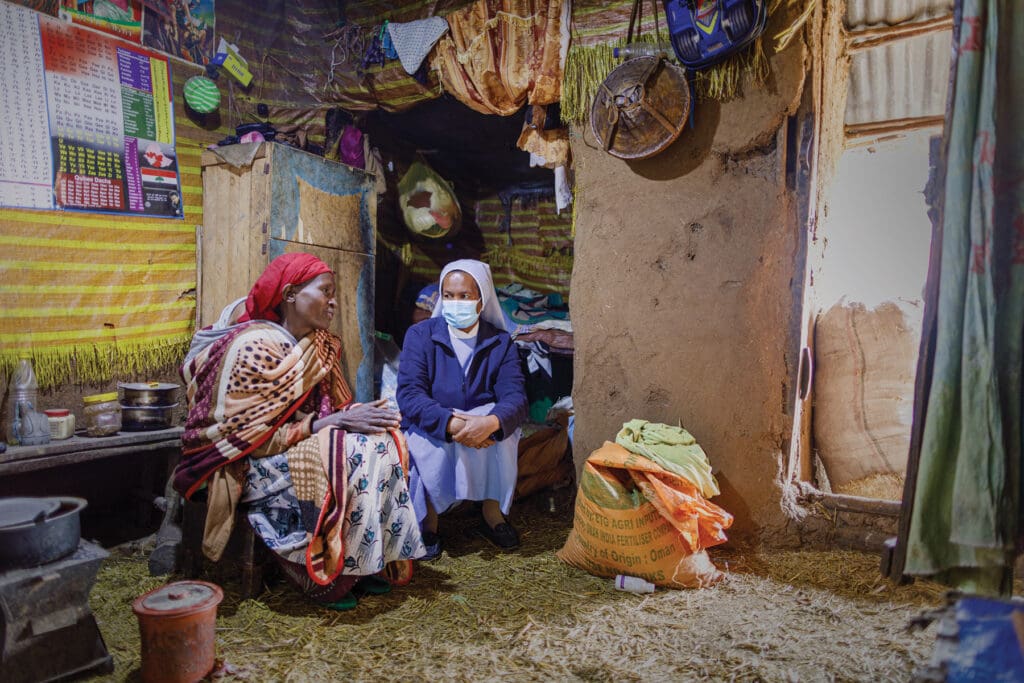
Aberash Abebe, 22, lives in a small government-made mud hut in Mendida with her husband and newborn. The hut is crumbling and the roof is leaking, but she still considers herself lucky to have a home. Her husband is on disability and is unable to work.
Lack of food has made it difficult to breastfeed her daughter, who often cries from hunger, so Ms. Abebe goes to the clinic daily for food for her baby. She is worried that a lack of aid in Mendida will mean she and her family will need to migrate to another part of the country.
Foreign aid cutbacks, natural disasters and strife in various regions of Ethiopia, including in the suburbs of the capital, have displaced an estimated 2.5 million to 4.5 million people and placed nearly 7 million people in need of emergency aid, report international organizations that track such data, including the International Organization for Migration.
Doctors Without Borders (M.S.F.) and the World Food Program also have warned about the possibility of extreme food insecurity in the Horn of Africa.
In May, M.S.F. reported the “needs are increasing” in Ethiopia’s Somali region, where failed rainfall over several years has “driven a severe drought emergency … pushing millions into acute food insecurity and forcing millions more from their homes.
Malnutrition has increased among residents, as hundreds of thousands of people have lost access to potable water, the medical group said.
The Integrated Food Security Phase Classification Global Partners estimate more than 10 million people in Ethiopia will face high levels of acute food insecurity this year. This is compounded by the 2025 freeze of U.S. government funds and dismantling of the United States Agency for International Development (USAID), once Ethiopia’s largest provider of humanitarian aid; in 2024, the United States provided $480.5 million in humanitarian funding to Ethiopia.
In the past year, the lack of funds has translated into a sharp decline of food delivery by many humanitarian organizations, including the W.F.P., which has since redirected its efforts to other global hotspots, such as the Middle East and Ukraine. Security issues in Ethiopia, including a rise in kidnappings and theft amid the ongoing armed conflicts, also have made it difficult for W.F.P. staff to reach vulnerable populations.
In Mekele, Wukro and Adigrat, cities in the northern, conflict-prone Tigray region, many humanitarian organizations have left. During the civil war that ended in 2022, more than 80 percent of the region’s population depended on humanitarian aid. Today, the Ethiopian Catholic Church, the social services of which play a crucial role in education and health care, is among the few charitable institutions that remain; it is working to meet as many needs as it can with limited resources.
Nonpartisan think tanks and the United Nations have warned of a potential proxy conflict in the region involving Eritrea and a leadership dispute with the federal government, which would worsen the situation. In the Amhara, Oromia and Gambela regions, where more than a million South Sudanese refugees have found shelter, there is fear that climate-change-induced drought will exacerbate food insecurity. In addition, conflict, random kidnappings of humanitarian workers and demands for ransom payments are forcing humanitarian organizations to suspend their delivery of essential services.
A new report by Mercy Corps also warns that, with Iran’s control of the Strait of Hormuz in retaliation for U.S. and Israeli attacks on Iran in March, the disruption “is driving up food, fuel and fertilizer prices,” affecting local Ethiopian farmers ahead of the farming season and consequently impacting millions of people.
As casualties linked to hunger rise across the country, the federal government has introduced a new levy on services — including telecommunications and online money transfers — to help finance its disaster-response infrastructure and to promote self-reliance; it also has appealed to donors for funds.
Back in Addis Ababa, Ms. Alem says her biggest worry is that her children, two of whom have been attending school for years, may perish from hunger or fall victim to the ways in which people seek to exploit the most vulnerable.
“That worry has made my life unbearable,” she says. “A sort of death sentence.”
The CNEWA Connection
CNEWA released an additional $100,000 in May to address food insecurity in Ethiopia, continuing its nutritional support with schools and parishes in Tigray, Amhara and Central Ethiopia regions. The food problem is driven by ongoing conflict and insecurity, multiyear droughts, decreases in international aid and the devaluation of the Ethiopian currency. CNEWA also supports church-run health facilities. In addition, it provides funds for Jesuit Refugee Service in the capital, Addis Ababa, which supports refugees who flee to the city.
To help CNEWA feed the hungry in Ethiopia, call 1-866-322-4441 (Canada) or 1-800-442-6392 (United States) or visit cnewa.org/donate.
Read this article in our digital print format here.