It was a strange kind of déjà vu for Brother Michael Petro, S.J., in the early hours of 2 March.
“When I heard the first bombardment, I knew that dozens of people would be seeking refuge at the church by morning,” he said.
Residents in southern Lebanon, the Bekaa Valley and the southern suburbs of Beirut awoke in the middle of the night to deafening airstrikes, signaling a regional spillover in the war waged by the United States and Israel against Iran that had begun just days earlier.
At the peak of the renewed escalation between Israel and Hezbollah, the Shiite Muslim group that commands considerable power in Lebanon, up to 1.2 million people — about to 20 percent of Lebanon’s population — were internally displaced; 2,294 were killed and 7,544 were wounded, according to government statistics. As of 8 July, nearly 500,000 people remain displaced, and the number of casualties has increased to 4,320 dead and 12,203 wounded.
Two successive ceasefires were brokered, on 17 April and 15 June, yet Israeli troops continue to occupy Lebanese territory, drone surveillance and airstrikes by both sides, in violation of the agreements, have not ceased.
In a repeat of the 66-day all-out war in Lebanon in autumn 2024, the displaced sought shelter in safer areas, such as Beirut and its environs. Organizations and grassroots initiatives, including church groups, shifted quickly into emergency relief activities, making appeals for funding, blankets and mattresses.
“Unfortunately, we were prepared,” said Brother Michael, who started a protection program for migrant workers in Lebanon with Jesuit Refugee Service. The program is based at the Jesuit-run St. Joseph Church in the central Beirut district of Achrafieh.
“We had mattresses stocked up from the last war and, for the past year, we had established our protection program, so we have a psychologist, more staff and the experience of running a shelter.
“During the war in 2024, we hosted 80-100 people at once,” he said.
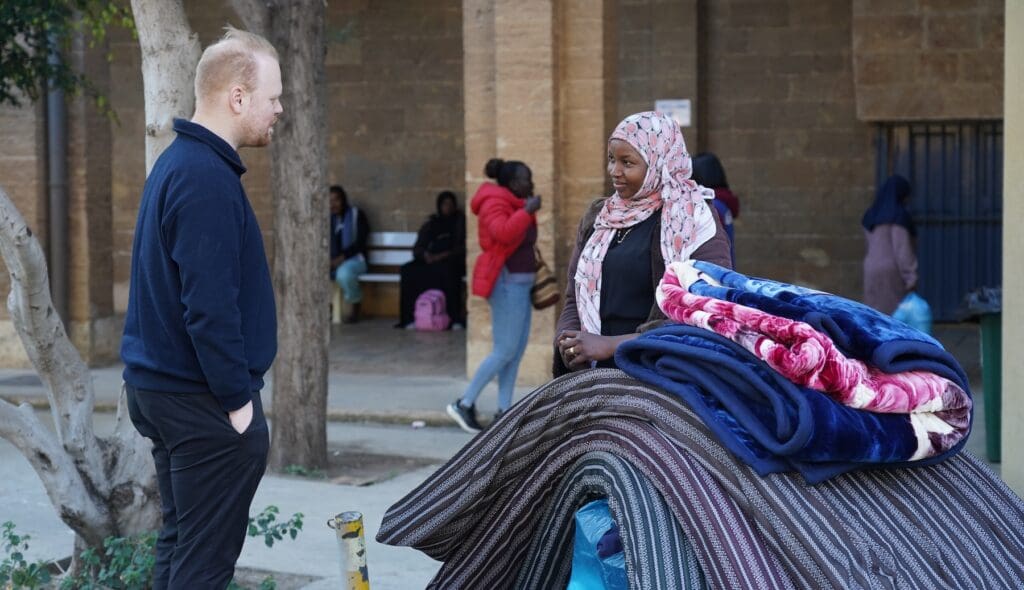
In April, the school on the church grounds was sheltering 200 displaced migrant workers, including 60 children, from Sudan, Bangladesh, the Philippines, Sri Lanka, Nigeria and Madagascar. Migrant workers were not allowed in the 616 government-run shelters in the country.
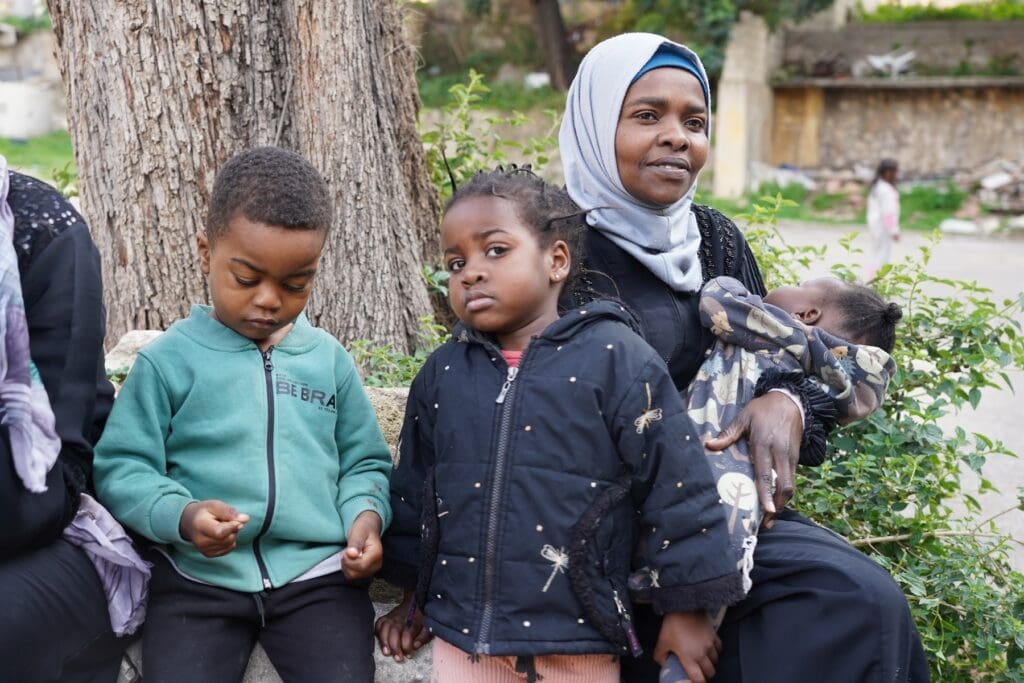
Hawa Hami and her three sons arrived at St. Joseph Church on 10 March. Their clothes and other essentials, packed into plastic bags, sat on top of two mattresses in the parking lot.
“We fled the southern suburbs and then we spent a week on the streets until someone told us that we could come here,” the Sudanese woman said.
Inside the school, an elegant staircase led to vast classrooms filled with mattresses. Women rested under blankets while children ran around. The men were gathered in the basement.
“We look after our children and we wash our clothes. This is how we spend our days,” said Ms. Zahraa, who declined disclosing her full name. She fled the southern village of Zrariyeh, where her husband works in the fields.
“The mental health and well-being of the displaced migrants is an immediate concern,” Brother Michael said. “Everyone is traumatized; many have lost their homes.”
Hygiene and the lack of education for children were mounting concerns. Across the country, public schools were turned into shelters, while private schools operated online or in-person, depending on their proximity to the bombardments, triggering fears that the most vulnerable children would be left behind.
“Everyone is traumatized; many have lost their homes.”
Four pregnant women — including Roudayna Mustafa, who was expected to give birth imminently — also were sheltering in the church.
“The church is trying to find the financial means to pay for my delivery,” said Ms. Mustafa. “We initially fled the war in Sudan. We don’t have residency here, so it is hard to find a job.”
Her daughter, Yana, was the first baby born in the shelter during this war.
About four miles south, Sacred Heart Hospital, run by the Daughters of Charity of St. Vincent de Paul, saw a surge in patients, including pregnant women, with the onset of the escalation.
“We are in a red zone,” said Elie Salem, the hospital director. A “red zone” is an area in Lebanon designated by the Israel Defense Forces subject to evacuation orders and combat operations.
The 120-bed facility is located about half a mile from the densely populated southern suburbs, also a red zone, which experienced heavy Israeli bombardments and blanket evacuation orders. The hospital received bombardment victims as well as the displaced in need of health care. It also recruited “displaced doctors, who, in turn, come with their patients,” Mr. Salem said.
The Lebanese government reported in early July that Israeli attacks had impacted 17 hospitals, rendering three nonfunctional. As well, Israeli double-tap or triple-tap attacks allegedly targeting medics (considered war crimes under the 1949 Geneva Conventions) have killed at least 135 Lebanese health care workers and wounded 406.
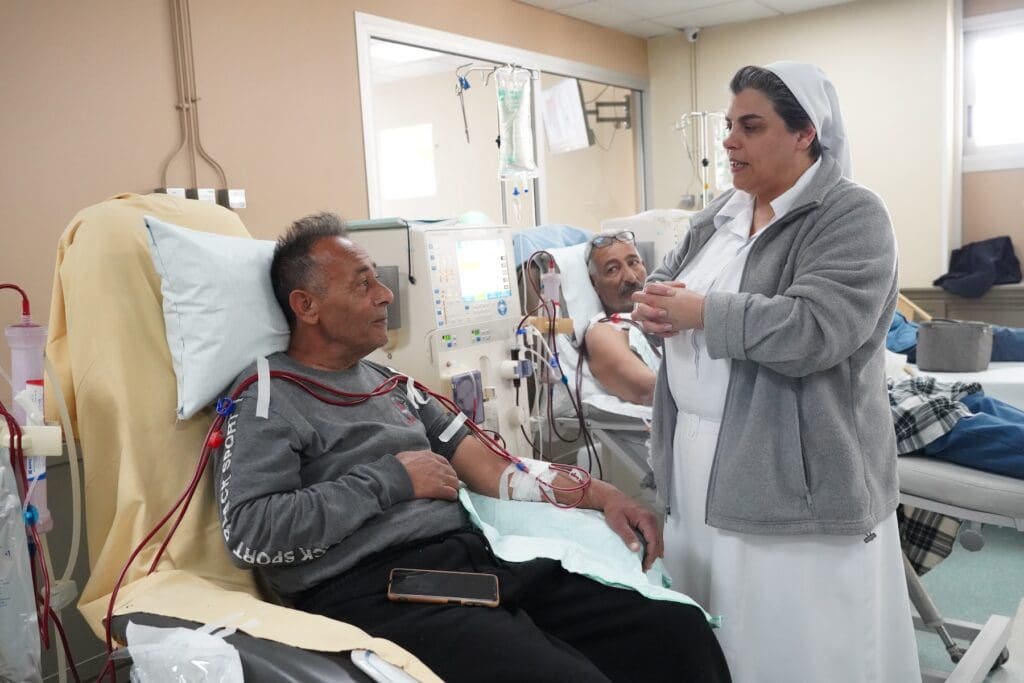
Mohamad Ayach, 68, who needs dialysis twice a week, was unable to receive his treatment due to the relentless strikes in the southern suburbs, where he lives, as well as his inability to leave his disabled adult child unattended. He finally made it to Sacred Heart Hospital eight days into the war.
“We look after our children and we wash our clothes. This is how we spend our days.”
“There is an atmosphere of both fear and solid faith in this hospital,” said Sister Lamia Tamer, a member of the Daughters of Charity, who heads the hospital’s social action committee.
“Despite the panic and danger, I have witnessed the dedication of many health care workers who keep supporting our patients.”
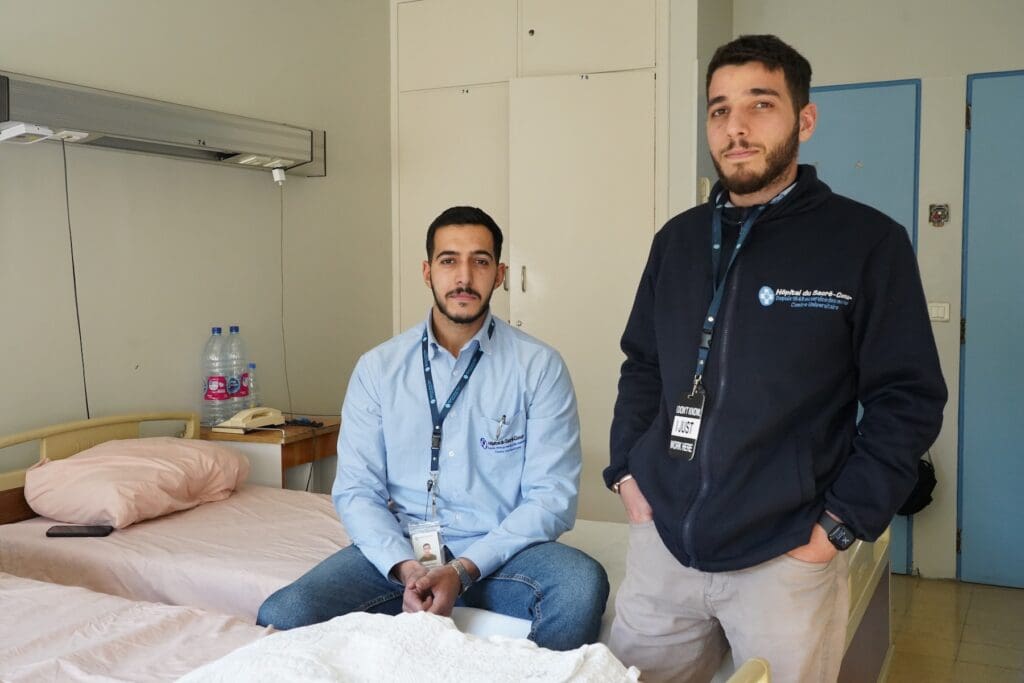
In early spring, the hospital offered shelter to about 50 staff either due to safety concerns or displacement. Hussein Fayad and Mustafa Daher, two 23-year-old biomedical engineers, were among those who took refuge at the hospital from the bombing in Beirut’s southern suburbs.
“We are surviving at the hospital,” said Mr. Fayad, who was observing Ramadan at the time. “You never know where and when the Israelis will bomb.”
In April, Mr. Salem’s primary concerns were financial. “We are receiving many displaced patients who cannot afford their health care costs. The health ministry is covering some of these costs,” and the Daughters of Charity were “covering the rest,” he said.
The hospital’s finances were worsened by the inflation triggered by the U.S.-Israel-Iran conflict: The hospital is dependent on fuel to run its generators because the state does not provide electricity around the clock.
The global economic context has taken a toll on Lebanon, which was already facing multiple crises. The 66-day war in 2024 cost the country $14 billion in losses, while a preliminary assessment of direct losses for 2026 was estimated at up to $4 billion. The sharp decline in 2025 in humanitarian aid from the U.S. and European governments have compounded these difficulties, stretching the country’s resources. In June, the “overall ask by the U.N. and partners” to respond to the humanitarian crisis in Lebanon through August was $639.9 million.
“There is an atmosphere of both fear and solid faith in this hospital.”
In the city of Dbayeh, eight miles north of Beirut, a 70-year-old camp set up to receive Palestinian refugees welcomed more than 60 displaced families in April. Initially, aid at the camp was limited.
“We gave out the blankets and clothes that we had,” said Sister Magdalena Smet of the Little Sisters of Nazareth, who has been living at the camp with members of her community in support since 1987.
Eventually, aid started to trickle in for infant formula, medicines, food, blankets, mattresses and clothes.
Randa Attaya, who fled the southern suburbs of Beirut and found refuge at the camp, picked up a food parcel. She had come to the camp when the war broke out in 2024 as well. At that time, 100 families had found refuge there.
“We have longtime friends who live here, and they have an empty house,” she said.
Ms. Attaya said humanitarian aid was more plentiful in 2024. “Back then, we received several distributions [of aid] to support us, from several organizations,” she said.
Sister Magdalena said people expressed more fear this year than they did in 2024. “Now, people are scared” that Hezbollah members will infiltrate the camp “and that we would be bombarded [by Israel],” she said.
“This war destroys the trust that exists among the people,” she added.
Several targeted assassinations in areas that were thought to be safe, such as a hotel in Hazmieh on 23 March and a Maronite social housing program in Ain Saadeh on 6 April, fueled these fears and stirred political tensions.
Nabih Tohme, president of the municipality of Dbayeh, said local officials coordinate with the Ministry of Interior and Municipalities, which ensures “these displaced families are not affiliated with Hezbollah.” Similar policies have been implemented in cities and districts across the country.
Sister Magdalena emphasized the importance of supporting families who are hosting relatives.
“Some of them lost several days of work because of the situation, and the prices have been soaring” for electricity, water and food, she said.
“Poverty at the camp is surging,” she added.
Sadeq al Khoury, a father of two, opened his home at the camp to his two sisters, their respective families and other relatives displaced by the war. His two-bedroom house is now home to 11 people.
“I work as an electrician, but sometimes 10 days will pass without any work,” he said.
“This war destroys the trust that exists among the people.”
His health has declined since he injured his leg and arm. “I also struggle psychologically,” he said, sitting in his living room and surrounded by piled up mattresses and folded blankets.
“How am I supposed to take care of my displaced family?” said Mr. al Khoury.
“We thank God for what we have,” said his sister Myriam al Khoury.
She and her family lost their home in the southern suburbs to the bombardments in 2024 and had been renting an apartment, also in the southern suburbs, until they moved in with her brother. She was unsure whether her former rental apartment was still standing.
The CNEWA Connection
In response to the war that broke out in Lebanon on 2 March, CNEWA rushed $100,000 in emergency funds for the distribution of food parcels across the south and the Bekaa Valley. The grant subsidized heating fuel expenses for numerous families and distributed food parcels to the families seeking shelter at the refugee camp in Dbayeh through its local partner, the Joint Christian Committee. In the area around Beirut, CNEWA-Pontifical Mission distributed $50 in food coupons during four months for 500 families of all faiths. The crisis in Lebanon is not over and CNEWA’s work on the ground continues.
To support CNEWA’s work in Lebanon, call 1-866-322-4441 (Canada) or 1-800-442-6392 (United States) or visit cnewa.org/donate.