Within candlelit churches, amid prayers for the living and the dead, Gaza’s Christians marked the birth of Christ with a faith bolstered by suffering. Their celebration was shaped by loss, displacement and a lingering sense of fear that has not fully receded.
After two consecutive years of war, a fragile sense of hope has cautiously resurfaced among them. Nearly three months after a ceasefire came into effect, Palestinian Christians, from to Gaza to Bethlehem, marked Christmas with public celebrations once again.
Before the Israel-Hamas war, Gaza’s Christian population barely exceeded 1,000. Since the war began, about half have left, seeking safety abroad. According to church sources, those who remain, Roman Catholic and Greek Orthodox principally, are displaced, having lost their homes during the bombardment, and many continue to shelter in the parish compounds or with extended family.
Churches and mosques in Gaza were not spared during the war. Religious affiliation offered no protection as places of worship were targeted. The Greek Orthodox Church of St. Porphyrios — one of the oldest functioning churches in the world — was struck while civilians were sheltering inside, killing 18 people. In total, 23 Palestinian Christians were killed in direct attacks on churches and their surroundings.
Both Holy Family Catholic Church and St. Porphyrios are located near what is known as the “yellow line,” an area adjacent to zones of ongoing Israeli military activity inside the Gaza Strip. Explosions along and within this fluid line occur almost daily. The sound of nearby blasts can be heard inside the churches, startling worshipers and reinforcing a persistent sense of vulnerability. Nevertheless, congregants continue to attend services, insisting on remaining in their land and clinging to patience and prayer.
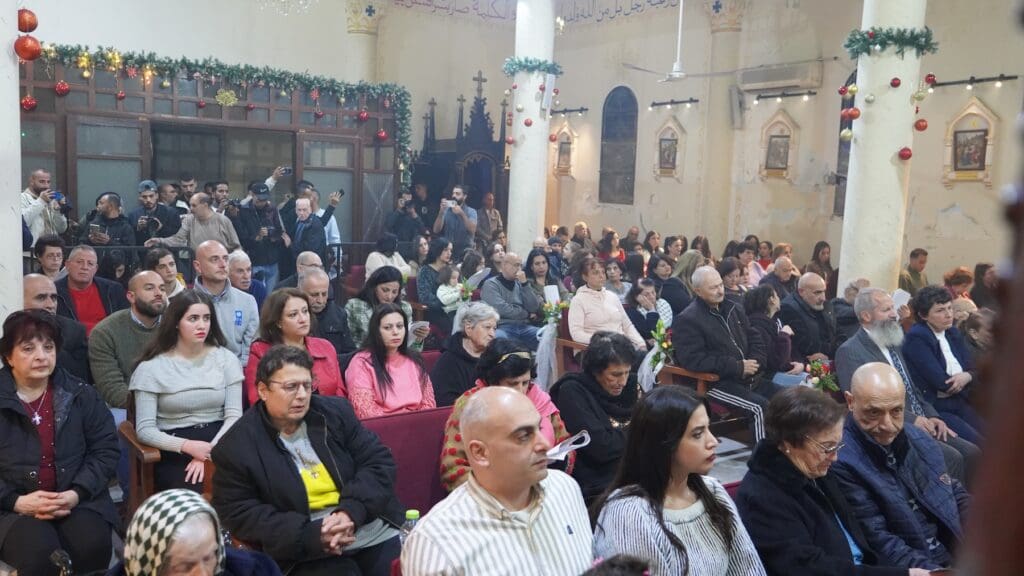
On 24 December, Holy Family Church began its celebrations of Christmas according to the Gregorian calendar used throughout most of the world. Nearly 300 people gathered for the Mass, quietly and reverently.
Three days earlier, parishioners had assembled for a pre-Christmas eucharistic celebration with Cardinal Pierbattista Pizzaballa, Latin patriarch of Jerusalem, during his pastoral visit to the Gaza Strip.
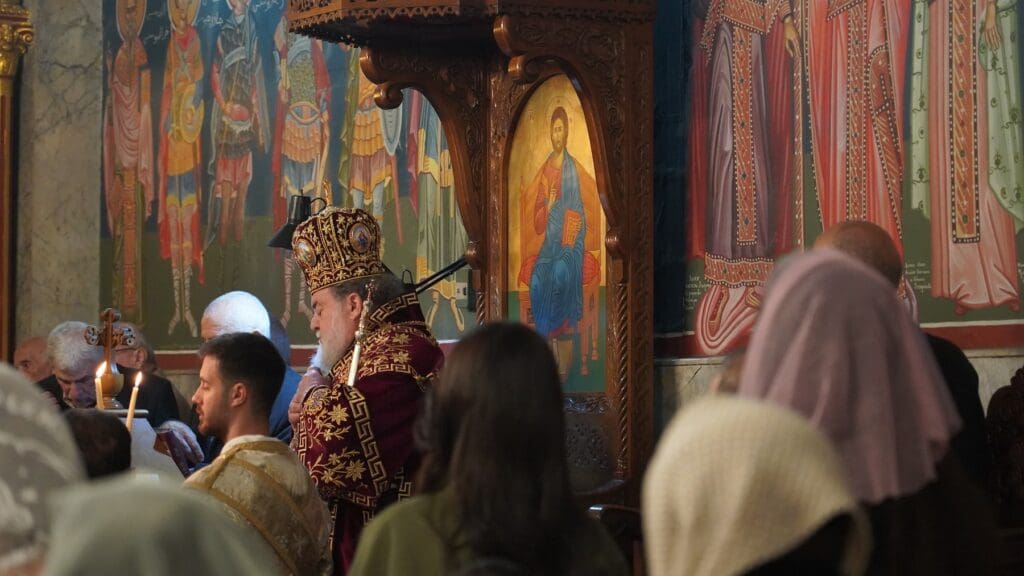
“We are not only called to build life, but to rebuild it,” he told the congregation in his homily on 21 December.
On Christmas Eve, the Rev. Gabriel Romanelli, pastor, recalled in his homily that Jesus was born into a world marked by injustice and darkness, not peace or comfort. He emphasized that Christmas does not depend on ideal conditions, but on faith grounded in justice and reconciliation. Addressing those who question how Christmas can be celebrated during war, he said peace is not merely a wish but a moral responsibility, rooted in reconciliation among people and with God.
Father Romanelli also prayed for peace and justice in Palestine, calling on believers to become instruments of peace in their daily lives. He reminded the congregation that glorifying God must be accompanied by a genuine commitment to justice, mercy and coexistence.
The message resonated deeply with parishioner Noza Al-Tarazi, 63.
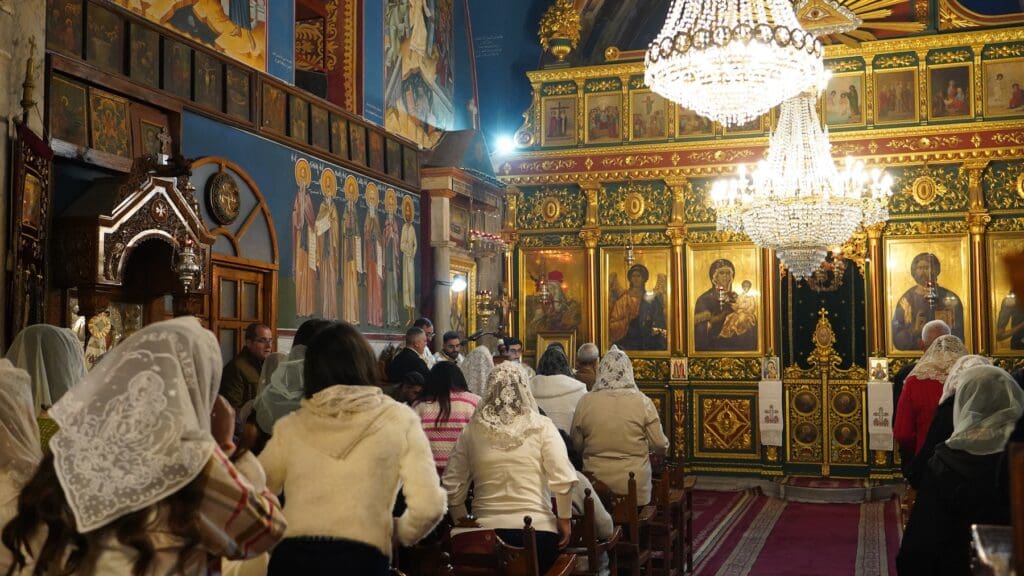
During the height of the conflict, Christmas was marked by church services alone, she said.
“This is the first time we are celebrating because we can finally say there is a bit of calm,” she said in an interview with CNEWA’s ONE magazine.
That calm, however, is inseparable from profound loss for Ms. Tarazi, whose daughter died during the war, not from an airstrike, but because of the collapse of Gaza’s health care system.
“She became ill, and I took her to Al-Ahli Hospital,” Ms. Tarazi said. “They couldn’t do anything because of the lack of medical equipment and medicine. She died there.”
Her loss reflects the wider breakdown of medical services in Gaza, where hospitals were overwhelmed, damaged or rendered inoperable, and shortages of medicine, fuel and electricity became routine during the war.
“The atmosphere now is better than what we lived through,” said Ms. Tarazi. “There is a Mass today and a small celebration afterward. It’s not like before the war, but it’s different from the past two years.”
“I hope [2026] will be a year of comprehensive peace for all of Palestine, especially Gaza,” she said. “I hope there will be reconstruction, that people can return to their homes instead of living in tents. Life is extremely difficult.”
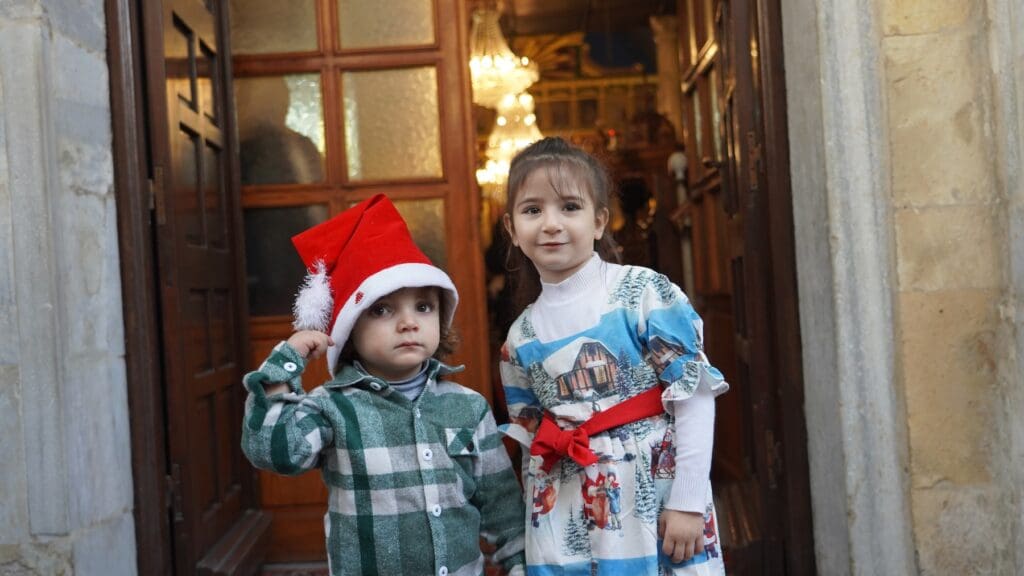
For Gaza’s younger generation, Christmas carries a similar contradiction between relief and fear. Fourteen-year-old Henna Shehadeh described the holiday joy as fragile and unstable.
“After the war stopped, there is some happiness,” he told ONE magazine. “But there is also pain and sadness. When you lose peace, you lose joy.”
Although the ceasefire has brought relative calm, the sense of security remains unstable. “We still hear drones, warplanes and sometimes shelling,” Henna said. “There is some safety, but there is fear at the same time.”
For children such as Henna, Christmas joy is overshadowed by worry.
“We try to play and spend time together,” he said. “My wish is peace in Palestine — in Gaza and in the West Bank.”
On 7 January, the Greek Orthodox community marked the feast of the Nativity at St. Porphyrios Church according to the Julian calendar. Nearly 200 worshipers attended the liturgy, which included hymns and prayers for relief from Gaza’s ongoing ordeal — not only the destruction of war, but winter rains flooding people’s temporary shelters.
Archbishop Alexios of the Greek Orthodox Patriarchate of Jerusalem called on believers to remain patient and steadfast, stressing that every hardship eventually leads to relief. During his sermon, he urged congregants to carry the peace of Jesus in their hearts and to spread peace daily through their words and actions.
Church officials say Gaza’s Christian community has paid a heavy price over the past two years, yet celebrating Christmas — even quietly and under the shadow of fear — is an act of spiritual resilience.
Journalist Diaa Ostaz shares his personal experience of covering Christmas celebrations in Gaza in this audio report: