Christians in Gaza must carry forward the spirit of Christmas — a spirit of light and tenderness — as they “rebuild life” after a devastating two-year war, said Cardinal Pierbattista Pizzaballa, the Latin patriarch of Jerusalem, on a three-day pastoral visit to the strip, 19-21 December.
Cardinal Pizzaballa visited the minority Catholic community in Gaza, the church’s various humanitarian projects, local hospitals, as well as those displaced by the war and sheltered in tents on the seashore. His visit concluded with Sunday Mass and a Christmas celebration at Holy Family Church.
The Sunday liturgy included the baptism of a newborn — an act described by many worshipers as a powerful sign of life amid the rubble. Nine children also received their First Communion. The cardinal described these sacraments as “a testimony to life and a testimony to hope.”
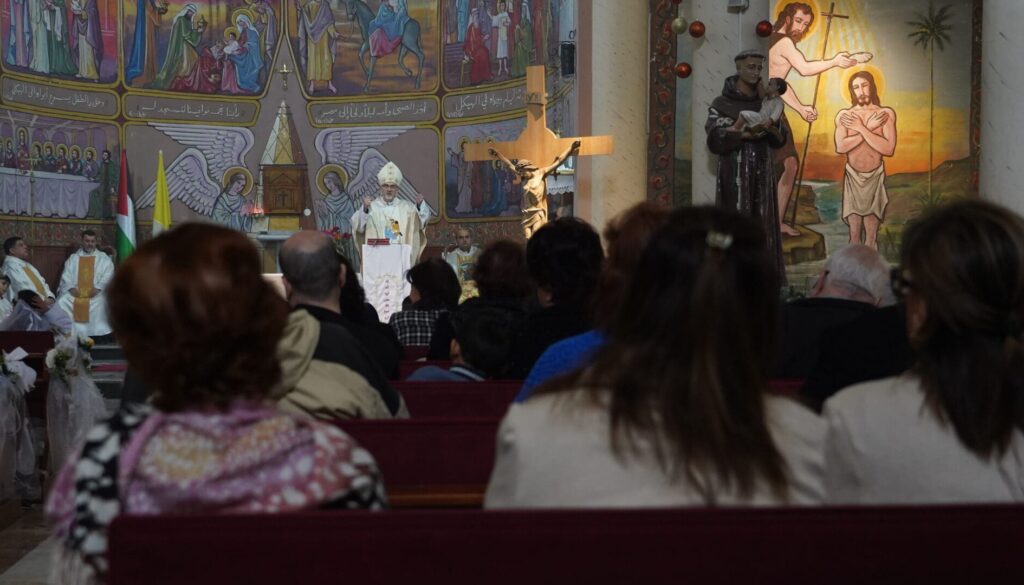
In speaking with reporters in a scrum outside the church on 21 December, Cardinal Pizzaballa underlined the importance of being in Gaza to celebrate Christmas with the small Catholic community. He described his visit as both pastoral and deeply personal, shaped by what he witnessed after months of war.
“This is my fourth visit after the beginning of the war, and I saw a difference this time,” he said. “I saw the new desire of a new life. I saw, that is, a completely different atmosphere.”
Despite the ceasefire and the visible signs of hope and resilience among the Gazan people, the cardinal said Gaza remains trapped in an ongoing humanitarian crisis.
“We are in a new phase, but all the problems are still on the table: housing, schools, hospitals, the conditions of life and the poverty are catastrophic,” he told journalists. “But it’s time now to look forward and to rebuild all [that] has been devastated.”
He expressed his appreciation for the way Gazans have lived through their circumstances. Reflecting on the broader political reality, Cardinal Pizzaballa said Gaza’s fate often has been shaped by decisions made by “the powerful people of the world” far beyond its borders.
“At the same time, we saw that the resilience of these people is what [in] the end will prevail,” he said. “For me, this is a big lesson. Even here, in Gaza — in the most depressed situation of the world maybe — it is possible to celebrate Christmas.”
The cardinal was moved by the presence of many children during his visit. “Where children are happy, life, the future, is solid,” he said.
“So our commitment now is how to [rebuild] from this devastation together, in order to transform Gaza” from “the most depressed place in the world” to the most vibrant place, he said.
“I’m confident because, all over the world, Gaza is in the heart of people,” he said. “Wherever I go, people ask about Gaza. If the will is here, where there is a will, there is a way.”
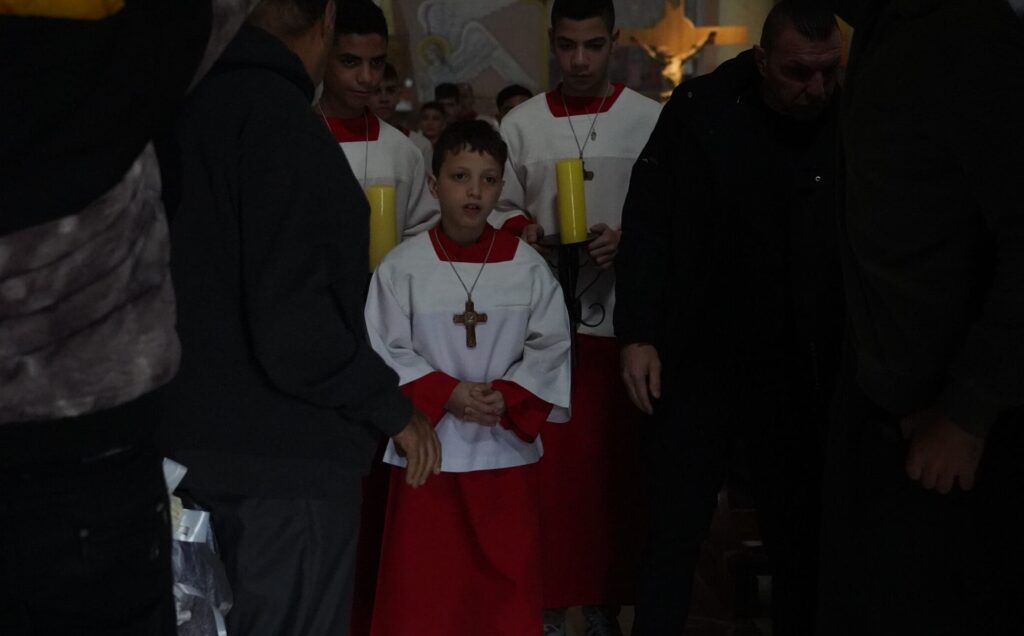
In response to a question put to him by CNEWA’s ONE magazine about the state of Gaza’s Christian community, which numbers less than 1,000 people, the cardinal said the “situation of Christian communities is not that different from all other communities.”
“They lost everything,” he said. “They are living here, as you see, in a very precarious situation. We transformed the churches into housing.”
In the rebuilding, he continued, “we will focus, first of all, on schools. There is no future without education.”
The next priority — with the help of other aid organizations — is to support health care, he said. “And, as soon as possible, housing,” he added.
Inside the church courtyard, celebrations were modest but heartfelt.
Khaled Tarzi, 14, compared this year’s gathering with the patriarch with the past two Christmases. “The celebrations are beautiful,” he told ONE magazine. “Last year, because of the war, we did not hold any celebrations. This year, we are celebrating the birth of Jesus Christ with a bigger and more beautiful celebration.”
Khaled expressed his simple wish for Christmas — one he believes is shared by all Gazans: “Our wish is that the war ends safely and peacefully, and that we all survive in peace.”
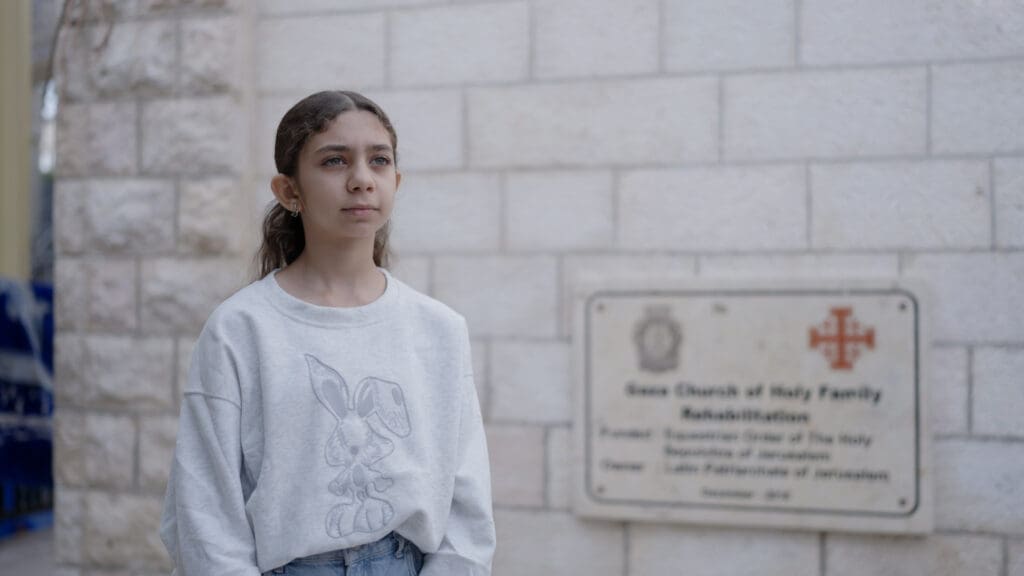
Eleven-year-old Julia George Anton said this Christmas feels unlike any she remembers. “This is the first Christmas we’ve experienced in peace,” she told ONE. “The past two years were during the war. We lived through sadness; homes were destroyed, people were dying.”
Although decorations and celebrations have returned, Julia said her joy feels incomplete. “We are happy because it’s the first time we’re celebrating,” she said, “but our hearts are still heavy with sadness for those we’ve lost, for the homes that were destroyed, and for our friends and relatives whom we no longer see.”
Cardinal Pizzaballa addressed this tension between hope and grief in his homily at Mass.
“There is no Christmas without birth,” he said, emphasizing that faith is inseparable from responsibility. He spoke of Jesus being born without shelter, drawing parallels with Gaza’s displaced families, and reminded worshippers that “God’s way is the way of poverty and simplicity.”
“We are not only called to build life, but to rebuild it,” he told the congregation. “During the war, you became a powerful example of life and light. In this new phase, we must carry this spirit — the spirit of Christmas — with its tenderness, its love and its attention to all dimensions of rebuilding, not only buildings, but to life itself.”
“In this new phase you must continue to be the light,” he said.
“The parish will not be abandoned,” he said. “You are not alone, and we will rebuild everything again.”