CNEWA marked its centennial at this year’s Catholic Media Conference in Atlantic City, 16-19 June, by contributing in several ways to the week’s quality professional development program.
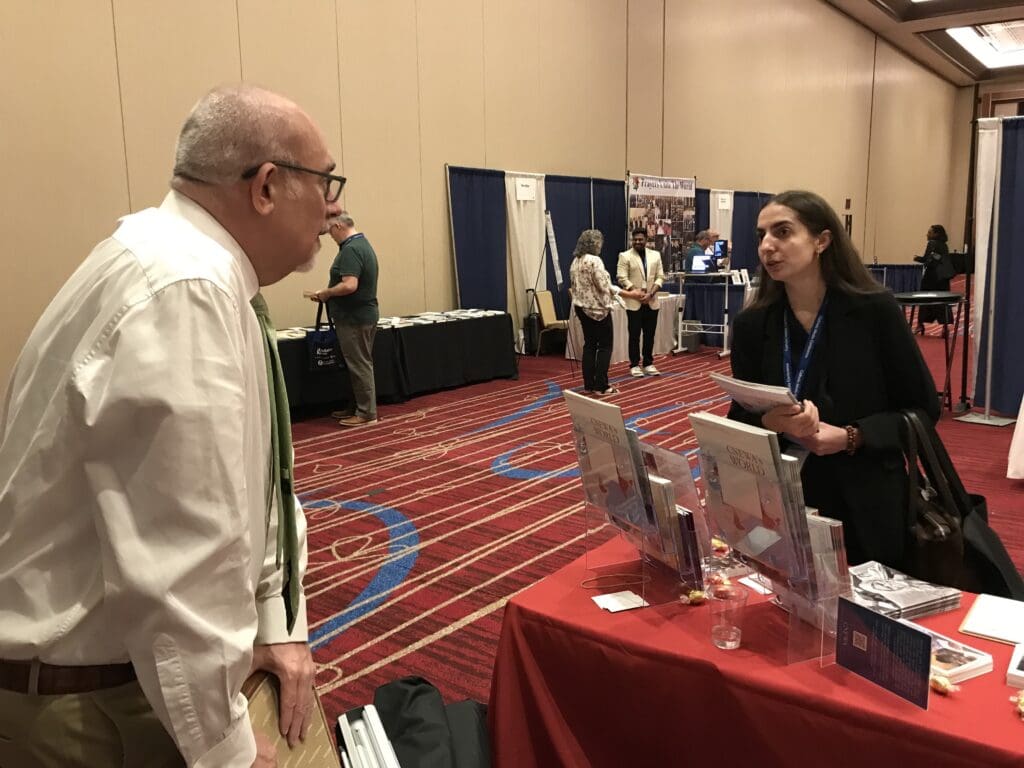
Members of CNEWA’s communications and marketing team, led by Michael J. La Civita, director of communications and marketing, offered a workshop entitled “How to Adapt News Stories to Create Social Media Content That Pops.” More than 65 people attended.
Mr. La Civita began by explaining how CNEWA has integrated its communications and marketing departments, which has demonstrated success in advancing and improving communications, messaging, branding and fundraising outcomes.
He outlined the major steps in establishing a communications strategy, namely knowing one’s mission, audience and organizational priorities.
“Develop the messaging, concept and keywords, and identify and isolate potential distractions,” he said.
Identifying distractions “is one of the most important things,” he said. “How do we tell our story without becoming identified as a partisan vehicle, as a culture warrior? We’re not in the business to do that. We shouldn’t be in the business to do that. If we are, we’re going to lose half our audience.
“What we’re trying to do is build up something, not tear it apart. What we’re trying to do is advance the mission and the Gospel, not inculcate division.”
He then introduced the case study for the day’s presentation: CNEWA’s strategic response to the USAID cuts across all communications and marketing platforms.
In explaining the progression of CNEWA’s response to the USAID shutdown — from a press release to establish the organization’s positioning to media relations, journalism assignments for CNEWA’s publication, ONE magazine, online marketing, direct mail appeals and social media — he laid the ground rules for moving a singular organizational priority through CNEWA’s multiple public channels.
“Remain objective, never betray impartiality in politically charged partisan language, and recognize the difference between journalistic and marketing messaging,” he said. “There is a very big difference, a very big difference, and we have to respect that.
“Good journalism serves as a primer. It lightens the lift for marketing, allows appeals to focus on why it matters, and provides calls to action.”
Laura Ieraci, ONE editor and senior communications officer, spoke about how journalism can support organizational goals by reporting on mission-aligned events and issues.
Ms. Ieraci noted that many dioceses have shuttered their news operations or are planning to transform their news publications into human interest magazines, based on “the idea or the premise that news doesn’t necessarily serve the mission.”
“If this is a belief that exists in your environment, then you’re not really understanding how you can maximize the news,” she said.
At CNEWA, “we understand how journalism can serve the mission,” she said.
As an editor she ensures that journalists, photographers and videographers bring back material from the field that can serve across all journalism, communications and marketing functions within the integrated department. Content is triaged for its various uses. For instance, some photos are used to illustrate the journalism, while others are held for promotional or marketing purposes.
In this model, journalism becomes “a source of information that also feeds marketing and social media,” she said.
Each member of the team works “in an integrated fashion, but we also work within the standards and ethics of our particular disciplines.”
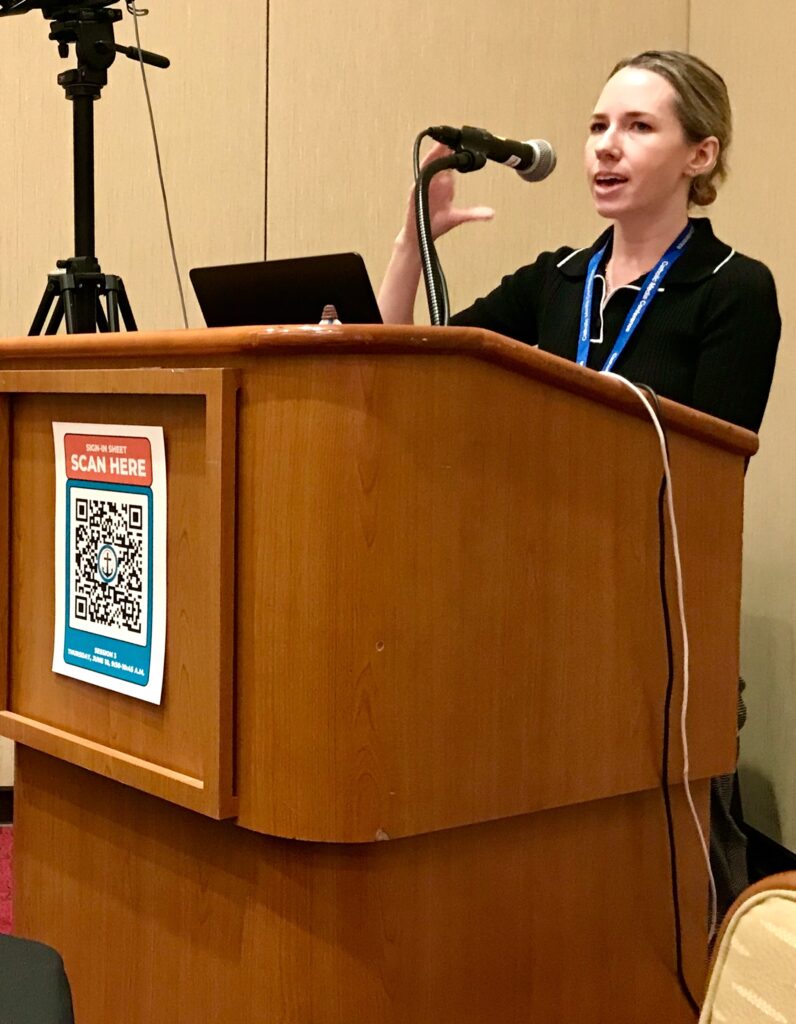
Elizabeth Belsky, marketing manager, then presented the strategies CNEWA employs to attract new donors and encourage consistent giving, including list acquisition. Within the case study of the USAID shutdown, Ms. Belsky spoke about how CNEWA reached beyond the church to attract potential donors from lists of people interested in humanitarian work generally.
“It’s really important to always be expanding your base and trying to bring in new people, especially as your current donor base … starts to age out,” said Ms. Belsky, who was named C.M.A.’s Advertising/Marketing Professional of the Year.
She spoke of curating donor lists based on interest, regularly reviewing audience data and using direct mail to inspire giving through “compassionate, emotional appeals that tell you, ‘Here is what we are doing. Here is why you should care. Here is the Gospel basis for our investment in this issue.’ ”
CNEWA’s marketing is “based in the concept of empathy first. We are an empathy-forward organization,” she said. “We believe that compassion and empathy are the strongest tools in our toolbox, and I think that could go for a lot of folks in this room.”
While writing copy to maximize search engine optimization (or S.E.O.) is important, marketers need to remember they are writing for humans first, she added.
“Content that is written solely for S.E.O. purposes can sound a bit like a simulacrum of a real human’s writing, or even worse, it can sound like A.I.,” she said.
She encouraged the audience to write marketing copy that is “specific, personal and resonant” — three keywords that focus her own writing — and not to be shy in asking for donations.
Francisca Enemuo, social media specialist, explained how she draws from the stories, video and photography produced by ONE magazine and repackages the information for social media, with additional editing and graphics.
“I think of visual storytelling, I think of hierarchy, I think of positioning, I think of using the right language and using the right visuals,” she said in explaining her approach.
The goals of CNEWA’s social media are to provide information about the agency’s work but also “to engage and convert people to the website,” she said.
“Social media is our first point of contact for a lot of people,” she said, so it must provide a clear understanding of the agency’s work. This will increase a person’s familiarity and trust of the agency, which are necessary to convert into donations, she explained.
With constant feature updates on social media platforms, as well as changes to social media use and consumption, adaptability is key for success, she said.
Elaborating on the case study, Ms. Enemuo showed how she adapted a two-minute audio report by a ONE journalist in Lebanon into three reels for social media called, “What happens when foreign aid suddenly stops?”
Social media “is a merge between communications and marketing,” she added.
“At the end of the day, people do see it as information first,” she continued. “But you’re also understanding who we are as an organization enough to want to convert and actually donate.”
Organizations that see social media “as an afterthought are very underutilizing the platform,” she said.
Ms. Ieraci and Barb Fraze, a contributing editor to ONE magazine, also gave a workshop on collaborative journalism, which is a sharing of resources, data and expertise among multiple newsrooms and publications with the goal of covering more vast and complex issues of interest to Catholic audiences. They encouraged some 45 media professionals present to shift from a “scoop” mentality to collaboration in view of stronger reporting with greater impact.
In marking CNEWA’s 100th anniversary, CNEWA also sponsored a breakfast for Catholic media professionals on 19 June. During the breakfast, staff screened CNEWA’s centennial video and Mr. La Civita gave a presentation on CNEWA’s work in supporting the Eastern churches’ pastoral and humanitarian efforts.
He spoke of the agency’s main mission areas, such as accompanying the church, which includes supporting the formation of church leadership, providing emergency response and responding to human needs, with special care to the specific needs of children.
Unaudited figures from 2025 indicate CNEWA distributed almost $21 million in aid, he said.
“That’s actually a decline, not because we didn’t have the funding, but because countries are placing more and more restrictions [on aid],” he said. He explained how the agency made up for the decline with greater distributions of assistance in the first quarter of 2026.
“You all read the newspapers and see what is happening in places like Gaza and Lebanon, it’s getting more and more difficult,” he continued. “Or India, Georgia, one has to register, for example, to be a charity, and those who receive the funding have to be registered with the government to accept it.”
In some cases, he explained, “N.G.O.s are actually being folded and denied legal personality and the ability to work.”
“So, this is making every penny that we spend that much more precious … because it’s difficult getting that funding in.”
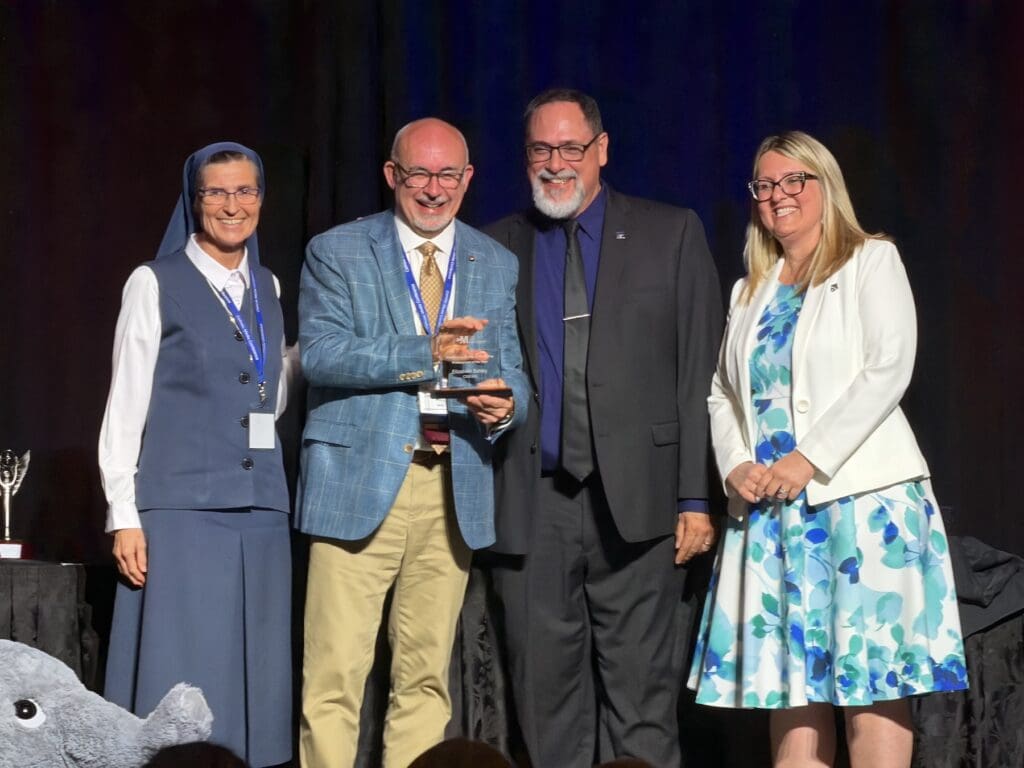
Mr. La Civita, who completed his third term as a member of the C.M.A. board of directors, which included time as vice president, also spoke of CNEWA’s mandate to educate and raise awareness of the Eastern churches both within and outside the church. The main communications vehicles for this mandate are ONE magazine, CNEWA’s websites and social media, which were conferred numerous C.M.A. awards at the awards banquet in Atlantic City on 19 June.
Ms. Ieraci was elected to board in the spring and began her term in June. For the past three years, she has served on the C.M.A.’s conference planning committee, including for 2026, and more recently on the ethics committee.