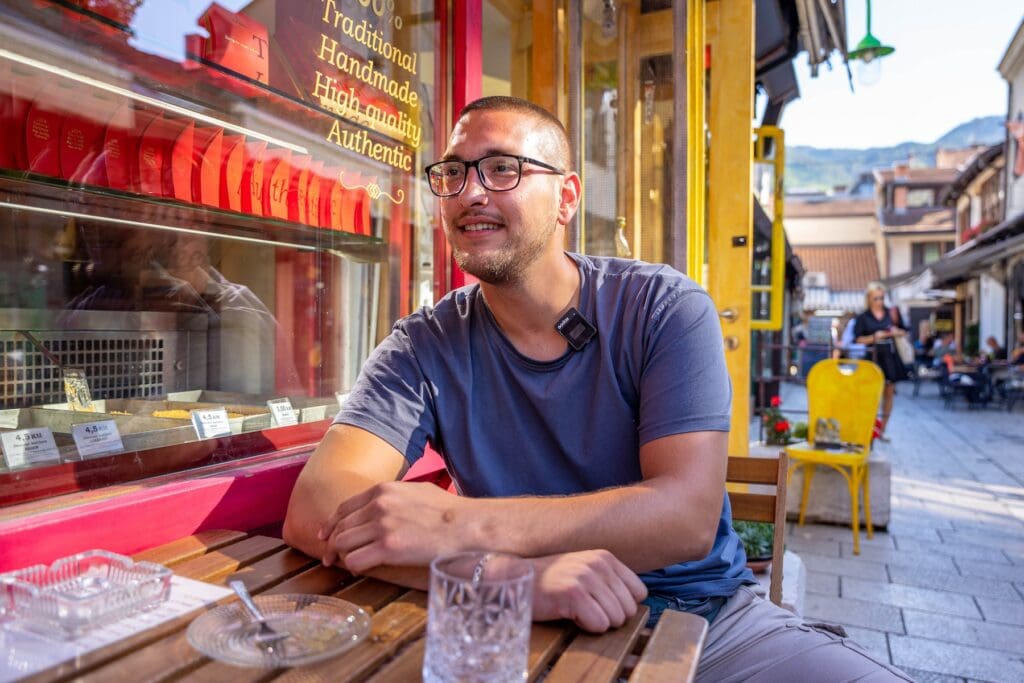
In the heart of old Sarajevo, called Baščaršija, where the smell of fresh coffee and baklava waft down a narrow lane, 24-year-old Alen Špilja is enjoying conversation and dessert.
Špilja’s ancestors have lived in what is now Bosnia and Herzegovina since the 15th century. He says in his family, with its interweaving of faiths and cultures, the memory of war does not dictate the present.
“In Yugoslavia everything was mixed, and Sarajevo remains like that today,” he told ONE magazine. “In one neighborhood you’ll find a mosque, a Catholic church, and an Orthodox church side by side.”
“It’s harder for the older generation,” who remember the three-year Bosnian war and suffered the loss of friends, relatives, homes and work, he said. “But if we focus on rebuilding and living in peace, we can do it. … a peaceful future is possible.”
Thirty years after the Bosnian War in which 101,000 people were killed or disappeared and more than 2 million displaced, the fear of renewed violence has not disappeared. However, the young adults who did not experience the war seem able to move on more easily.
“In Bosnia we have a saying: ‘Everything is fine — as long as no one is shooting,’ ” said Mia Džanko, a 15-year-old student in Sarajevo.
Each day after school, Mia hurries to a theater workshop. Her schedule is full and her backpack heavy — textbooks, notebooks, sheet music. She attends a gymnasium, studies music, performs with a youth theater, and speaks fluent English and German. Her parents encourage her wide interests, and Mia herself is energetic and optimistic — like her family, which endured the war and remained resilient and entrepreneurial.
“I didn’t live through the war, but you feel its aftershocks,” Mia said. “Politicians constantly talk about conflict and contradictions, and you’re always waiting for something. Even 10- and 11-year-olds discuss the war, repeating the stories of their parents and grandparents.”
Mia has her own family stories. When the war began, she recounted, her mother’s family left — first for Croatia, then Slovenia until they ended up in Germany. Mia’s great-grandmother kept sending them letters, but most stalled at the borders. Only one arrived — on her mother’s birthday — with a gold ring tucked inside. She loved her granddaughter so much that she risked sending it, though she might have needed it herself during the siege of Sarajevo, when everything was scarce.
In 1995, the family returned under a German repatriation program that helped restore housing. Mia then shared how her mother, once back home, stepped out onto the balcony of her great-grandmother’s apartment — part of it had burned during shelling before being repaired — and said: “Nowhere is the sky as blue and as beautiful as it is at home.”
Her family’s story — and the calm, steady optimism with which they lived through the war — guides her.
Mia is convinced that the past must be spoken aloud — and that culture is the best way to do that is through culture.
“We work through trauma in theater — through productions, workshops, educational programs. It can be painful, but it helps us understand what happened.”
Art, she added, is the best tool for the young because it teaches reflection and dialogue, especially when students from different communities meet. At the same time, she draws a sharp line between society and politics: “There aren’t big problems among ordinary people right now. The problem is politics. We have three presidents [a Bosniak, a Serb and a Croat] — and they and their parties, in effect, cultivate conflicts and division.”
What the moment needs, Mia said, is empathy: “We have to learn to ‘put on someone else’s shoes’ — to feel what others feel and be guided by that.”
She said the country’s budget priorities are obvious: education and health care rather than “an army of officials.”
Her optimism is not naïve but practical: “We can’t forget old crises just because new ones happen.” Even so, she said, she tries to “look for light in dark times.”