After 66 days of war with Israel last autumn, few in Lebanon could have imagined such a scene: Pope Leo XIV traveling across the southern suburbs of Beirut, which have been heavily impacted by Israeli bombardments.
As in many other parts of the the country, banners that read “Blessed are the peacemakers” and “Lebanon wants peace” hung along the road, while people amassed on the roadside to welcome the pope.
In his first address to Lebanese officials at the Presidential Palace after arriving in Beirut on 30 November, Pope Leo highlighted the resilience of the Lebanese people, saying the Lebanese “do not give up, but in the face of trials, always know how to rise again with courage.”
Sister Joumana Sassine said the pope’s words resonated with her. She traveled from the Maronite St. Joseph Monastery in Jrabta, a major pilgrimage site where the tomb of St. Rafqa is housed, to the Basilica of Our Lady of Lebanon in Harissa on 1 December to attend the meeting of Pope Leo with clergy, religious and lay pastoral workers.

“We resist and persevere, but sometimes, even with hope, you need the encouragement that such a visit provides,” she said.
Sister Joumana brought Jessica Nassif with her. Ms. Nassif, an 18-year-old novice at the monastery, was “thankful and happy” to see Pope Leo.
“I am hoping to meet God through this encounter,” Ms. Nassif said, adding that she hoped listening to Pope Leo’s address would “bring peace to the hearts, including my own.”
Najwa and Robert Al Khoury, who serve in the Maronite archeparchy’s marriage and family ministry, said they came to pray for peace for Lebanon, which would help families who have been forced to flee their homes or who are struggling due to the economic crisis.
The 2,500 people at the gathering greeted Pope Leo with cheers and cries of “Viva il papa.”
“It was an emotional moment, filled with tears and the feeling that the pope is here with us, is one of us,” said the Rev. Dany Frem, who ministers at St. Therese of the Child Jesus Church in Beit Mery-Mansourieh and served on the organizing committee for the gathering in Harissa.
Church leaders and pastoral workers from across Lebanon addressed the pope, sharing the challenges of working on issues pertaining to migration and detention in Lebanon, as well as in areas affected by war.
“As consecrated people, we are [the pope’s] eyes and ears of the church on the ground in the parishes and the dioceses,” said Syriac Catholic Bishop Isaac Jules Boutros, responsible for youth ministry in Beirut.
Pope Leo quoted St. John Paul II’s 1984 Message to the Citizens of Lebanon: “You are the ones responsible for hope in today’s Lebanon.”
“Create, there where you live and work, a fraternal climate,” Pope Leo said.
Referring to the “tenacity” of Lebanon’s clergy, religious and lay pastoral workers, the pope said “it is in being with Mary at the foot of Jesus’ cross that our prayer, that invisible bridge which unites hearts, gives us the strength to continue to hope and work, even when surrounded by the sound of weapons and when the very necessities of daily life become a challenge.”
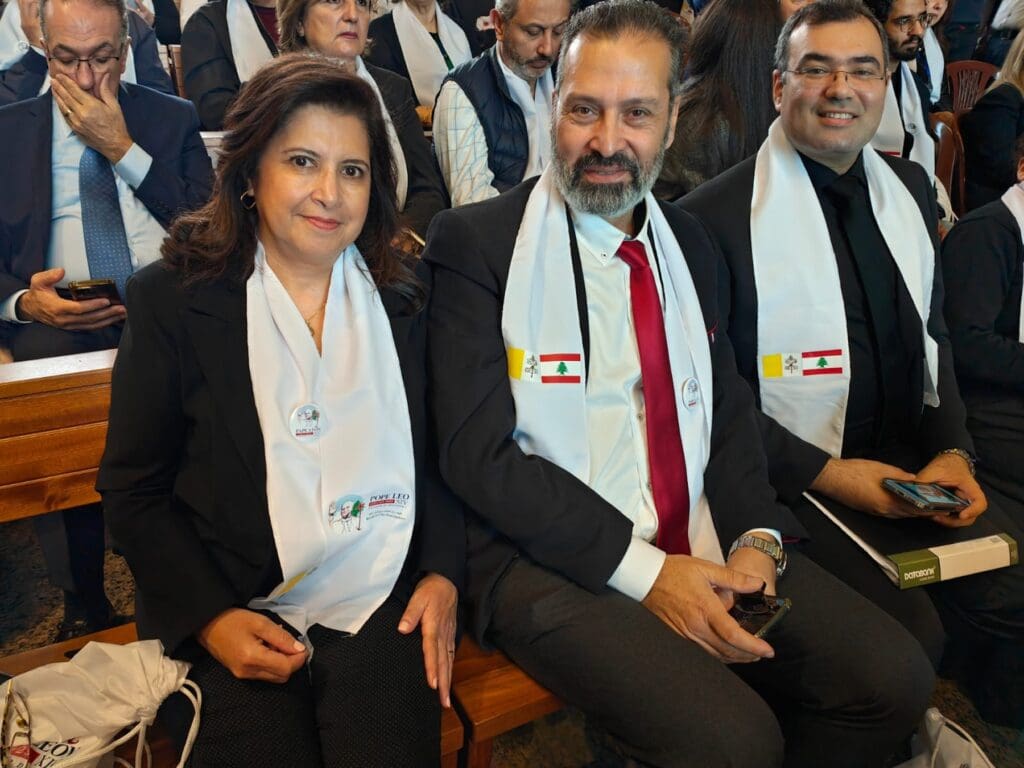
Since Pope Benedict XVI’s visit in 2012, Lebanon has received up to 1.5 million Syrian refugees; endured the COVID-19 pandemic and one of the world’s worst economic crises; tried to recover from the 2020 Beirut Port blast that killed more than 200 people and injured 6,000; and war. According to a 2024 report by the World Bank, 73 percent of Lebanese were living in poverty.
Pope Leo also emphasized the responsibility that the church has for young people. He said it was important to include them in church structures, “appreciating their fresh contributions and providing them with opportunities.”
Noting that the “church in Lebanon has always cultivated education,” Pope Leo encouraged church workers to “continue this praiseworthy work.”
“Let your choices, prompted by the most generous charity, serve to meet the needs, above all, of those who cannot help themselves and those found in extreme situations,” he said. “In this way, the formation of the mind will always be united to the education of the heart. Let us remember that our first school is the cross and that our one teacher is Christ.”
Msgr. Peter I. Vaccari, CNEWA president, traveled to Lebanon for the papal visit. He attended the gathering in Harissa, along with Adriana Bara, national director of CNEWA in Canada, and Michel Constantin, director of CNEWA’s regional office for Lebanon, Egypt and Syria.
Since the outbreak of war between Israel and Hezbollah in 2023, CNEWA has directed $1 million to Lebanon in emergency aid and reconstruction efforts, causing a shortage of funding available for “the poorest of the poor in schools,” said Mr. Constantin.
“Poverty in Lebanon has reached unprecedented levels,” he said. “The churches and schools in the South are on the brink of collapse.” He called for support to ensure “both Christians and Muslims can access education.”
While the church in Lebanon is heavily engaged in provided much needed care in health and education, its pastoral mission is “just as essential,” he said.