A new venture in the Hashemite Kingdom of Jordan between the Royal Institute for Inter-Faith Studies and CNEWA-Pontifical Mission aims to promote greater understanding and appreciation about Christianity.
The collaboration points to CNEWA-Pontifical Mission’s credibility in Jordan after decades of working effectively in interreligious contexts, especially among refugees and other vulnerable, majority-Muslim populations.
The initiative is intended to “help Jordanians get correct information about Christians in Jordan,” says Ra’ed Bahou, regional director of CNEWA-Pontifical Mission in Amman.
“We are locals, not foreigners.”
The Christian presence in what constitutes contemporary Jordan dates to the earliest days of the faith and was at its height during the Byzantine era. Christians now represent less than 3 percent of Jordan’s population of 11.5 million, of which 97 percent adhere to Islam.
A country with low sectarian conflict, Jordan has experienced heightened social tensions since the Hamas attacks on Israel on 7 October 2023, Israel’s subsequent retaliatory assault on Gaza, which the U.N. Commission of Inquiry has called a “genocide,” and the U.S. and Israeli war on Iran in February.
Jordan is an ally to Israel and the United States, and its airspace is used to intercept Iranian missiles launched toward Israel. Destroyed missiles become shrapnel that falls within the country. In addition, Iran bombed U.S. military bases in Jordan in June and then again after the collapse of the Iran-U.S. agreement on 8 July.
“The war has created a growing gap between religions, between Sunni and Shiite Muslims, and between the Christians and the Muslims,” Mr. Bahou says.
Iran is officially a Shiite Muslim nation and backs both Hamas in Gaza and Hezbollah in Lebanon.
“Some people see Christians as more Western” and see the West as backing Israel, he says. “They also perceive the United States as Christian,” so “the Christians can suffer indirectly” from this perception.
The context of war in the region underlines the necessity for dialogue and increased understanding, especially since religion “is seen as the cause of war and is used to justify land occupation,” says Amer Al-Hafi, academic adviser at the institute and professor of interfaith studies at Al al-Beit University in Jordan.
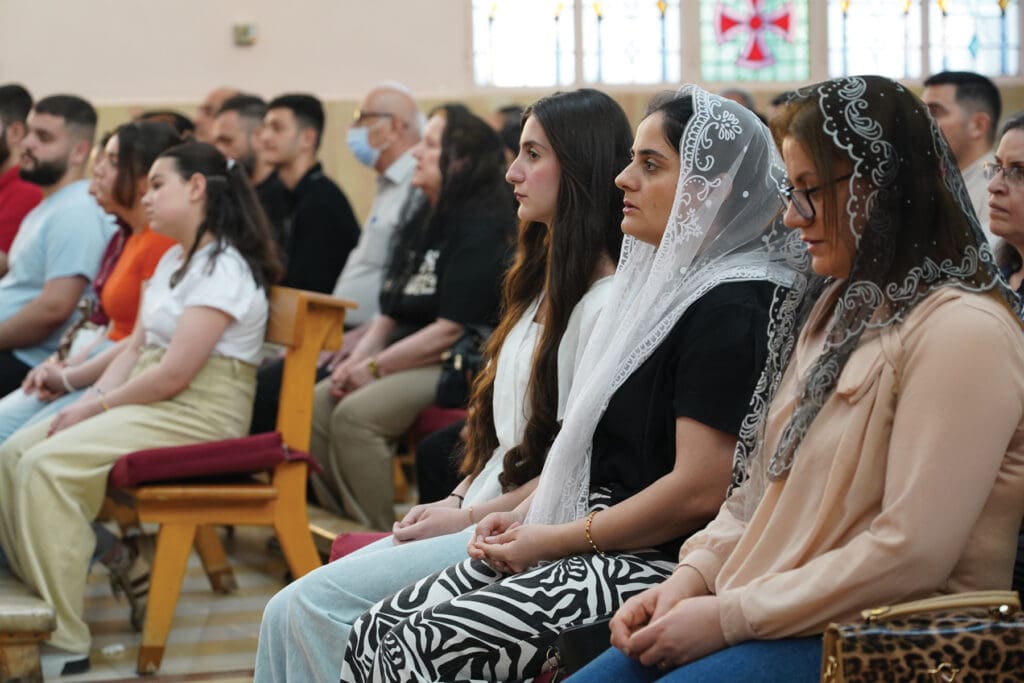
“We live this coexistence [in Jordan], but we do not speak much about it,” says Mr. Hafi, underlining that coexistence needs to be established in cultural and academic fields, hence the cooperation that began this year between the institute and CNEWA-Pontifical Mission.
“The war has created a growing gap between religions, between Sunni and Shiite Muslims, and between the Christians and the Muslims.”
The Royal Institute for Inter-Faith Studies was founded under the patronage of Jordanian Prince El Hassan bin Talal in 1994, the year Jordan signed its peace agreement with Israel. The institute promotes interreligious dialogue and organizes youth activities on Jordan’s Christian heritage.
“Since the ’60s, the royal family has played a major role” in interfaith dialogue, says Norig Neveu, a historian with the French Institute of the Near East, researching religious issues in Jordan. “Between 1948 and 1967, Jordan had authority over the holy sites in Jerusalem, maintained relations with the Vatican and oversaw pilgrimages.”
“This positions the Jordanian monarchy as a royal family who protects the Christians, who acts as a mediator and protector,” Ms. Neveu says. This is more than symbolic, as the Hashemite family had governed Islam’s holiest city of Mecca from the 10th century until the early 20th century and descends from the family of the prophet Muhammad.
In line with the Hashemite family’s solicitude for dialogue with Christians, the institute held its eighth joint interreligious conference with the Dicastery for Interreligious Dialogue at the Vatican in mid-May on the theme, “Compassion and Human Empathy in the Modern Age.”
“We need to have a correct understanding of religion,” Mr. Hafi says, “and we need to understand our heritage, because Christianity is a crucial part of our history and civilization.
“We need to be more aware about interreligious relations,” he adds, “and to create resources to develop the knowledge of Jordanians about these issues.”
The Christian population in Jordan, although small, is diverse. According to the Jordanian government, the majority is Greek Orthodox. However, Armenian Apostolic, Eastern and Roman Catholic, Coptic and Syriac Orthodox, and a few Protestant communities flourish, and include as members Bedouin families in Madaba and near the crusader-era city of Kerak.
In addition to providing pastoral care to the faithful, these churches offer an array of social services, including health care and education, to the millions of vulnerable people who have migrated to Jordan over the past century, seeking work or refuge from war and persecution.
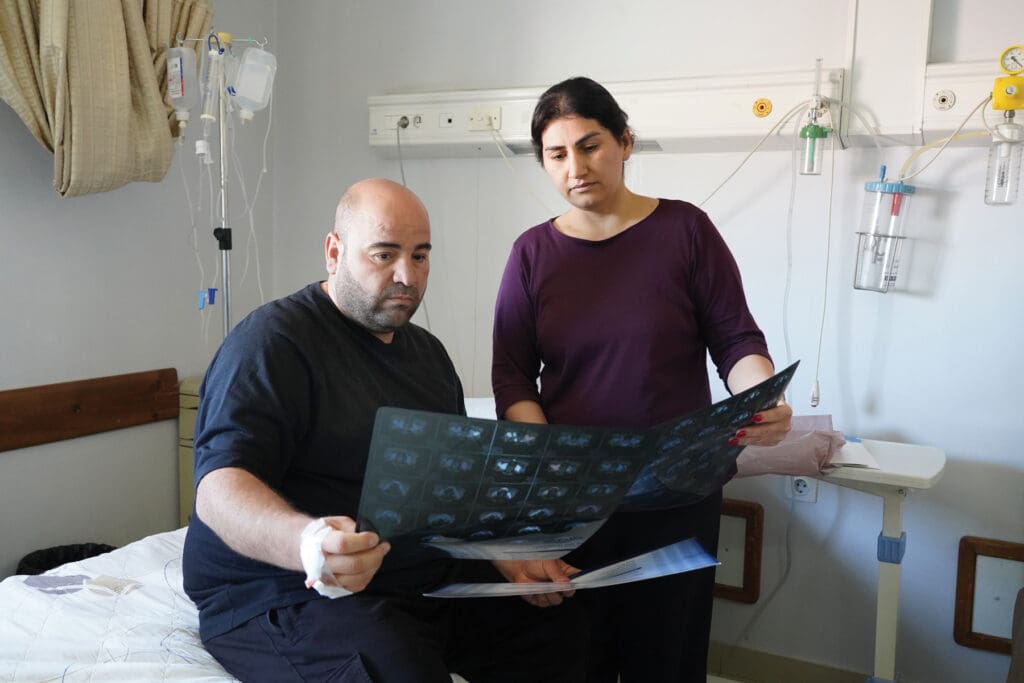
Evan Behnam, a Christian, came to Jordan from Iraq, where he had worked in construction. In mid-June, he sat fatigued, looking at his medical X-ray at the Italian Hospital, founded in 1926 in one of Amman’s poorest neighborhoods. Mr. Behnam was told he will need gallbladder surgery that will cost nearly $1,200, which he cannot afford.
“Everything has become expensive and I cannot work,” says Mr. Behnam. His wife cleans houses to support the family; one of their three children has special needs.
Mr. Behnam is dependent on health care support provided by church-led organizations: CNEWA-Pontifical Mission has covered $352 of his medication, and he is responsible for the remaining $141.
Nancy Haddad, who oversees the coordination between CNEWA-Pontifical Mission and the Italian Hospital, administered by the Dominican Sisters of the Presentation of Mary, says CNEWA-Pontifical Mission will cover $282 of Mr. Behnam’s surgery, and the hospital will ask Caritas Jordan to cover the rest.
“The most important thing is stability, especially for the children.”
“Most patients I refer are Jordanians,” Ms. Haddad says. “The rest are of various nationalities, and we support them regardless of their faith.”
In March 2025, UNHCR Jordan estimated that “close to $19.4 million in funding toward the health sector had been withdrawn” due to cuts in foreign aid, anticipating an impact on “454,000 refugees and 75,000 Jordanians.”
Omar Abawi, acting executive director of Caritas Jordan, says his office lost a quarter of its budget — $2.5 million — in funding over the past year due to cuts in foreign aid.
“We used to cover one million dinar ($1.4 million) in health care expenses at the Italian Hospital, and now we are down to half of that,” he says.
Nassim Samawi, administrative director of the hospital, reports the funding cuts have been devastating.
“As a result, our number of patients decreased by 25 percent in 2025 compared with 2024, and by a further 15 percent in 2026 compared with 2025,” he says.
Heading a private, nonprofit hospital, he worries about the hospital’s decreasing revenue.
“We have been in a deficit since the pandemic,” he says.
Abeer Maradi, a mother of six, is among the 12,000 Iraqis in Jordan, including Christians, who fled Islamist militias.
Her family fled their home in Mosul in 2021, with “a few clothes and first Communion pictures,” after weeks of repeated threats against her husband, Osama. They moved in with her sister in Al Hashimi Al Shamali, an area of Amman with many economic and social challenges.
“The most important thing is stability, especially for the children,” Ms. Maradi says, wiping away tears as she recalls how her family home was destroyed by Islamic State militants, and how her father was killed in the Iran-Iraq war when she was 4.
Her family is among the 930 Iraqi refugee families in Amman to benefit from CNEWA’s food coupon program, which includes distributions at least twice a year.
“If there were work, it would be okay,” Ms. Maradi says.
A UNHCR report on a survey of refugees in Jordan this year found 66 percent of refugees in the country live below the poverty line. “Despite relative stability in poverty rates since 2023, economic vulnerability has deepened,” it says.
Jordan is not a party to the 1951 U.N. Refugee Convention. Therefore, all refugees have the status of “temporary guests,” except for Palestinians, who constitute a considerable segment of Jordan’s population. Although in theory they are allowed to work, in practice, permits can be almost impossible to obtain due to national policies and cost, which can amount to several months’ wages.
Ms. Maradi cleans homes for cash, which earns her about $56 per month. Sometimes the church informally employs her husband and eldest son. Ms. Maradi’s siblings and mother resettled in Australia, and her mother covers their $253 monthly rent.
“As for the rest, we have to find solutions,” Ms. Maradi says.
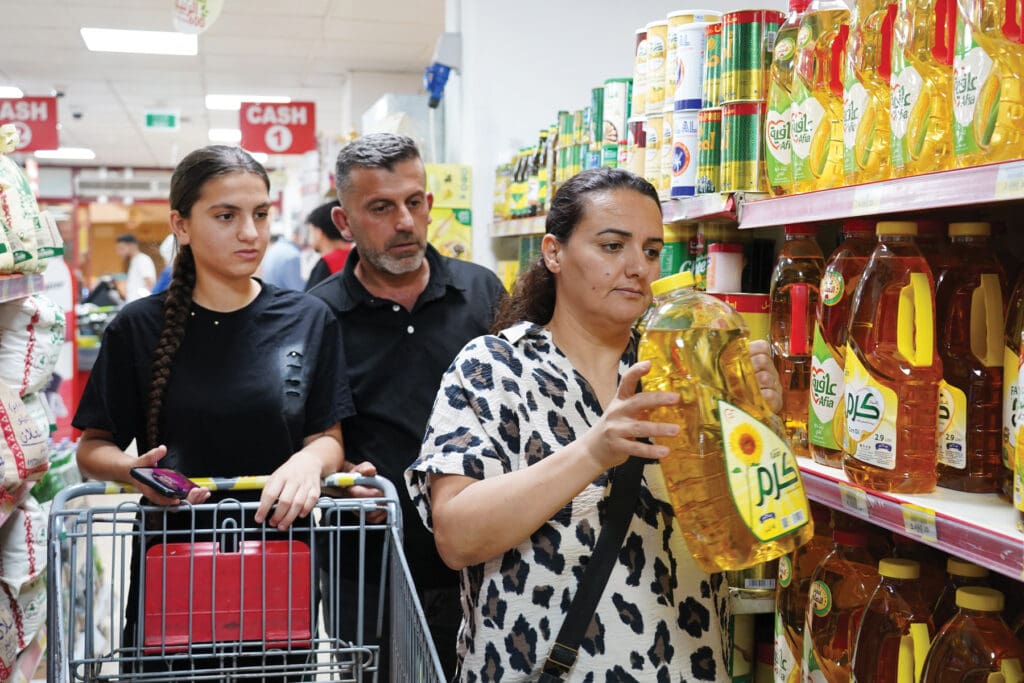
With the $70 food coupon she received from CNEWA-Pontifical Mission in June, she purchased chicken, as well as cooking oil, tomato paste, rice and shampoo.
“Today we bought expensive things, thanks to the food coupons,” she says.
Mr. Bahou says inflation has impacted the food coupon program. The increase in the price of meat “by at least 10 percent” this past year means “fewer people are able to afford it.”
This increased financial strain occurs against a backdrop of U.S. foreign aid cuts, starting in January 2025, and shrinking foreign aid budgets in European countries. The tourism sector, which accounts for 15 percent of Jordan’s gross domestic product, also ground to a halt in March, due to closed airspace and security concerns with the war in Iran, according to The Washington Institute for Near East Policy.
The UNHCR, which assists 440,000 registered refugees in Jordan, has been “highly impacted” by these cuts, says spokesman Yousef Taha.
“We had to reduce some services, such as cash assistance,” he says. By the end of May, the agency had received only 23 percent of the funding requested from international donors for 2026.
Jalal al Husseini, an associate researcher at the French Institute of the Near East, says refugees in Jordan “rarely go hungry, but limited access to health care puts them in danger.”
“Since the ’60s, the royal family has played a major role” in interfaith dialogue.
“If they are not insured and cannot pay for their health care expenses, they rely on local charities, churches, the UNHCR, N.G.O.s, as well as royal institutions and the [Jordanian] Zakat Fund, a government body that manages the distribution of alms and charity at the local level,” he says.
The Mother of Mercy Clinic located in Zerqa — an industrial city in Jordan that has welcomed Palestinian refugees since their expulsion from their lands in 1948 — has been providing health care services to refugees and other vulnerable groups for 44 years. The Dominican Sisters of St. Catherine of Siena have been running the clinic since 2001.
“The war has led to higher prices, and UNRWA [the U.N. agency for Palestinian refugees] limited their services, so we anticipate that more patients will come to us this year,” says Sister Maryan Khume, a medical doctor and director of the clinic.
“Before the war in Gaza, we used to see 40 patients per day. Now, we receive around 60,” she says.
The clinic provides free consultations for men, women and children; psychological counseling; as well as laboratory tests and medicines at a discounted rate.
“My patients’ salaries cannot cover more than the first 10 days of the month,” says Dr. Isaura Rajab, a gynecologist. She limits her prescriptions to “one or two medicines, as the patients cannot afford more.” She says the food they can afford, which is of poor quality, leads to deficiencies. She diagnoses anemia and sees “women losing their teeth around the fifth month of pregnancy.”
On 24 June, twins Houda and Lama, a week old and weighing less than four pounds, had their first visit to the clinic.
“My daughter came here during her pregnancy. They monitored her weight and blood pressure. She had her ultrasounds here,” says Hind Tarawoni, the twins’ grandmother. “They took very good care of her, and she didn’t pay anything.”
“Here we feel respected and really looked after,” the Jordanian woman says. “And when we told the team that my daughter was pregnant after nine years of trying, they were even happier than us!”
“The clinic is a blessing for the patients, and our patients are a blessing to us,” Sister Maryan says. “I am happy to see them coming with their families. It shows their trust.”
The CNEWA Connection
As some humanitarian organizations reduce operations in Jordan in the wake of cuts in foreign funding, CNEWA-Pontifical Mission has seen “a 10 percent surge in demand” for support, says Ra’ed Bahou, regional director of CNEWA-Pontifical Mission’s office in Amman. These requests come on top of the agency’s regular commitments: $95,000 to subsidize the annual budget of Mother of Mercy Clinic in Zerqa; $68,000 for the health care needs of 870 patients at the Italian Hospital in Amman; and $120,000 toward a yearlong food coupon program for 930 refugee families.
To support this crucial work, call 1-866-322-4441 (Canada) or 1-800-442-6392 (United States) or visit cnewa.org/donate.
Read this article in our digital print format here.