The ancient monastery of Deir Mar Musa clings to the pale red face of a rock formation in Syria’s Qalamoun Mountains, exuding a quiet peace. Isolated in the desert heights an hour north of Damascus, the last approach to the monastery can be done only on foot, climbing a grueling set of stairs carved into the rock.
Tourists and pilgrims have started returning to experience the monastery’s tranquility, now that the country’s 14-year civil war — marked by strife that killed more than 600,000 people and injured millions more — has ended. The monastic community also suffered during the war — losses that have sharpened, rather than diminished, its unique mission.
The contemporary history of the monastery began in 1982 with Italian Jesuit Father Paolo Dall’Oglio. While studying Islam and Arabic in Damascus, Father Dall’Oglio explored the ruins of the long-abandoned sixth-century Syriac monastery. Deir Mar Musa al-Habashi was dedicated to St. Moses the Ethiopian, who had converted to Christianity in Egypt after being dismissed as a slave of an official for choosing a life of crime and debauchery.
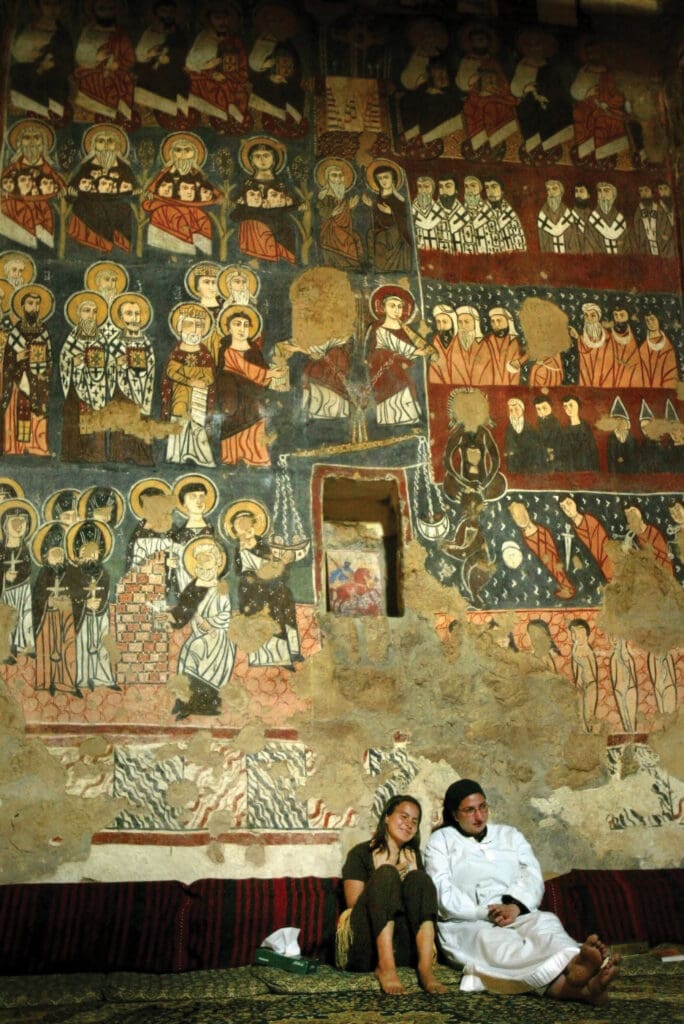
Father Dall’Oglio was captivated by the solid 11th-century structure, with its prominent 12th-century tower, simple dormitories that overlook the Syrian plains, and small chapel with 11th- and 12th-century frescoes depicting Christ’s baptism, the martyrs Sts. Barbara and Juliana of Nicomedia, and the apostles.
For centuries, the frescoes had been exposed to desert winds and neglect. With the help of archaeologists, art historians and volunteers over several years, Father Dall’Oglio secured roofs, repaired walls and restored the fragile images, ensuring they could speak again to a new generation of pilgrims.
Father Dall’Oglio’s vision for Deir Mar Musa extended beyond the restoration of an ancient church to the founding of a new monastic community dedicated to peacebuilding and dialogue with Muslims in the heart of the Levant.
Father Jacques Mourad, now the Syriac Catholic archbishop of Homs, joined Father Dall’Oglio in this mission of prayer, work, hospitality and interreligious dialogue; they formed a stable monastic community in 1991. The community was named al-Khalil, the Arabic honorific for the Hebrew patriarch Abraham, the father of Judaism, Christianity and Islam, known for his hospitality. Soon, visitors of all faiths from around the world began to arrive.
The allure of Deir Mar Musa is the feeling of “freedom in the desert … open like the heart of God,” said Archbishop Mourad.
For years, the monastery thrived as part of the local community, making inroads in Christian-Muslim relations and poverty-alleviation efforts, especially in neighboring al-Nabk.
To some, the community’s relationship with Islam was unorthodox. Archbishop Mourad said even he at first struggled occasionally with Father Dall’Oglio’s vision to love Islam and its adherents as part of their monastic call to follow Jesus and live out the Gospel. The monastery’s mission “is not easy to understand,” the archbishop said, but it is to be “a testimony of the love of Jesus for the Muslim community.”
“If you love those who refuse to love you back, this is the testimony of Christ,” he said.
The charism later expanded, with new monastic foundations in Sulaymaniyah, Iraq, in 2012, and Cori, Italy, in 2013. Currently, within the al-Khalil community, there are two monks, two nuns and two novices; in Iraq, there is one monk and one nun; and in Italy there is one nun.
Christians should be “the cement of the mosaic of Syria.”
Al-Khalil’s mission of hospitality unfolded in a country where political subjugation under the regime of Bashar al-Assad ran deep. However, the repression came to a head in 2011, when the Arab Spring arrived in Syria, prompting a swift and cruel crackdown by the government.
Fighting between rebels and government forces plunged the country further into violence. Father Jihad Youssef, the current abbot, said fighting was close to the monastery during the Battle of al-Nabk in January 2013. Army helicopters circled overhead, monitoring the monastery and bombing nearby.
Sister Carol Cooke-Eid, a German-born member of the monastic community, said the monastery went from about 50,000 visitors in 2009 to just a handful by 2013. As a result of the al-Nabk battle, residents went months without electricity or access to cell phone service, and no one was able to travel safely.
The emergence of Islamic State (ISIS) presented a clear threat of violence to the community as well. ISIS took advantage of growing instability in Syria to carry out attacks in pursuit of a caliphate. It targeted religious communities and showed violent contempt for Christians. Despite the challenges, al-Khalil continued during the civil war, although on a smaller scale, to offer respite, hospitality and opportunities for dialogue.
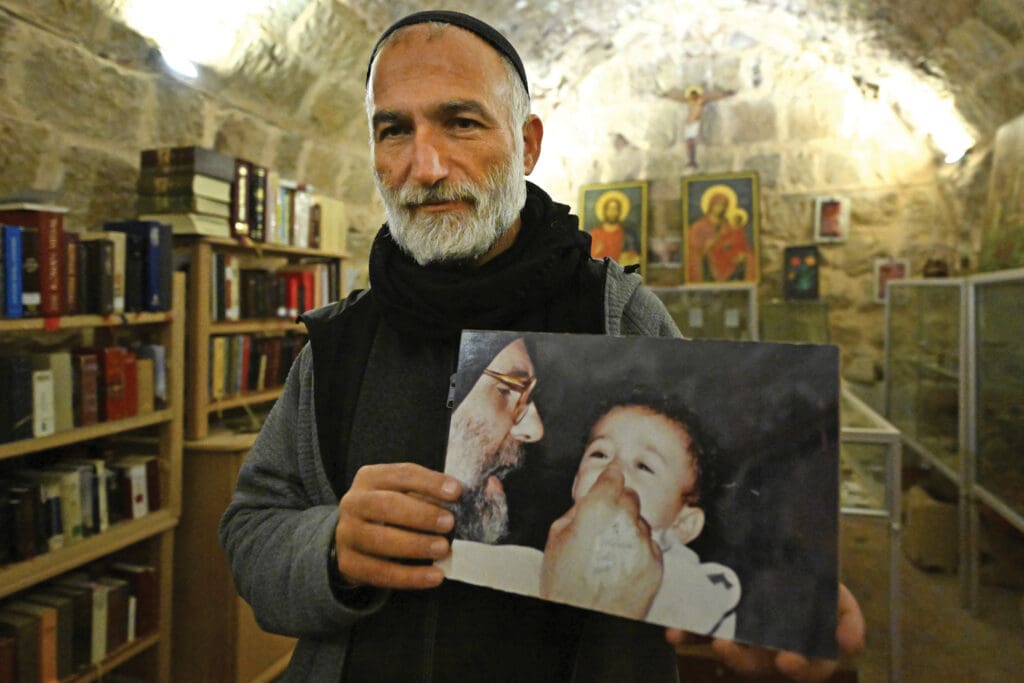
Father Dall’Oglio felt the need to speak up amid the violence and repression, and he published an article in support of government protesters. The government in turn ordered his expulsion in 2012. He left and found refuge in Italy and in Lebanon.
However, Father Dall’Oglio returned in July 2013 through Raqqa, northern Syria, to negotiate the release of friends from a group identified as Islamic State. He was never seen again and is presumed dead, although his remains have yet to be found.
Father Mourad, then pastor in the Syrian town of Qaryatayn, where he was working to
restore the Mar Elian Monastery, mourned the loss of Father Dall’Oglio, whom he had described as his “closest friend until the end.”
Soon after, the historic Christian community of Qaryatayn was targeted and, in May 2015, ISIS kidnapped Father Mourad and a deacon. They were held in Raqqa for almost five months, experiencing physical and psychological torture, before being transported to Palmyra, where 250 of Father Mourad’s parishioners also were held prisoner. Eventually, they were released back to Qaryatayn under the surveillance and rules of Islamic State, which had destroyed the Mar Elian Monastery that had been carefully restored.
He said the brutality he experienced deepened his faith as well as his love for his Muslim neighbors, who were the first to bring meals to him and his parishioners upon their return to Qaryatayn. Neighbors also later risked their lives to smuggle Christian girls and, eventually, Father Mourad, out of the community.
The allure of Deir Mar Musa is the feeling of “freedom in the desert … open like the heart of God.”
With the equilibrium restored with the retreat of Islamic State, Syrians started visiting Deir Mar Musa again. Nouhad Dergham first traveled to the monastery in 2009 with her parents and met Father Dall’Oglio. However, it was only as an adult, when she became interested in meditation and in the priest’s writings, that she visited again.
Ms. Dergham, now a young mother living on the outskirts of Aleppo, works with the monastery to compile and translate Father Dall’Oglio’s works. She also participates in the monastery’s efforts to “widen the space of our tent” by involving laypeople.
She said what she treasures most about al-Khalil is it “never presented itself as perfect, or as a ‘chosen community.’ They have always been vulnerable and accepted themselves as being at the will of God.”
Having emerged from years of darkness, the al-Khalil community has recommitted to its vision of hope and dialogue. It has restarted hosting events, from Ramadan retreats to visits by international groups, including foreign journalists, now returning to Syria since the civil war ended.
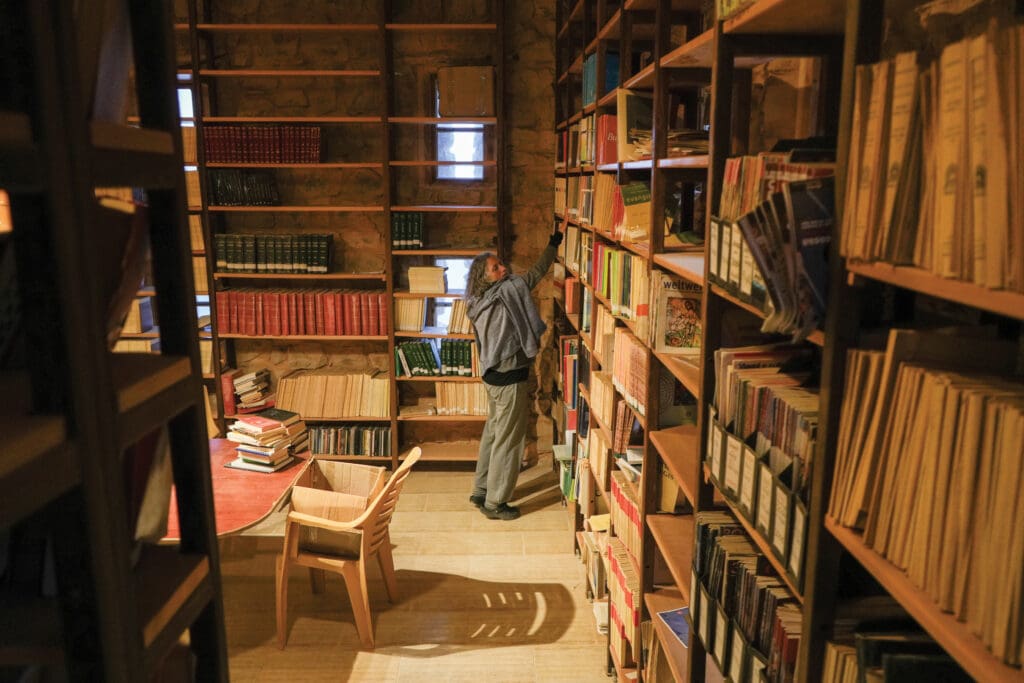
Visitors are greeted with warm bowls of “mulukhiyah,” a traditional jute stew on rice, topped with lemon. A day at Deir Mar Musa is bookended by worship in the chapel at sunrise and sunset. The time between prayer is filled with work — tending to the animals, cleaning the facilities, growing vegetables or studying in the cavernous two-story library with numerous titles on Islam and Christianity.
Over the years, only a handful of visitors have embraced a monastic vocation at Deir Mar Musa. Others have discovered “that their vocation was elsewhere — in marriage, with another religious community, in the diocesan priesthood, and so on, and these have left here happy and consoled, praising God,” says the community’s 2023 Christmas letter.
Despite his episcopal charge, Archbishop Mourad remains involved with the monastery and brings its vision of interreligious dialogue to his archeparchy. Last year, he approved the entirety of the monastic constitution written by Father Dall’Oglio; it had obtained the nihil obstat from the Holy See in 2006.
In late July, he celebrated a memorial outdoor liturgy for Father Dall’Oglio at the end of a four-day interreligious event at the monastery on ways to heal after Syria’s civil war. The liturgy was the first public opportunity in Syria to honor the priest’s life.
In speaking with ONE, Father Youssef acknowledged the immense loss the country experienced during the civil war. In 2012, Syria had about 1.5 million Christians, representing about 10 percent of the population; by 2022, that number had fallen to about 300,000.
He also described last year’s coup of the Assad regime and subsequent change in the Syrian government as “a golden opportunity” for the country to rebuild a peaceful and equitable state. Without the Assad government’s repression, and with the transitional government pledging to support democracy, interfaith dialogue might finally take place on a broader scale, he said.
Father Youssef was also hopeful those who were displaced will return to participate in this rebuilding, despite the concerns of violence against minority groups, such as the June suicide bombing at a Greek Orthodox church in Damascus during Divine Liturgy.
“We need social cohesion,” he said, and Christians should be “the cement of the mosaic of Syria.”
The CNEWA Connection
After a brutal 14-year civil war and the emergence of a new government, Syrians are seeking ways to rebuild and return to normalcy. An important step is recreating a sense of social cohesion and healing through efforts that promote peace, interreligious dialogue and reconciliation. CNEWA remains committed to supporting the church’s many initiatives in restoring and rebuilding Syria. These initiatives, like the programs offered by the monastic community at Deir Mar Musa, are open to Syrians of all faiths and creeds.
To support CNEWA’s mission in Syria, call 1-866-322-4441 (Canada) or 1-800-442-6392 (United States) or visit cnewa.org/donate.
Read this article in our digital print format here.