From the editors: This feature is the third in a series highlighting CNEWA’s milestones in the past 100 years and the ways in which the mission has adapted to the changing needs of the world of the Eastern churches. These articles will be assembled into a special commemorative volume titled, “A Century of Healing and Hope,” and published in 2027.
It may seem cliché — and perhaps insensitive — to cite how men of consequence have shaped world events in a series that chronicles faith-based initiatives in the pursuit of healing and hope, justice and peace. Yet, the story of CNEWA is shaped indeed by persons of consequence, men and women, who have read the signs of the times in the light of faith and responded to the humanitarian, socioeconomic and spiritual challenges of our volatile world.
In earlier installments this cast has included the names of once prominent figures, now largely forgotten, whose vision, leadership, grit and determination positioned CNEWA, and its operating vehicle in the Middle East, Pontifical Mission for Palestine, as a quiet and effective force of the Holy See — the very definition of “soft power.” Incontestably, the principal protagonist in this story is St. Pope Paul VI, whose solicitude for the land and peoples of the Middle East especially chartered the course of CNEWA. Surrounding the pontiff, however, assembled a supporting cast of men and women no less worthy, no less heroic or consequential.
One such figure is John Gavin Nolan.
“ ‘Thanks be to God I’m back safe. I never thought I’d make it out alive,’ ” wrote Msgr. Robert L. Stern in the pages of this magazine soon after the death of Bishop Nolan in November 1997 about a conversation he had had with the bishop years earlier.
“What happened?” I asked.
“Well, the last week I was in Saudi Arabia, two friends invited me to go with them on a trip into the Dead Zone, the great desert in the south. We were traveling by camel with two Bedouin guides. The second day into the desert, they couldn’t find the oasis where we had planned to spend the night. One of the guides went searching for it, but never returned. We kept going the next day, until we ran out of water.”
I was hooked. I was on the edge of my seat, wondering what would come next. Dramatically, he continued:
“That night the other guide vanished while we slept. My friends started to panic, but I told them not to worry. The next night the camels collapsed and died of thirst. …”
“Wait a minute,” I interrupted, “camels don’t die of thirst after three days.”
I suddenly realized that I had fallen for it again. Once more my boss, Msgr. (later, Bishop) John G. Nolan, had spun out a tale, plausible at first and then increasingly so far-fetched that it didn’t seem that it could be true — at least, not entirely true.
A priest of the Diocese of Albany, Msgr. Nolan joined CNEWA in 1962, first serving in Beirut, where he directed the activities of Pontifical Mission throughout the Middle East. A few years later he returned to New York to serve alongside his brother priest from Albany, Msgr. Joseph T. Ryan, who, as national secretary of CNEWA and president of Pontifical Mission for Palestine, had accompanied Paul VI in January 1964 on his historic pilgrimage to the Holy Land.
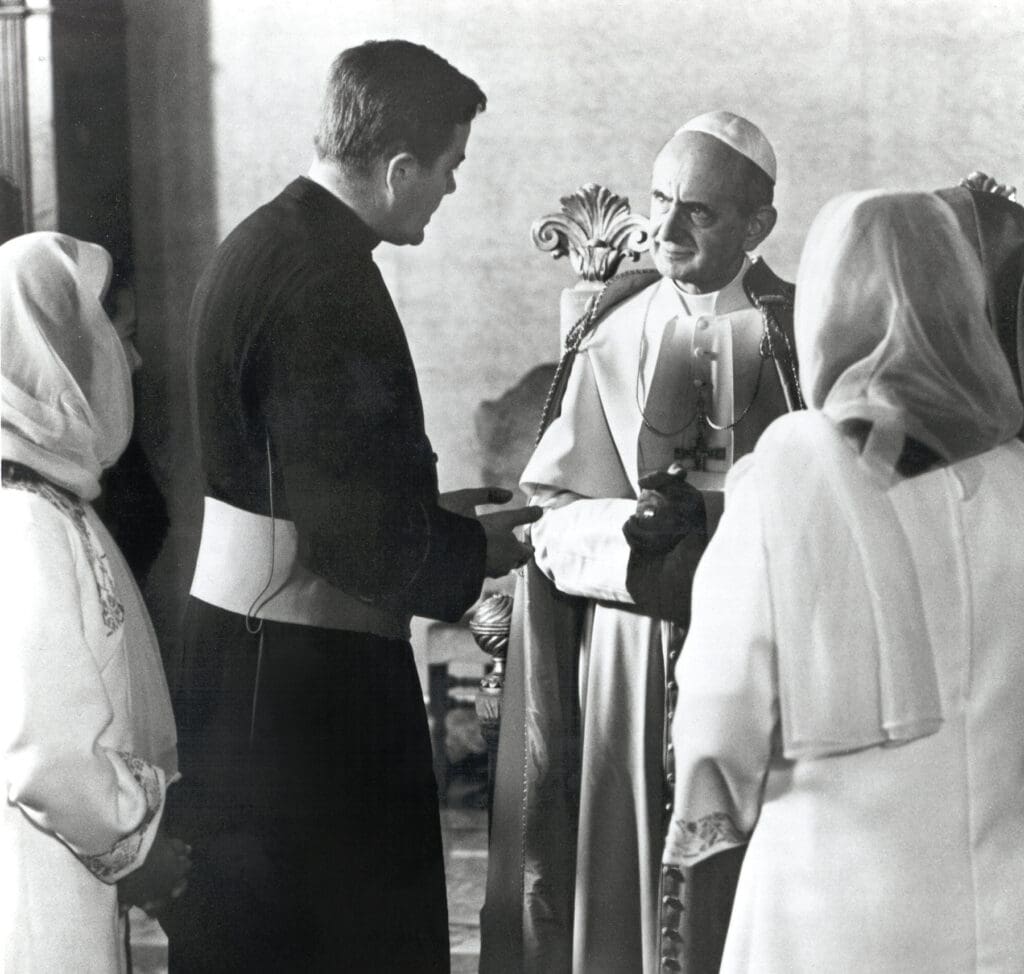
The consequences of that journey would make an indelible mark on CNEWA. While the burden of responsibility first fell on the shoulders of Msgr. Ryan, it would be his confrere, Msgr. Nolan, who would carry things on when elected CNEWA’s national secretary in March 1966, after the pope appointed Msgr. Ryan as archbishop of Anchorage.
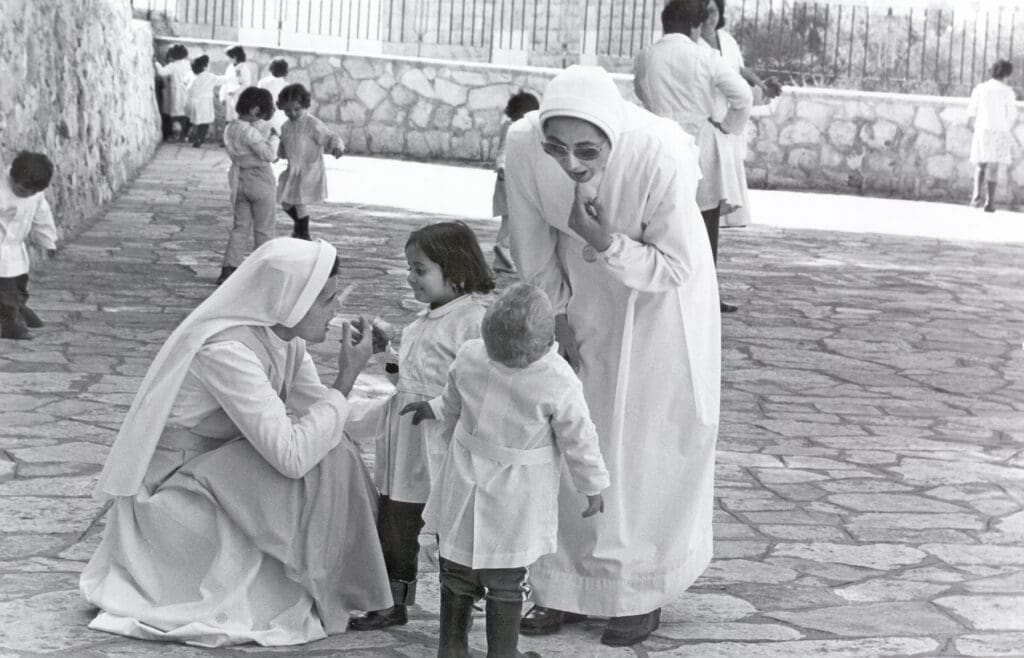
“His heart was always in the Holy Land,” continued Msgr. Stern, who succeeded Bishop Nolan in 1988. “As did his predecessors, he spent every Christmas there. He always shared in the ceremony and splendor of Midnight Mass in Bethlehem. Then, Christmas morning, he would go to the Pontifical Mission Girls’ Orphanage and offer Mass for them. After, with the children gathered around him, the celebrant would become Santa Claus, giving each of them her gift.”
“This is my parish,” he would say with deep feeling. “This is my family.”
Wherever he went, whomever he was with, he would spin them a fascinating tale, but end up asking them to sponsor a child. His imagination was so great that he always imagined others would respond with the same love he had.
And they usually did. When Msgr. Nolan concluded his service with CNEWA — having been appointed auxiliary bishop for the Archdiocese for the Military Services, U.S.A., serving once again alongside his friend Archbishop Ryan — CNEWA’s average annual income had soared from about $4 million to more than $18 million. Much of this income was associated with CNEWA’s Needy Child Sponsorship Program, which at its height enrolled more than 30,000 children in child care programs of the Eastern churches from Argentina to India.
Early in his tenure, Msgr. Nolan conceived of a fund to be marketed as a one-to-one sponsorship plan in which CNEWA would invite sponsors to contribute $10 a month toward the support of a specific child in the care of a church-run facility. Sponsors in turn would receive letters from the religious sisters or priests caring for the child four times a year.
He enlisted the support of the Rev. John McCarthy, an American priest serving the Holy See’s Congregation for the Eastern Church, as its liaison to CNEWA, persuading the priest to embark on a 70-day fact-finding trip to identify qualified programs in 12 countries. Father McCarthy returned on 6 January 1967, “exhausted,” he confessed in an interview with this author years later, but convinced of the need for such a program, which Msgr. Nolan promptly began within the month.
From that day forward, Msgr. Nolan was a tireless advocate on behalf of these children in need. As Peg Maron, who helped document the history of CNEWA, wrote in 2001: Whether “in elevators, at dinners, at meetings, he would beg friend and stranger alike to sponsor his ‘kids.’ ”
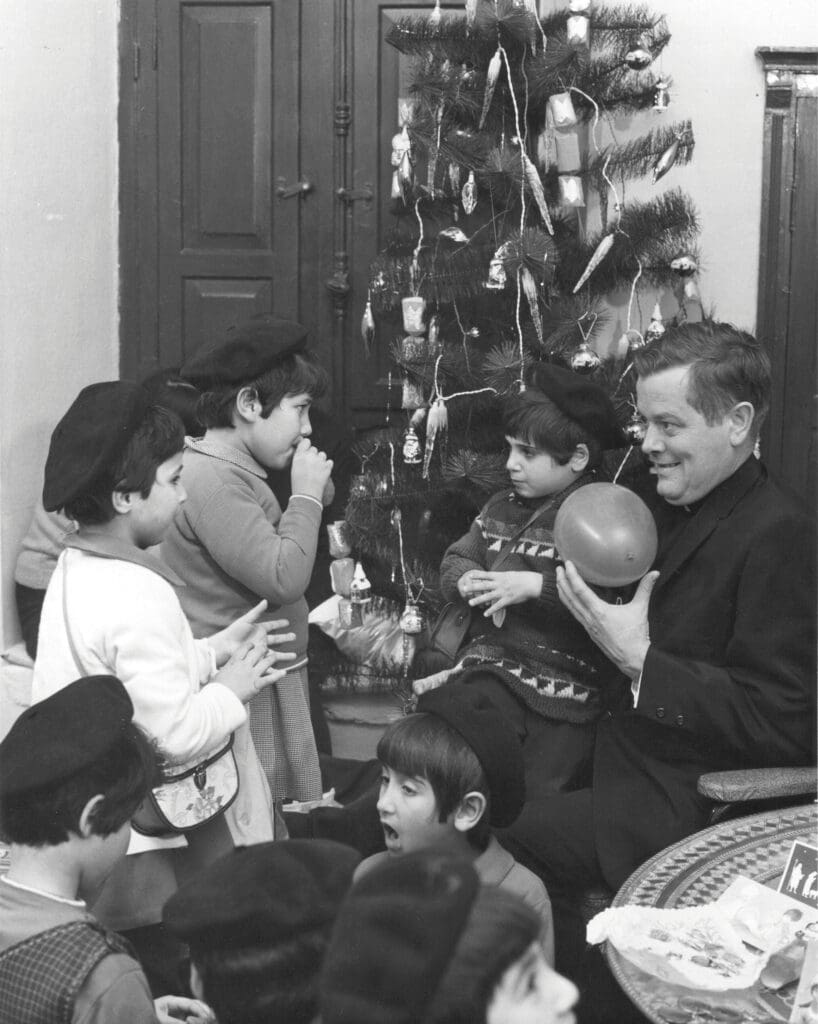
“The needy child sponsorship program that Msgr. Nolan started,” Msgr. Stern continued, “helped not only those little girls in Bethlehem, but tens of thousands of children all over the world.”
Ever the showman, Msgr. Nolan selected three of these children to appear in a promotional film about CNEWA’s work in the Holy Land. Milton Fruchtman, who won Peabody Awards for his documentaries, produced “The Untold Story” in 1970. The film included the first-ever record of a private papal audience, featuring Msgr. Nolan, three girls from the Pontifical Mission Orphanage in Bethlehem, Sister Elisabeth Marie of the Missionary Sisters of Our Lady of the Apostles, who ran the orphanage, and the pope. Hugh Downs hosted the 30-minute special, which focused on the work of CNEWA-Pontifical Mission with children throughout the Holy Land, which aired nationally on Christmas Eve 1971, with an estimated viewing audience of five million.
Msgr. Nolan’s gift with people and storytelling came in handy for, not long after he took the helm at CNEWA-Pontifical Mission, the situation in the Holy Land deteriorated. It took on a new level of urgency even as he strengthened longstanding partnerships and moved forward with programs inspired by the papal visit in 1964.
For nearly two decades, more than a million Palestinian refugees — homeless, stateless, desperate, angry and dependent on foreign sources for humanitarian and moral support — turned their frustrations on the state of Israel. Some joined resistance and national movements that launched attacks from bases in nearby Egypt, Jordan, Lebanon and Syria, provoking sharp Israeli reprisals that exacerbated poor relations among the neighboring states until 5 June 1967, when war erupted.
Within a week, the Israeli military defeated the combined forces of Egypt, Jordan and Syria, and occupied the Old City of Jerusalem and the remainder of Arab Palestine, which then included the West Bank, Gaza, the Sinai Peninsula and the Golan Heights.
Overnight, a second wave of displaced Palestinian civilians, many dispossessed a second time, fled the imposition of martial law by the occupying Israeli military and sought refuge with their neighbors. Already burdened with the weight of a people suffering from anguish and desperate with no prospects of ever returning home, the governments of Jordan and Lebanon nearly collapsed as war raged there (Jordan,1970-71; Lebanon, 1975-90), when the Palestinian resistance movements took on the leaders of their host nations.
The effects of what is commonly called the Six-Day War — a continuation of the first Arab Israeli confrontation — have been calamitous, and remain behind much of the troubles in the region today. Yet, the global Catholic community has remained ever close to “these brothers and sisters of ours,” as Paul VI stated in his 1974 apostolic exhortation, “Nobis in Animo,” “who live where Jesus lived and who, in the vicinity of the holy places, are the successors of the very first church, which gave rise to all the other churches.”
Immediately after the cessation of hostilities, CNEWA organized a conference in Beirut of regional nongovernmental organizations, Catholic and secular. Chaired by Constantine C. Vlachopoulos — a former official with the United Nations Relief and Works Agency for Palestine Refugees in the Near East (UNRWA), recruited by Msgr. Nolan in 1966 to serve as executive director of Pontifical Mission for Palestine — the organizations assessed the short- and long-term humanitarian needs and planned a coordinated response to assist those Palestinians remaining under military occupation in the West Bank and Gaza and the refugees living in exile.
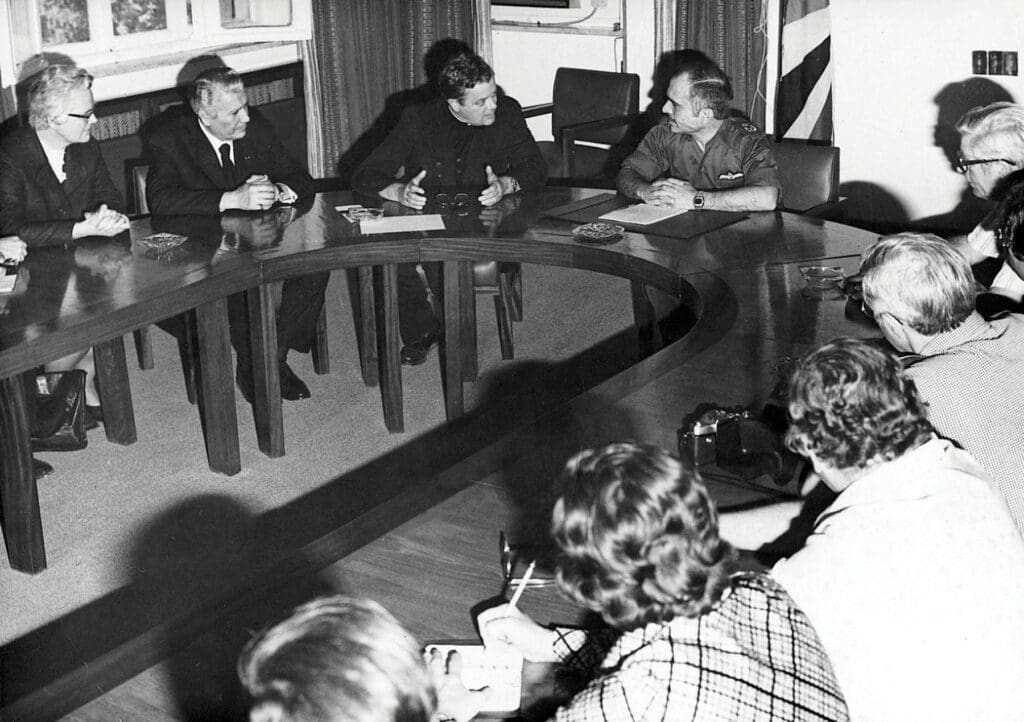
Concurrent with the conference, the Holy See dispatched Msgr. Nolan to the region. In his subsequent report to Cardinal Angelo Dell’Acqua of the Secretariat of State, dated 29 June 1967, Msgr. Nolan reported that Palestinians “in the area newly occupied by the Israelis are still emigrating to the East Bank [Jordan] … with travel assistance as far as the Jordan [River] provided by the Israelis,” adding that “once they leave, these people are not permitted by the Israelis to return to their homes in the West Bank.
“The economy of ‘old’ Jerusalem and the West Bank, tied so closely to tourism, is virtually at a standstill. … Religious institutions are also without cash as all bank deposits have been frozen by the Israelis.
“While continuing its activities in Lebanon, the West Bank and, hopefully, the Gaza Strip,” he added, “the [Pontifical Mission] will set up an office in Amman to assist the 100,000 new refugees there …”
That week, Msgr. Nolan and Mr. Vlachopoulos assembled an “emergency team” in Amman, led by Carol Hunnybun, the administrator of the Jerusalem office. The team began receiving, sorting and distributing relief supplies donated in support of the refugees from throughout the Catholic world, which included some 5,600 tons of food and milk powder; 26,700 blankets; more than 50 tons of clothing and shoes; 90 tents; 10,000 mess kits; 5,500 cooking stoves; 17 tons of medical supplies, antibiotics and vitamins; and more than 1,000 tins of potted meat.
The crisis response work of CNEWA’s Pontifical Mission team in Amman was replicated elsewhere, including Gaza, where the Pontifical Mission School for the Blind was devastated during the six days of fighting, its records destroyed and supplies and equipment looted. Quickly, CNEWA renovated and reopened the school, as did other social service works of the church, particularly in the West Bank and Jerusalem, where religious communities of men and women had long operated schools, foundling hospitals, homes for the aged and those with special needs, trade schools and workshops. Nevertheless, the tide had turned, and the region’s Christians, most of whom were from the middle classes, began to emigrate in large numbers.
“We have already had occasion to express openly our anxiety at the decreasing number of Christians in the ancient regions that were the cradle of our faith,” Paul VI wrote in his 1974 exhortation. “Unfortunately, the local church is lacking in material means. It is also suffering from the serious and prolonged consequences of the war that, it can be said, has been going on for decades. And it is not possible to ask the local faithful for sufficient help, since most of them have barely enough to keep themselves alive.”
Guided by the actions, words and vision of the pontiff, the global Catholic communion responded.
“Now Archbishop Pio Laghi was responsible for all the big breakthroughs in the Holy Land,” said Ms. Hunnybun.
In May 1969, the pope appointed him as his representative, or apostolic delegate, for Jerusalem and Palestine. In an interview with CNEWA in 1999, Cardinal Laghi described the pope’s instructions when he assumed the role: “ ‘Please try to limit the exodus of Christians [from the Holy Land]. Do whatever you can.’
The Mission will have to expect, in the situation, which is now evolving, to contribute to projects of aid, of rehabilitation and development.
“What could I do?” he reflected. “I established immediately a commission for justice and peace … and I gathered all the ordinaries: the Latin patriarch, the custos, the auxiliaries, the responsibles of the other Catholic communities, and we started to speak out.”
The prelate had many ideas, “but the ideas [could] not be implemented unless you had money and support. Not only financial support, but moral support as well.” The apostolic delegate found that support in Msgr. Nolan and CNEWA-Pontifical Mission.
“I immediately sympathized with him,” Cardinal Laghi recalled when he first met the young John Nolan, then stationed in Beirut as special assistant to CNEWA’s Msgr. Joseph Ryan.
“I knew he was a man I could work with, that we could understand each other. I relied on him and on those who represented him … Carol Hunnybun and Helen Breen.”
Together, this team forged partnerships worldwide, engineering housing programs, such as the Holy Land Arab Housing Society, repurposing facilities to address new needs, such as the opening of the Notre Dame Centre as a pilgrim hospice, and bolstering a host of existing programs that, while serving the common good, also supported the Christian community with employment, thereby stemming emigration. But there were several initiatives directly inspired by the pontiff’s pilgrimage to the Holy Land in 1964 that remain as symbols of that time.
“ ‘When I was there in 1964,’ ” Cardinal Laghi recalled the pope saying, “ ‘I promised to establish an institute for the deaf and mute. Please do it.’ ”
On 30 June 1971, with the approval of the Holy See, the Sisters of St. Dorothy and CNEWA-Pontifical Mission for Palestine founded the Ephpheta Paul VI Institute in Bethlehem, which for 55 years has taught hearing impaired Palestinian children from the age of 5 through high school to lip read and speak, freeing them from a prison of silence and isolation.
That same year, the Ecumenical Institute for Theological Research, or Tantur, opened — a realization of a wish of the pope to establish a place of shared prayer, study and dialogue, a place of encounter with Jews and Muslims.
But, the cardinal recalled just a few years after the death of Bishop Nolan, “We needed a university that would prepare young Palestinians for a Palestinian society. … We had to correct this. We had to establish a Catholic university in Bethlehem. … We needed a school to prepare chefs, tourism and hotel management, business and the arts. And we needed teachers. We had to prepare teachers.
“Now all this may seem insignificant, but in the Holy Land, if you build with a little stone, it becomes a monument.”
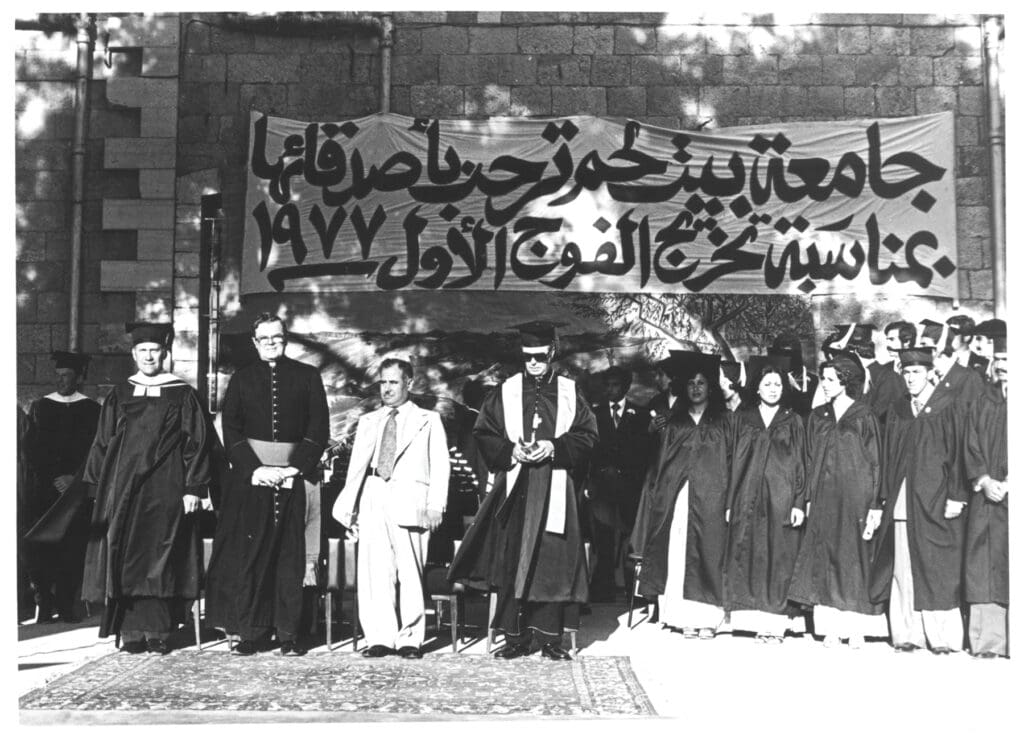
In 1973, the De La Salle Brothers of the Christian Schools, who Paul VI had asked to administer such a school, opened Bethlehem University with operating funds secured by CNEWA and the Congregation for the Eastern Churches. Despite the sociopolitical and economic challenges of operating in such a hostile environment, the university is indeed a monument to fortitude and hope, enrolling more than 3,000 students a year; 17,000 have graduated, men and women, Christian and Muslim, who, in the Lasallian tradition, continue to build and serve Palestinian civil society.
The exuberant embrace of faith and charity given by Paul VI, especially through those associated with CNEWA and its Pontifical Mission for Palestine, were not reserved exclusively for the peoples of Palestine. Marking its 25th anniversary, Paul VI wrote to Msgr. Nolan, “its diligent president,” that “we have followed with personal interest this activity in the various forms which it has taken to meet the grave and multiple needs of the refugees,” adding that its work “has been one of the clearest signs of the Holy See’s concern for the welfare of the Palestinians, who are particularly dear to us because they are the people of the Holy Land, because they include followers of Christ and because they have been and still are being so tragically tried.”
Nevertheless, he continued, “our Mission for Palestine is thus about to be faced with a compelling task. In addition to continuing its assistance without distinction of nationality or religion to those who have suffered or are suffering in any way as a result of the repeated conflicts which have devastated that region, the Mission will have to expect, in the situation, which is now evolving, to contribute to projects of aid, of rehabilitation and development.”
Msgr. Nolan, and his team of partners that included members of the laity and religious, took up this task, opening mobile medical clinics in rural Jordan and Gaza; setting up emergency aid programs for families besieged by factional warfare in Lebanon; covertly visiting the U.S. hostages taken in Tehran during its revolution; and quietly enlisting the support of wealthy oil magnates for Msgr. Nolan’s “kids.”
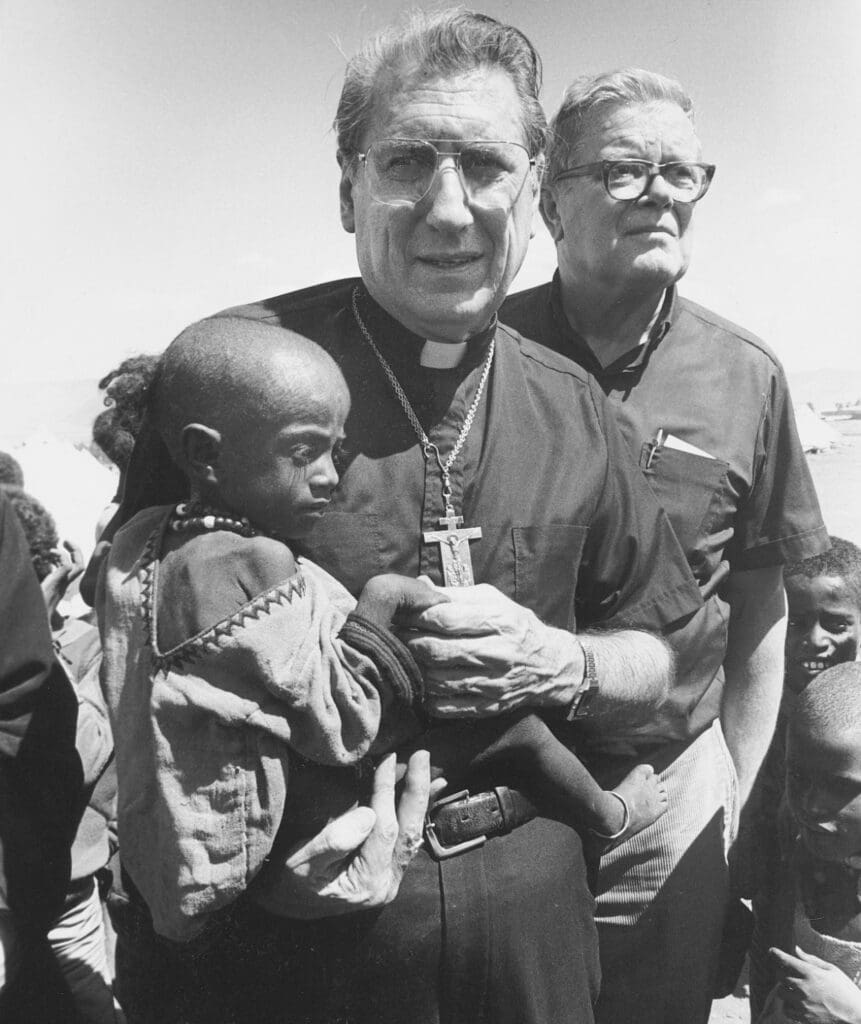
Toward the end of his years at CNEWA, as famine began to devastate Ethiopia, he took his good friend, John J. O’Connor — who then served as cardinal archbishop of New York and ex officio chair of CNEWA — to that ancient land, enlisting more support for its malnourished children and raising the profile of the needs of its people among Catholic and secular organizations alike.
Years later, at his funeral in a jammed St. Patrick’s Cathedral in New York, after all the tributes were paid and prayers said, that same cardinal said, “I knew that rascal pretty well myself,” affectionately reminding all those in attendance how this man of exuberance and faith was also a man with a deep reservoir of love and joy.
Read this article in our digital print format here.
Read the next installment in the December issue.