Wearing warm hats and winter coats, a small group of pilgrims pray the Hail Mary in hushed tones in a mountaintop church in Annaya, Lebanon. The church sits within Sts. Peter and Paul Hermitage, part of a monastic complex where the renowned Maronite monk, St. Charbel Makhlouf, lived for nearly three decades.
The thick stone walls of the hermitage block out January’s strong winter winds. The only sound is the footsteps of pilgrims on the ancient tile floor. As the pilgrims move from the church to the saint’s cell and then to the chapel, the silence is awash with solace and contemplation.
Shortly before nine o’clock, having finished their prayers, the pilgrims step out and find a dramatic view. Situated 4,300 feet above sea level and 42 miles north of Beirut, the site offers a panorama of Lebanon, from its snow-capped mountains to the Mediterranean Sea.
It is the 22nd day of the month, when thousands of pilgrims, Lebanese and non-Lebanese, gather in Annaya for the monthly pilgrimage in honor of St. Charbel, setting out along a winding road to the Monastery of St. Maron. Built in 1828 after the hermitage was established, the monastery houses the tomb and relics of the Maronite monk and hermit.
At the entrance to the monastery, some pilgrims collect and consume the soil from the site of the tomb where he was first buried. Then, pilgrims pray in St. Maron Church, light candles in the courtyard and pray before his actual tomb.
Alemnesh Tafara and Asrati Beletamengstu, two Ethiopian women who work in Lebanon, joined the January pilgrimage.
“I ask St. Charbel to heal me. He is the only one who can,” says Ms. Tafara, 46, who has breast cancer and is unable to afford health care. She and her friend, both domestic workers, attend the pilgrimage monthly and take sacred oils, water and oak leaves back to Beirut. St. Charbel used to pray in the shade of an oak tree, which later became a relic, from which pilgrims have taken leaves and bark.
Elie Bilem, 34, has attended the pilgrimage every month for 10 years in thanksgiving for his answered prayers.
“I asked him to find me work, and he did,” says the ski instructor and bar owner. “Here I feel calm, I reflect on what has happened in my life, and on what I will do next.”
St. Charbel was born Joseph Makhlouf in 1828 in Bqaa Kafra, a village of Mount Lebanon. He entered the Monastery of St. Maron, a monastic community of the Maronite Church, an Eastern church of the Syriac tradition in full communion with the bishop of Rome. At 23, he took the name Charbel after an early Christian ascetic. He was ordained a priest at age 31 and, after spending 16 years in the monastery, he retreated to the hermitage in 1875. There, Father Charbel led a secluded life, dedicating his days to prayer and work in the nearby fields, undisturbed by the tremendous societal shifts occurring in Lebanon at the time, including the transition from Ottoman rule to the rule of the French and British. He died on Christmas Eve, 1898, and was buried at the monastery, where an oily substance oozed from his incorrupt body for more than 60 years. He was canonized in 1977.
Since St. Charbel’s death, more than 29,680 miracles have been attributed to his intercession, says Father Louis Matar, O.L.M., monastery bookkeeper and member of the Lebanese Maronite Order, whose main task is to assess and record these miracles.
“Around 10 percent of them happened to non-Christians,” Father Matar says.
In January, the monastery recorded two additional healings, one in the United States and the second in Lebanon.
However, the miracle that catapulted devotion to the saint was reported by Nohad al-Shami, a mother of 12, who suffered a stroke on 9 January 1993, and was left partially paralyzed. Her eldest son, Saad, went to the hermitage the following week, 18 January, appealed to the saint and took blessed oil and soil back to his mother.
“I said to him, ‘Please heal my mother, we still need her, and, if you heal her, we will make your name known all over the world,’ ” said Mr. Shami, 72, during an interview in his home, surrounded by pictures and paintings of his mother.
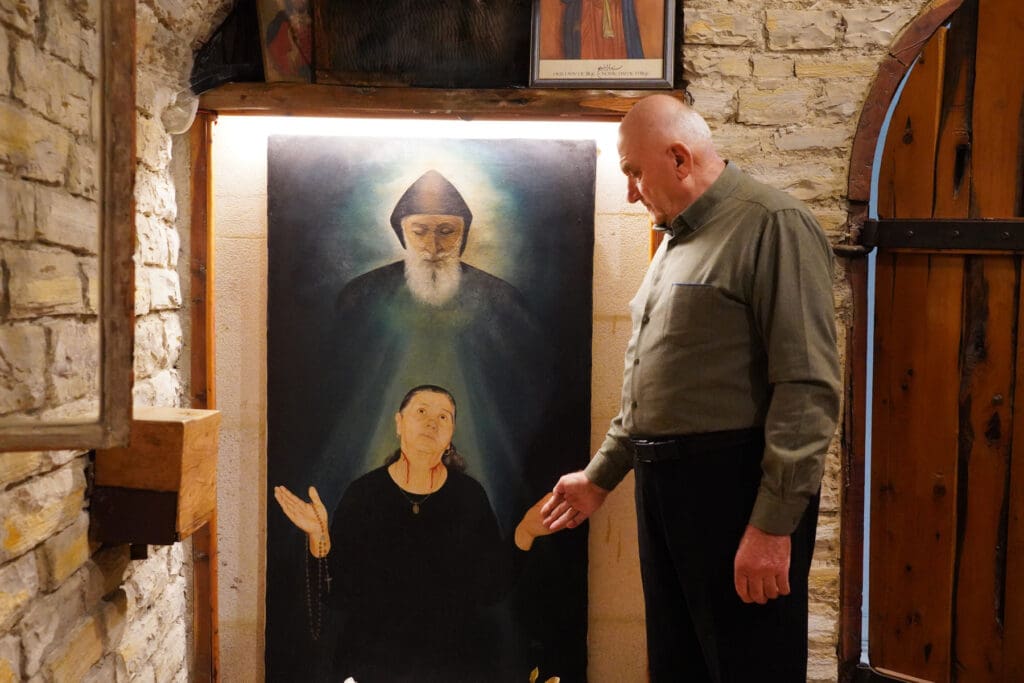
On 22 January 1993, Mrs. Shami had a dream, in which St. Charbel, accompanied by another monk, performed surgery on her and told her: “I performed the surgery to help people regain their faith. I ask you to visit my hermitage in Annaya on the 22nd of every month and attend Mass regularly for the rest of your life.”
When Mrs. Shami awoke, she had two neck scars. These scars opened and bled on the 22nd of each month. She did as St. Charbel instructed until her death last May.
“There are 10 million Maronites outside Lebanon, which helps spread the story of St. Charbel.”
Other people who have experienced miracles have shared similar stories of “surgeries” being performed on them in a dream.
Antonio Ishaac, 28, stopped all his treatment for Crohn’s disease in December 2024. In May 2025, he went to the monastery, consumed soil from the saint’s first tomb, and prayed to Jesus and to the saint, saying: “Either you heal me or I will die from this illness. I accept it.”
“After two days, during one entire night, I experienced the equivalent of two years of pain,” he recounts. “When I woke up, the pain had vanished. I took some tests several months later, and the disease had disappeared.”
His miracle was recorded at the monastery last October, along with a miracle reported by Nancy Nehme. A university English instructor, Ms. Nehme had been suffering from a herniated disk that caused debilitating pain in her back and leg.
“One night [in 2017], I had been praying to St. Charbel before a picture of him, but I could not sleep and I was in pain. So, I told him that I was disappointed in him and that I would not pray to him anymore, and then I felt guilty for saying such a thing,” she says.
“I ask St. Charbel to heal me. He is the only one who can.”
“I suddenly felt someone standing behind me in my bedroom and I was certain that it was St. Charbel,” she continues. “I felt two hands pressing hard on me and turning me upside down on my bed, when I heard a voice say, ‘Your body is going to see heaven.’ ”
An M.R.I. in 2024 indicated the disk was “back to normal,” she said. “Now, we often visit St. Charbel; he has become part of the family.”
Roula Talhouk, director of the Institute for Muslim-Christian Studies at Saint Joseph University of Beirut, says St. Charbel “is the most beloved saint for the Lebanese.”
Across Lebanon, St. Charbel, depicted with lidded eyes, a long white beard and a black monastic hood, is a familiar face. His image is in countless homes, hanging from rear-view mirrors and encased in outdoor shrines on street corners.
He “was Maronite, spoke our language — the Lebanese Arabic language — and remained present [spiritually] throughout all the wars and difficulties we faced,” Ms. Talhouk says.
“These miracles are extraordinary, and people enjoy them,” she adds. The monastery is open round the clock, which fosters a feeling of proximity to the saint, she says.
“All this makes it a place of pilgrimage and prayer for theologians, believers and anyone seeking quick answers. It is the place where one has the best chance of experiencing a miracle,” she says.
“It is very human, yet very beautiful: The Lebanese allow themselves to talk to St. Charbel in a filial way.”

The monthly pilgrimage to the Monastery of St. Maron can draw up to 30,000 people — Christians, Druze, Hindus and Muslims — and sometimes even 75,000 people, Father Matar says. Before COVID-19, some 4.5 million pilgrims visited the monastery each year.
“Now, with the war in Europe and the Middle East, we receive fewer visitors,” Father Matar adds. Still, the shrine will go through 13 tons of incense per year and up to five tons of candles per month.
In December, Pope Leo XIV became the first pope to visit the monastery and pray at St. Charbel’s tomb.
“He wrote nothing and lived a hidden and silent life, yet his reputation spread throughout the world,” the pope said of St. Charbel’s legacy.
“The Holy Spirit shaped and created him, to teach prayer to those whose lives were without God, to teach silence to those who live in noise, to teach humility to those who seek to stand out, and to teach poverty to those who seek wealth. All of these are situations that go against the tide, and that is why they are attracted to him,” he said.
Abbot Tannous Nehme recalls Pope Leo’s visit with great emotion, saying it “was a confirmation that the church’s journey begins with prayer, and St. Charbel’s life shows that the pursuit of God is our foremost duty.”
However, the saint’s renown has not prevented his misappropriation for partisan cultural and political agendas.
“In Lebanon, religion is exploited by politics,” Ms. Talhouk says. Statues up to 88 feet tall have been erected and large processions organized “to signal the strength of the Christian presence in certain areas.”
Yet, outside Lebanon and its partisan politics, St. Charbel continues to gain in popularity. Last November, a monastery dedicated to St. Charbel opened in France, while in New York the shrine dedicated to the saint in St. Patrick’s Cathedral draws thousands daily.
“There are 10 million Maronites outside Lebanon, which helps to spread the story of St. Charbel. And social media play a role as well,” as new miracles are announced on these platforms, Ms. Talhouk says.
“St. Charbel Makhlouf has become a universal saint,” says the Rev. Paul Matar, a priest of the Maronite Archeparchy of Beirut, who serves on the formation team at the patriarchal seminary.
The saint’s popularity “is not only due to his miracles, but to the depth of his God-centered life,” he says. He has observed how the saint “is celebrated in a manner that is popular, liturgical and deeply existential.”
St. Charbel “lived everything contained in the Scriptures.” His faith, “radically centered on God,” was marked by silence, prayer and “total self-sacrifice,” and his spirituality was “interior, faithful and persevering,” he explains.
“In a country marked by profound economic, political and social crises, St. Charbel thus becomes a companion on the journey.”
Read this article in our digital print format here.