The Old Bridge in Mostar stood for centuries as the signature landmark of the largest city in the Herzegovina-Neretva Canton. It spanned the Neretva River, connecting the Catholic and Muslim neighborhoods on either bank — a symbol of friendship between peoples.
However, the fighting that erupted in Bosnia and Herzegovina in 1992 destroyed the iconic 16th-century bridge, a UNESCO World Heritage site.
For almost four years, the country’s three principal communities — the mostly Muslim Bosniaks, Catholic Bosnian Croats and Orthodox Bosnian Serbs — engaged in a civil war, triggered by Yugoslavia’s dissolution after the fall of the Soviet Union.
As different states of the former Yugoslavia declared their independence, the longstanding ideology of “Greater Serbia” — a vision to gather “all Serbs” into one state by absorbing territories beyond Serbia’s current borders — reemerged strongly. The Republic of Bosnia and Herzegovina declared independence on 5 April 1992, and war ensued.
The human cost was shattering. Up to 101,000 people were killed or disappeared, more than two million were displaced — only one million eventually returned — and war-related sexual violence was widespread, estimated at up to 50,000 victims. The conflict left about 452,000 residential buildings — about 37 percent of housing at the time — partially or completely in ruins.
The war, fueled by the collapse of the federal system, rising nationalism and competing territorial claims, brought sieges — including the yearslong siege of the Bosnian capital, Sarajevo — ethnic cleansing and mass atrocities, culminating in the genocide at Srebrenica.
In July 1995, the Srebrenica enclave — designated by the United Nations as a “safe area” —sheltered around 25,000 Bosniaks under the protection of the Dutch U.N. peacekeepers stationed there. When Serb forces advanced, the U.N. peacekeepers requested NATO airstrikes but help never came and the Serb units entered the city.
From 11 to 15 July, they separated more than 8,000 Muslim men and boys from the women and other children, then executed the men and boys and buried them in mass graves. The others were evacuated, although some women and girls were raped and killed as well. This mass killing stands as the only recognized genocide in Europe since World War II.
Four months later, on 21 November 1995, the Dayton Peace Accords were signed in Dayton, Ohio — later signed ceremoniously in Paris on 14 December — ending the Bosnian War and establishing a fragile peace.
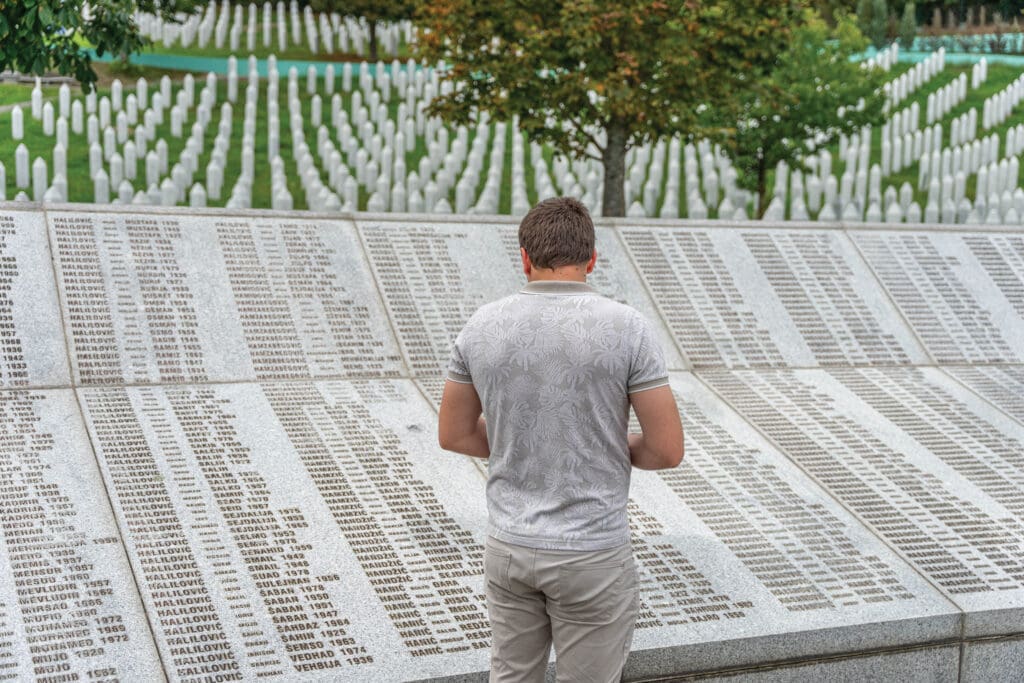
Today, in Potočari, a mere four miles from Srebrenica, the Srebrenica Genocide Memorial unfurls across soft, rolling hills, rows of white markers rising and dipping with the land — a topography of loss turned to prayer. Each July, newly identified victims are laid to rest. This year, on the 30th anniversary, seven more were buried, bringing the total to 6,772.
“On a personal, human, psychological and spiritual level, people need inner freedom … Some call it the liberation of memory, letting go of heavy remembrances.”
Thirty years since the genocide, the wounds and trauma of the war in Bosnia and Herzegovina remain. And not all Bosnians are united in their memory of the war, even as they work toward reconciliation and a lasting peace.
In Mostar, members of the Catholic, Orthodox and Muslim communities have been collaborating to rebuild their city. Bright murals now grace restored buildings, and the Old Bridge, rebuilt in 2004, links the two banks of the city once more — a symbol of reconciliation.
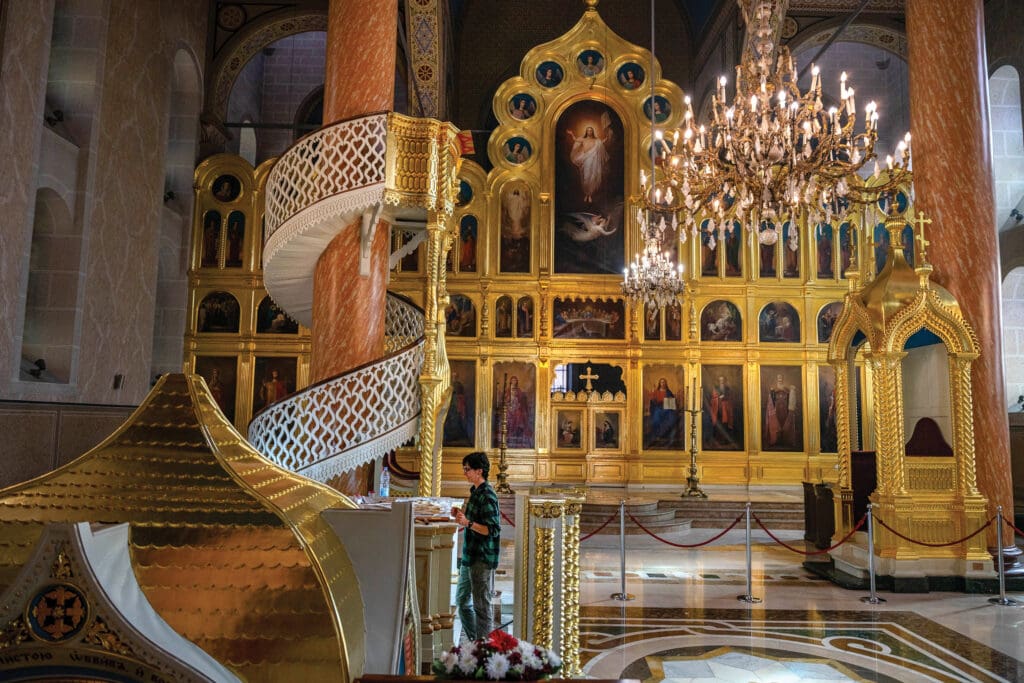
The war damaged or destroyed Mostar’s places of worship, including Holy Trinity Serbian Orthodox Cathedral. The building remains standing, but resembles a shell, as the interior is largely unfinished. Regular liturgies have yet to resume. The progress since the restoration, started in 2011, remains uneven, hampered by intermittent funding and strict heritage regulations. Theft, vandalism and bureaucratic and political hurdles have stretched the timeline.
In September, the steady tap of hammers filled the nave. The supervisor on the job site, a Bosnian Croat who identified himself as Radmilo, was installing a marble mosaic on the cathedral floor. He and his Catholic Croat crew were racing to complete the installation by Christmas.
“When we take on a project, it doesn’t matter whether it’s Catholic or Orthodox,” he says. “We simply work together.”
“I was there. I know how it was. The media and politicians keep playing with the facts.”
It is daybreak when Mersudin Hasanović rolls in from his night shift at one of the four border crossings with Serbia. He and his wife, Ismeta, rent several rooms on the upper floor of their home in Srebrenica. He exchanges pleasantries with his guests while Ismeta makes breakfast in the kitchen. The air hangs with the smell of eggs and strong coffee; on the table are fresh vegetables, homemade cheese, a crisp baguette and a spicy vegetable relish.
Mr. Hasanović was 14 and living in Raðenovići, a Bosniak village about 25 miles southeast of Srebrenica, when the war began. After feeding their livestock each morning, he and his family would “head into the forest to hide and survive the shelling.”
“We were heavily shelled from the Serbian side,” he says. “The Yugoslav People’s Army was effectively fighting the Bosnian Serbs.”
He clearly remembers 7 July 1992, the day he survived by a hair’s breadth. Soldiers across the Drina River — in what was then Serbia — opened fire at him and other Bosniak boys with a heavy anti-aircraft machine gun.
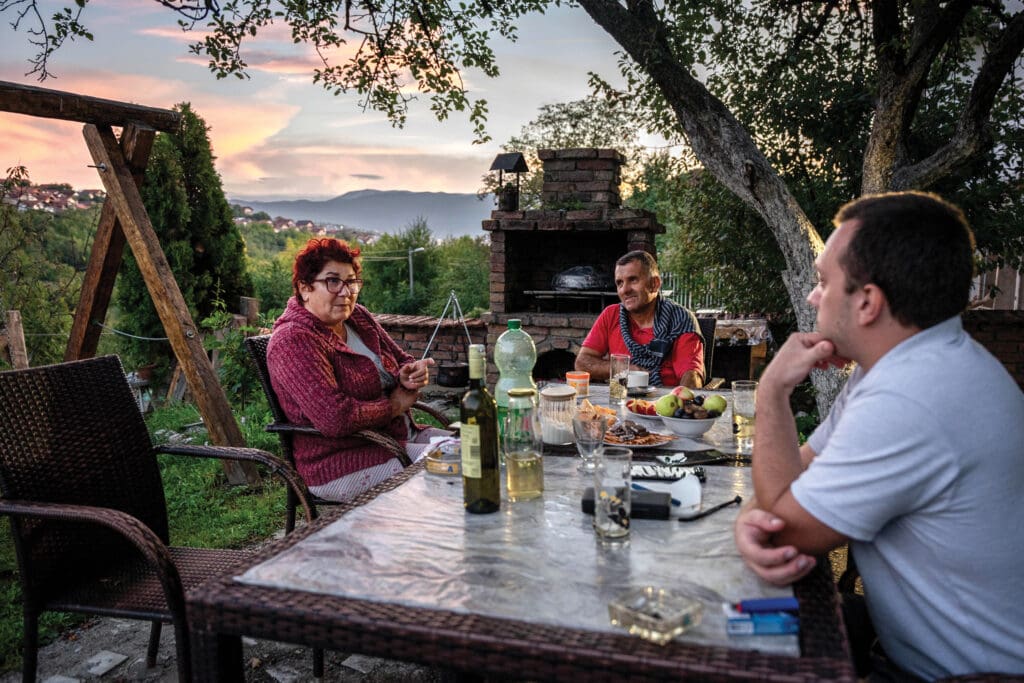
“It’s a strange feeling, hearing bullets whistle past and explode in the ground right beside you while you run as hard as you can,” he recalls. The following March, he fled Raðenoviči.
Before the war, he says, no one fixed on religious identity. “On our street, most were Muslims, but many men married Serb women. We were friends,” he says. But then, things changed.
“At first, they played on Serb fear and vulnerability, and that fed the surge of nationalism. Institutions split. Propaganda flipped reality,” he says. “In the end, there were no real winners in the war, only a few profiteers.”
Mr. Hasanović and his wife have not turned on the news in about 15 years. They and their two children watch only films and streaming platforms.
He describes Srebrenica’s cultural life today as vibrant. With international support, time and the community’s own work on trauma, the town is steadily moving away from its reputation as a place of unending grief and horror.
“When I came back in 2004, I still hated Serbs,” he says. “My uncle was killed in that war. There was too much to carry. Then I realized it was destroying my health. I’m a believer. I believe everyone will receive what’s due, if not now, then later.
“You can’t build your happiness on someone else’s grief.”
“Dialogue is the instrument of civilized people in their search for solutions.”
In many towns, the families of victims live next to those believed to have perpetrated war crimes. While the war ended, the question of justice remains open.
Among those committed to peacemaking in the country is the minority Catholic community that makes up about 15 percent of the population.
“As Catholics, we believe that in Bosnia and Herzegovina — and everywhere people live in conflict or post-conflict realities — it is essential to preach forgiveness and reconciliation,” says Archbishop Tomo Vukšić of Sarajevo.
“But beyond words, what matters even more is to bear witness in practice: to show, through concrete examples, that we have forgiven those who caused harm and that we want to build reconciliation among people.”
The archbishop serves on the national interreligious council with Muslim, Orthodox, Catholic and Jewish leaders. The council was founded in 1997 to promote dialogue, reconciliation and social cohesion.
“Overall, the trends in Bosnia and Herzegovina are positive,” he says. “There is growing rapprochement and cooperation, although misunderstandings do occur.
“I have often said: There is no morally acceptable alternative to dialogue. Dialogue is the instrument of civilized people in their search for solutions.
“This never excludes the application of just laws — that is the task of the state and those responsible for it. Yet on a personal, human, psychological and spiritual level, people need inner freedom,” he adds. “Some call it the liberation of memory, letting go of heavy remembrances.”
Reconciliation at a national scale is a complex process that extends beyond roundtables and chanceries.
Sabina and Amir Zekić live in a neighborhood of detached homes in Sarajevo, the country’s capital, on the southern slope of Mount Žuč, about eight miles north of the city center.
The hill overlooking the city was a strategic point during the war and the site of a battle, where the army of the newly formed Republic of Bosnia and Herzegovina successfully repelled Bosnian Serb forces on 8 June 1992.
The Zekić family lived in Sarajevo throughout the war and the city’s nearly four-year siege. Today, the Bosniak couple rents out rooms in their home to travelers; inevitably, the two have become conversation partners on the war. Many visitors pause in front of the building next door, pocked with shrapnel.
“A shell hit here,” Mrs. Zekić explains. “My father-in-law was killed. My husband’s sister was wounded. Everything was shattered and burned, but we rebuilt.”
As a hospital nurse during the war, she saw death, fear and despair she still finds difficult to discuss. A report by the International Criminal Tribunal for the former Yugoslavia reports more than 9,500 casualties of the siege, while other sources list more, among them more than 1,000 children.
“During the shelling, we hid with our Serb neighbors,” Mrs. Zekić recalls. “Then their son suddenly left ‘for the other side.’ Later the whole family emigrated to the United States and never came back. He was declared a war criminal. People said he had taken part in killings.”
Mrs. Zekić has worked with people of other faiths throughout her life — even during the siege.
“Where politics didn’t interfere, relationships stayed normal,” she says. “We didn’t understand why this war was needed. Ordinary people didn’t start it. It was politics. And when politicians decided to stop, the war ended.
“We still live peacefully now, but turn on the TV, and the split begins. Different channels tell opposite versions of events,” she continues. “I was there. I know how it was. The media and politicians keep playing with the facts.”
Mr. Zekić nods in agreement.
“I lost my father and three sisters,” he says. “Our family scattered. We stayed. Now I have my wife, my sons and a fragile peace. That’s what matters.”
In a country where religious affiliation was closely identified with violent conflict and atrocities, the separation of religion and state as foundational for peaceful coexistence enjoys broad support. According to a survey by the International Republican Institute in 2017, 79 percent of Bosniaks, 78 percent of Bosnian Croats and 79 percent Bosnian Serbs prefer a secular state.
However, a USAID youth survey conducted five years later found the highest percentage of Bosnian youth, 42 percent, express the greatest trust in religious institutions over other public institutions, even though they remain critical of institutions overall.
Religious communities remain vital in Bosnian society, and it is precisely at the intersection of the secular and the religious that trust takes root.
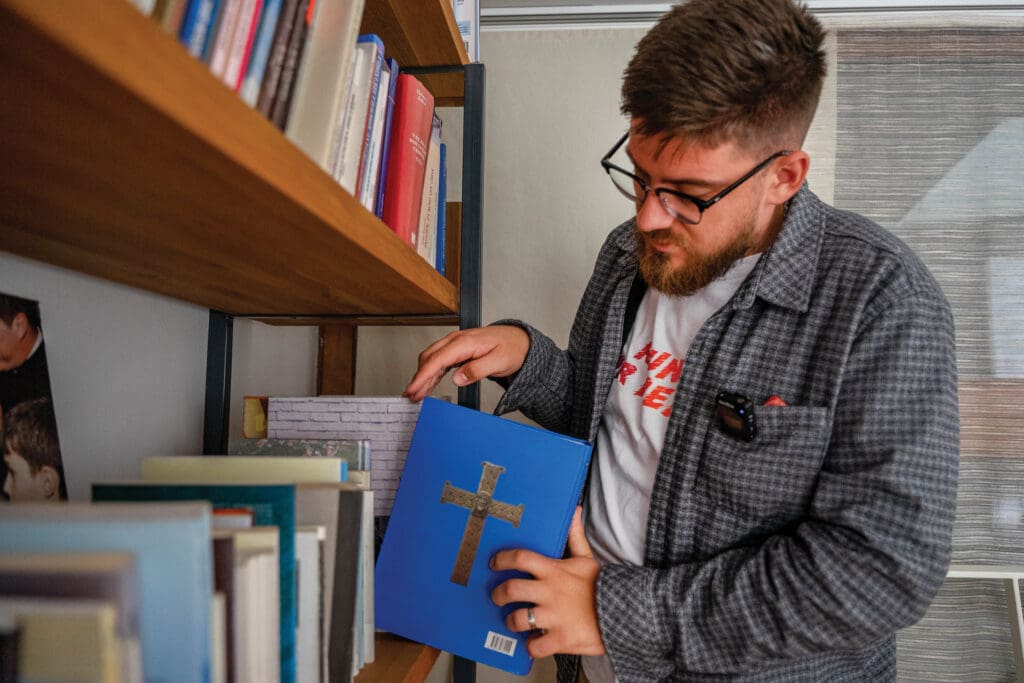
The Archdiocese of Sarajevo’s John Paul II Youth Center has been forming young adults in interreligious dialogue and reconciliation since its founding in 2007. Father Šimo Maršić says he conceived of the center as “a place where young people could meet, learn and build a future together regardless of confession.”
It draws young people of all faiths, hosting ecumenical and interreligious initiatives, from volunteer projects and training sessions to sporting events and field trips. Pope Francis visited the eight-story building in 2015, blessing it as a space of dialogue and hope.
Its flagship program, “Let’s Take a Step Forward Together,” is one of the region’s most successful interreligious initiatives. The center is developing youth outreach on social media and other digital platforms.
“We hold peace conferences, organize a Run for Peace, and support local projects where youth from different religions play on the same team. That builds trust,” says Father Maršić, who also teaches in the Catholic faculty of theology at the University of Sarajevo.
This year’s run drew about 200 teens. Father Maršić reviewed the results of the run with Željko Maksimović, the project coordinator and a member of the Orthodox community.
“Our Orthodox youth center collaborates with the John Paul II Youth Center,” Mr. Maksimović says. “Everything that creates a platform for meeting and dialogue is in demand: joint sports, educational sessions, exchanges — what matters is doing something together.”
The activities are organized through schools and have strong parental support. Each year, the center publishes “Little Steps,” a collection of successfully completed initiatives.
“The most important thing is the encounter,” Mr. Maksimović says. “At events like this, kids meet, talk and step over invisible boundaries. Dialogue is the key. Big steps start small.”
Despite public optimism, in private conversations — around kitchen tables, at markets, among friends — the same anxiety surfaces again and again: fear of a revenge cycle by one side or another. Propaganda feeds the desire for and the fear of retribution.
“It is hard to gauge how much the desire for revenge resides in particular people,” Archbishop Vukšić says. “That, like forgiveness, is bound up with personal stories.”
“When we speak of forgiveness, we are not calling for the suspension of just laws or for leaving evil unpunished. Forgiveness and reconciliation free the conscience and the soul; they are striving for the good,” he says, underlining distinctions vital in the lengthy process of reconciliation.
“Justice belongs to the courts, the police, the law. Reconciliation is always the liberation of the heart.”
The CNEWA Connection
Thirty years after the Bosnian War, the work of peace and reconciliation continues. Neighbors work together to rebuild trust. Religious leaders work on local councils. Each 11 July, the United Nations commemorates the International Day of Reflection and Commemoration of the 1995 Genocide in Srebrenica, Bosnia and Herzegovina. The work of seeking justice, peace and reconciliation through dialogue with “the other,” whether in Eastern Europe, Northeast Africa or the Middle East, remains a key component of CNEWA’s mission.
To support CNEWA’s work in advocating for peace and dialogue, call 1-866-322-4441 (Canada) or 1-800-442-6392 (United States) or visit cnewa.org/donate/.
Read this article in our digital print format here.