Despite the ongoing conflict in the Middle East, Pope Leo XIV’s first foreign apostolic trip included Lebanon, bringing hope to people who have faced a series of crises and calling on them to step up as peacemakers in the region.
From 30 November to 2 December, people lined the streets with Lebanese and Vatican flags; they filled churches and cheered “Viva il papa!” Those few days served as a “renewal for the Lebanese,” said Michel Constantin, director of CNEWA-Pontifical Mission’s regional office in Beirut.
In line with the theme of his visit, “Blessed be the peacemakers,” the pope urged peace in his meetings with government officials, religious leaders and the faithful. He also stressed the responsibility of the church and the state toward the people, especially the poor.
The past six years have been challenging for the Lebanese, who experienced their country’s political breakdown and one of the world’s worst economic crises, exacerbated by the 2020 Beirut port blast and war with Israel.
According to the World Bank, even before hostilities began between Israel and Hezbollah in October 2023, more than 70 percent of the country was experiencing multidimensional poverty, which includes monetary poverty, education and basic infrastructure services.
In this context, Pope Leo’s visit offered “three days of hope,” said Maronite Bishop Michel Aoun of Jbeil, president of the Assembly of Catholic Patriarchs and Bishops in Lebanon.
“It provided a roadmap for the government, the politicians and for us, the people of the church,” he said.
Bishop Aoun, who coordinated the church committee for the visit, said Pope Leo urged government officials “to listen, first and foremost: Peace can only be established on the basis of truth and forgiveness.” The pontiff also encouraged the local church “to be present, compassionate, and close to others,” he added.
Greek Orthodox Metropolitan Antonios al Soury of Zahle, Baalbek and their dependencies said the pope “planted joy and compassion everywhere he went.”
In his various speeches, Pope Leo spoke about reconciliation within Lebanese society, building on the “purification of memory” that St. John Paul II had called for during his 1997 visit.
“There are personal and collective wounds that take many years … to heal,” Pope Leo said.
“If we do not work … to bring together those who have suffered wrongs and injustice, it is difficult to journey toward peace,” he told Lebanese leaders, including several former heads of militias from the Lebanese Civil War.
“You are a people who do not give up, but in the face of trials, always know how to rise again with courage,” he said.
His visit to the Shrine of St. Charbel, located at the Maronite monastery of Annaya, about 35 miles north of Beirut, on 1 December drew a lot of media attention. There, he prayed before the tomb of the saint, much beloved in Lebanon and throughout the world; about 30,000 miracles have been attributed to the intercession of St. Charbel.
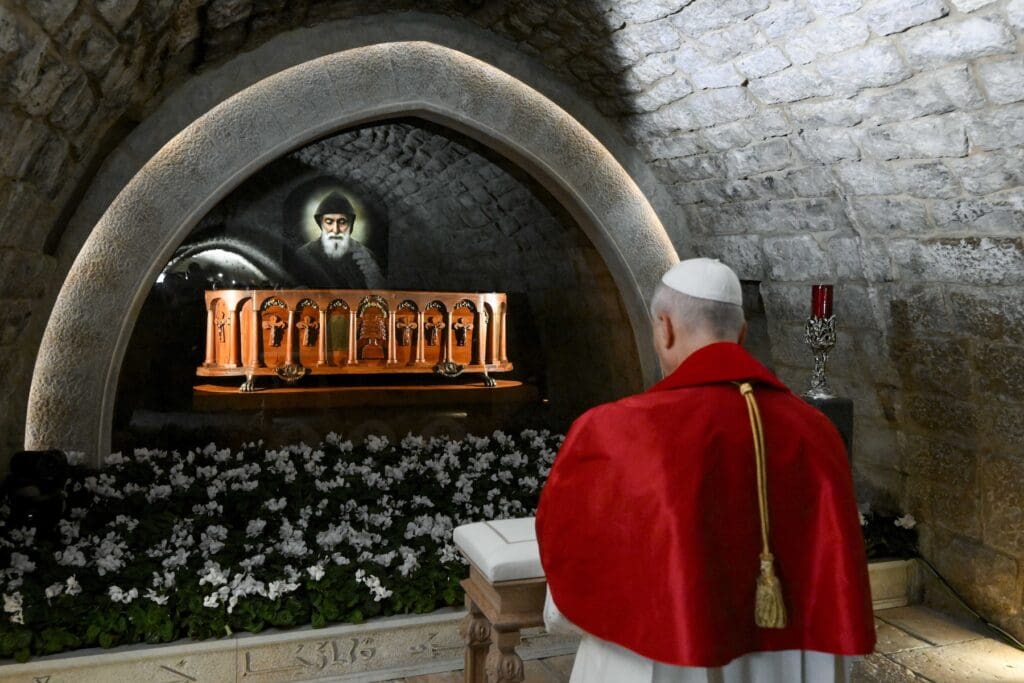
“St. Charbel is a saint for the Catholic Church, but he has also performed miracles for believers throughout the Middle East and of all religions, so he is an international saint,” said Father Youssef Matta, a priest at the monastery.
Immediately afterward, Pope Leo met 2,500 clergy members, religious and lay church workers at the Basilica of Our Lady of Lebanon in Harissa, north of Beirut. He listened to the testimonies of those who experienced migration, human trafficking, detention and war. He quoted John Paul II’s 1984 Message to the Citizens of Lebanon, saying: “You are the ones responsible for hope in today’s Lebanon.”
Sister Joumana Sassine, who traveled from Maronite St. Joseph Monastery in Jrabta, said the Lebanese “resist and persevere, but sometimes, even with hope, you need the encouragement that [a pope’s] visit provides.”
Najwa and Robert Al Khoury, who serve in local marriage and family ministry, said they came to the basilica to pray for peace in Lebanon. Peace, they said, would help families forced from their homes due to war and those who struggle due to the economic crisis.
The pope also demonstrated closeness to the poor in his visit to the Hospital of the Cross, the only psychiatric hospital in Lebanon that is run by the Franciscan Sisters of the Cross.
Thousands of people had massed in the monastery of the Cross’s courtyard to greet Pope Leo. Among them was Greta Kassouf, who had come from Zahle, some 33 miles East of Beirut, with her three children, including Rita, her 11-year-old daughter with disabilities.
“I hope that the pope will pray for Lebanon, for our children, and especially for my daughter Rita,” she said.
In the hospital’s auditorium, Mother Marie Makhlouf thanked Pope Leo for his visit, “which tells the world that these forgotten people are not a burden on society, but the treasure of the church.” Tears and emotion caused her to pause her speech several times.
This unique facility cares for 800 inpatients across three departments, and faced closure during the economic crisis.
“Our mission is a daily miracle,” she said. “How do we continue without support and yet open our doors wider whenever the world closes its doors to those who knock?”
“What we witness in this place is a lesson for everyone,” Pope Leo said, “for your land, and even for all humanity.”
Mr. Constantin, CNEWA’s regional director in Beirut, said these sisters “are the only options for the poorest of the poor who live with physical and mental disability in the country.”
“The role of the church in Lebanon goes well beyond its usual mission because the government relies on it in many crucial sectors, such as health care and education,” he said. “If the church can’t carry on, the country will fall apart, and the welfare of the society will decrease immensely.”
Theologian Souraya Bechealany of Saint Joseph University of Beirut said Pope Leo is following in the tradition of Pope Leo XIII, who established the foundations for the social doctrine of the church in the late 19th century. His attention to those who suffer is indicative of his commitment “to justice, human dignity and communion.”
“Pope Leo truly follows in the footsteps of Vatican II,” she said.
The visit of John Paul II in 1997 trip was cited frequently during Pope Leo’s visit, with many religious leaders quoting the saint’s famous declaration that “Lebanon is more than a country — it is a message of freedom and an example of pluralism for East and West.”
Bishop Aoun said the ecumenical and interfaith meeting in Beirut’s Martyrs’ Square on 1 December resulted in “an update of this message, with all Christian and Muslim leaders expressing Lebanon’s uniqueness, and reaffirming the desire to remain together.”
Linda Ghaddar, who participates in Muslim-Christian dialogue, said “since 2023, the war has deepened social and political divisions and increased sectarian tensions due to economic and security pressures.”
“Interfaith dialogue is now an existential necessity for ensuring national stability,” she said.
Hiba Samaan, a French teacher at the Don Bosco and Marie-Dominique School of the Salesian Sisters in Hadath, some 50 miles from Beirut, said the pope’s visit “eased the tensions between the communities that I was feeling since the escalation of the war” with Israel in 2024.
“Usually, every day, we hear bombardments and we anxiously wait for the warplanes to fly over us, and this visit gave us three days of peace of mind,” she said.
“I really liked that the Muslims attended the visit together with the Christians; it purifies hearts and brings souls closer together,” said Ms. Samaan, a Shiite Muslim. While the pope’s itinerary did not include the Bekaa Valley, the visit provided an opportunity for her students to learn about the pope and his global role, she added.
Standing in solidarity once again with the suffering experienced by the Lebanese, Pope Leo led silent prayer on 2 December at the site of Beirut Port explosion on 4 August 2020, which killed at least 236 people and injured 7,000. The silent prayer was followed by a closing Mass nearby.
“This visit was a touch of tenderness from a father who cares for his children who are hurting,” said Cecile Roukoz, who lost her brother in the explosion. “I felt like I was going to cry, as I feel powerless that my brother died under such circumstances.”
Amnesty International reports that a national investigation into the blast, which was politicized and stalled repeatedly, resumed in February 2025.
“Even though Pope Leo cannot intervene in judicial matters, this visit sends a very strong message that the investigation must be carried out,” Ms. Roukoz said.
Before his departure, Pope Leo once again appealed to the Lebanese to “let the attacks and acts of hostility stop” and to “choose peace.” Within minutes of his plane leaving Lebanese airspace, the buzzing of Israeli drones returned.