Violist Ester Slepchenko, a young Israeli Messianic Jew, dreams of initiating musical projects that will promote connections among students of diverse cultures and religions.
The 22-year-old studies at the Magnificat Institute, located at the Franciscan St. Saviour Monastery in Jerusalem’s Old City, as well as at the Jerusalem Academy of Music and Dance at Hebrew University of Jerusalem.
Ms. Slepchenko’s dream is inspired by her experience at the Magnificat Institute. Founded 30 years ago as a small music school that taught organ and piano, the institute evolved into a de facto multifaith community as it expanded to teach other instruments, bringing together students of all creeds with Jewish teachers. In recent years, Christian and Muslim teachers also have joined the faculty.
“I want to make that change, [to show] that it is always possible to do something different,” Ms. Slepchenko said about the institute’s multifaith reality. “That this way of connection, peace and friendship is something that is possible.”
Father Alberto Pari, O.F.M., institute director for the past 11 years, envisions the Magnificat Institute and other interreligious initiatives in the Holy Land as “spreading seeds that will bloom into beautiful flowers and trees that will bear fruit.
“We allow for possibilities and spaces to be together and to grow,” said the Italian Franciscan, who has lived in the Holy Land since 2007. “When any war will finish, when calmness will come back, or normalcy, there will be wounds that are so huge to heal that they need someone external who is not Muslim, who is not Palestinian, who is not Israeli, not Jewish.”
The Franciscans “have this privilege — to be together with them, but not part of them completely,” he continued. “Our task will be really to create bridges and try to reconcile. To [make spaces for] meeting and listening to each other, knowing each other.”
Tanya Beltser, the institute’s artistic director, said the school welcomes students of all creeds.
“It is part of the school’s D.N.A. that it belongs to everybody,” said Ms. Beltser, an observant Jew from Ukraine who was among the first teachers to join the institute in 2004 when it broadened its program.
“We are not focused on the differences,” she said, referring to the various religions among students and staff. “We are focused on the right thing: high-quality music education, which is creating something very beautiful.”
The institute is not a “bubble,” said Tala Akkawi, 25, a classical guitar teacher who is Muslim and joined the staff in 2023. Rather it is a space where teachers and students can fully exist and interact with each other, bonding over their love of music. For many, it is the first opportunity they have to interact with people from diverse backgrounds, she said.
“There are some Muslim students who, for example, have never actually interacted with Christian teachers, so this is a new experience for them — to have Christian classmates, or Christian teachers or even Jewish teachers,” said Ms. Akkawi. “It changes the perspective on things, and we don’t have a lot of that in Jerusalem.”
Such connections among different faith traditions form an alliance “against extremism, racism and hate” and create “an action of faith, within the abyss.”
Even within seemingly unending conflicts in Israel, faith leaders have developed peacemaking and dialogue initiatives through small acts of personal connection.
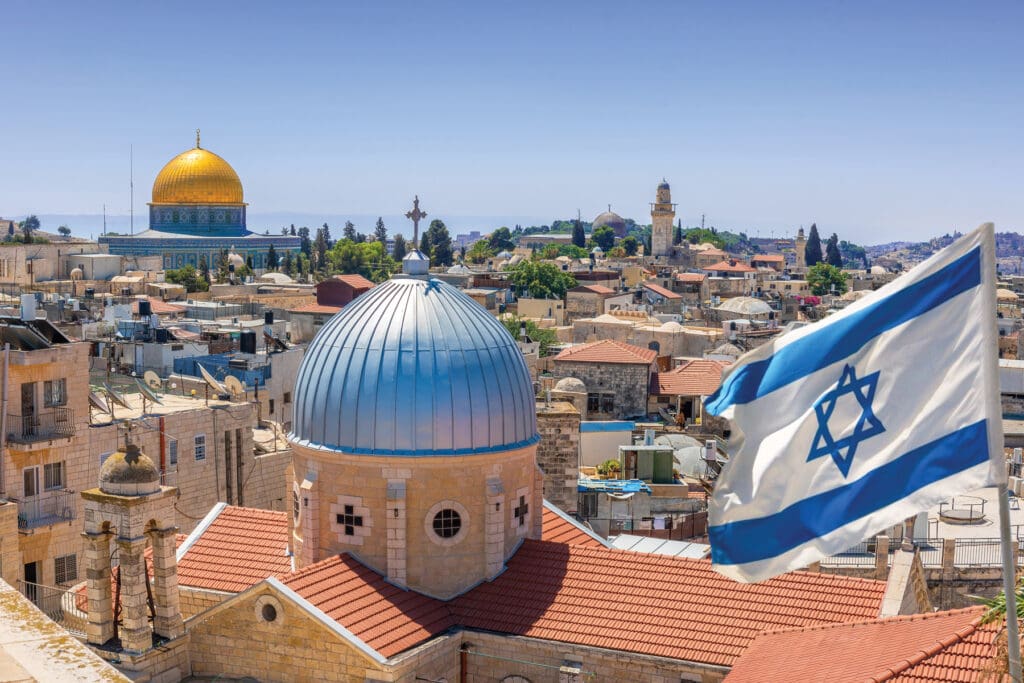
A monthly interfaith text study between the Hebrew-speaking Catholic Community of Sts. Simeon and Anne and the Jewish traditional Zion community in Jerusalem is among these initiatives.
For 13 years, between 30 and 40 people, about half from each community, have gathered one Wednesday a month at Sts. Simeon and Anne Church in the center of the city. They study the Hebrew Bible, the New Testament, Psalms, and Jewish and Christian commentaries on these texts, and writings by Christian and Jewish scholars.
The group has become a “safe space of connection and mutual respect,” said Ilana Rivka Nelson, a member of the Zion community, who co-founded the group. She said the group “feels like a healing embrace within the broken reality of alienation, hatred and war that surrounds us.”
“Every month I walk out of our gathering with renewed faith in humanity and God.”
Rabbi Tamar Elad-Appelbaum of the Zion community said such connections among different faith traditions form an alliance “against extremism, racism and hate” and create “an action of faith, within the abyss.”
The group began as part of a multifaceted initiative in tandem with the founding of the Zion community by Rabbi Elad-Appelbaum and her husband, Joseph, in honor of their grandparents. However, the story of her French grandfather was particularly meaningful for her.
As an ultra-Orthodox young man during the Holocaust, he joined a partisan group led by a priest to save Jewish and Roma children.
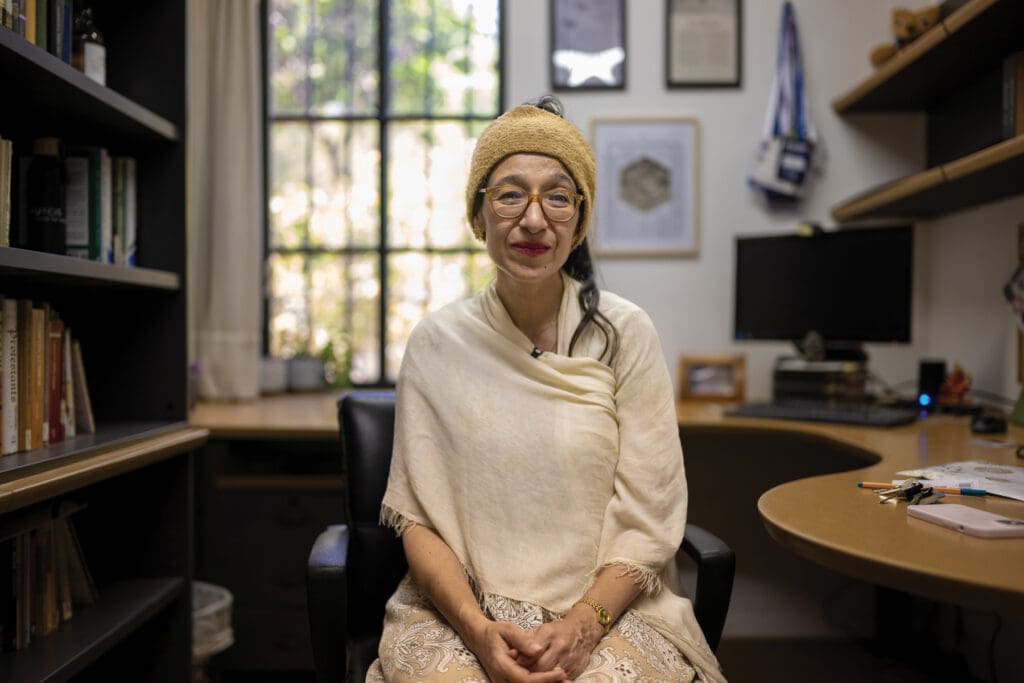
Most of her grandfather’s family was killed in Auschwitz, and when he arrived in Israel it was important for him to have a “connection of gratitude, courage and care” with the Christian community in Jerusalem, she said.
The Zion community, the joint text study group, and the social activist and charity work the two communities do together are in his honor and in honor of other righteous people, she said.
The two communities “pray for each other, and we are also friends for each other,” she said.
“We do many endeavors, and one of them is studying together. It is one of our [mutual] traditions of studying, of contemplating, of depth of conversation. Not only activism, but also very gentle listening to each other and getting to know each other’s sacred texts and respecting each other,” she added.
“We believe that conversation, dialogue and fraternity are the responsibility of every believer, every person of faith, especially those who live in the holy city of Jerusalem,” she said.
Topics studied together include family, generosity and gratefulness in each tradition.
“Every time we [take] one theme and we [see] how similar we are and how our traditions are driven by similar values, but also how sometimes we are different and how we complete each other, and it’s wonderful,” she said.
“We support each other, defend each other; we do everything we can to create a model exemplar of coexistence.”
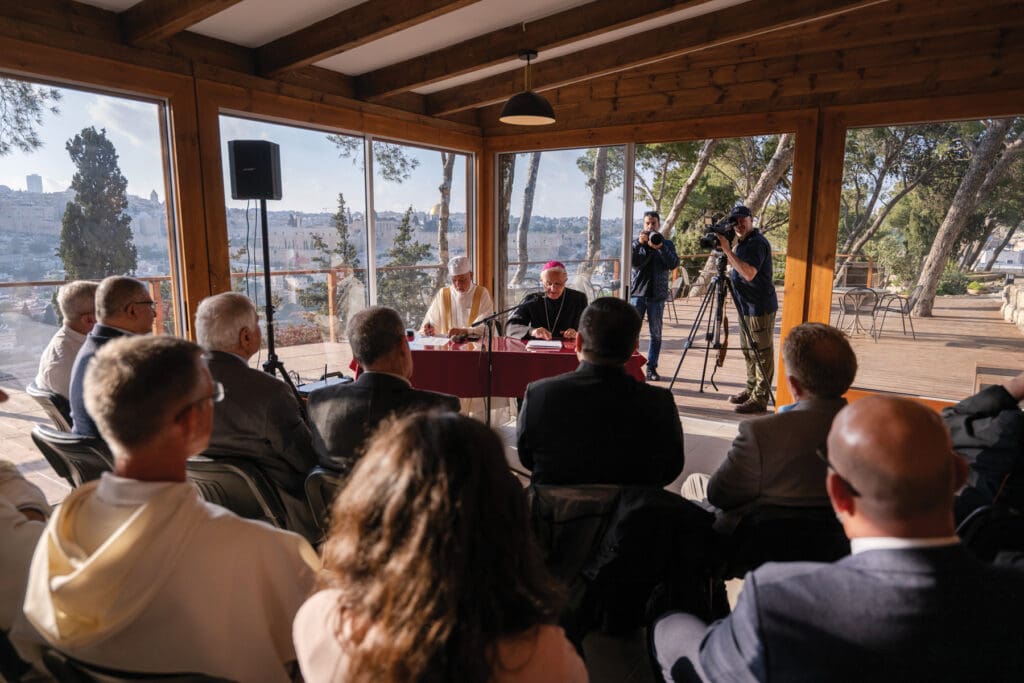
The Rev. Piotr Zelazko, patriarchal vicar of St. James Vicariate for Hebrew-speaking Catholics in Israel, has no illusions about the smallness of the peacebuilding community in the Holy Land, but he said the church’s commitment to dialogue is rooted in its vocation and must remain steadfast despite the ongoing challenges.
“It will always be like a drop in the ocean,” said Father Zelazko. “But if a drop says, ‘I’m nothing,’ then there’s no ocean.”
The aftermath of the Hamas onslaught of southern Israeli communities on 7 October 2023, and the Israel-Hamas war that followed, have harmed coexistence efforts in the Holy Land, deepening fear, anger, grief and mistrust across the board. In these conditions, religious fundamentalism has grown on all fronts, straining Jewish-Muslim, Jewish-Christian and Muslim-Christian relations. Those engaged in dialogue and peacemaking often are viewed as delusional at best and traitors at worst.
The threat of war continues to weigh heavily on the region. The ceasefire brokered between the United States and Iran has collapsed. Ongoing clashes between the Israeli Defense Forces and Lebanon’s Hezbollah combatants and continued Israeli strikes in Gaza have further contributed to a pervasive sense of insecurity, uncertainty and heightened stress.
Within Israel and the occupied Palestinian West Bank, settler violence directed at Palestinians has increased as Palestinian attacks against Israeli civilians, especially in Jerusalem, continue. The Religious Freedom Data Center reported a significant increase in harassment cases against Christians throughout Israel. Founder Yisca Harani noted more than 88 incidents had been documented this year by early June, most in the Old City of Jerusalem, with 63 in the second quarter alone, putting 2026 on track to surpass last year’s total of 181 cases.
The Israel-Hamas war also impacted the work of the Interfaith Initiative in the Negev. Father Zelazko founded the group with Jewish and Muslim leaders 13 years ago, while serving at St. Abraham Church in Beersheva, south of Jerusalem. Although they scaled back activities when the Israel-Hamas war began, members continue to visit schools and other groups when invited.
“We have to keep working on it and the times will be better,” Father Zelazko said.
For the past four years, he has led Christians at the annual Interfaith March for Human Rights and Peace in Jerusalem, where Jews, Muslims, Christians and Druze advocate for equality, a shared society and human rights. This countermarch is organized by the Interfaith Forum for Human Rights close to Jerusalem Day, an Israeli national holiday that commemorates the Six-Day War of 1967. The goal of the interfaith march is to convey an alternative vision for Jerusalem to the more prominent flag parade promoted on the actual holiday, which of late has become a flashpoint of Israeli nationalist extremism directed against Christians and Muslims.
Father Pari from the Magnificat Institute participates in the interfaith march; this year, a flute-and-clarinet duet from the institute performed at the opening of the march on 14 May.
Catholic participation at the march reflects a broader tradition of Catholic engagement in building bridges among Jerusalem’s religious communities. At the heart of this tradition is the Benedictine Dormition Abbey on Mount Zion — considered the birthplace of “Nostra Aetate,” Vatican II’s declaration on the church and its relations with non-Christian religions — which has been a cornerstone of Catholic interreligious dialogue in Israel, said Abbot Nikodemus Schnabel, O.S.B.
The abbey’s commitment to dialogue with Jews and other faiths remains central to its identity. Abbot Schnabel said effective dialogue in the Holy Land must involve “looking together in the same direction” and engaging in shared initiatives.
In August 2024, at the height of the Israel-Hamas war, when most cultural venues were closed, the abbey hosted Jerusalem’s Manofim Contemporary Art Festival, featuring Jewish and Muslim artists addressing themes of war.
Hosting the event was based on the theological conviction that human dignity, lost in war, is restored through creativity, as humans are created in the image of God, said Abbot Schnabel.
“You come in contact with your dignity when you’re creative, and this was the reason I said: ‘Come all to us. Come all to us. We were the shelter for the artist,’ ” he said.
The Holy Land’s religious and cultural diversity should make it a place of dialogue, but instead, decades of conflict have deepened divisions and mistrust, said Joseph Hazboun, who directs CNEWA-Pontifical Mission’s regional office in Jerusalem.
Within this fraught environment, he added, the church and its social institutions have a responsibility to rebuild relationships before polarization worsens.
CNEWA-Pontifical Mission has spent decades developing programs that bring Christian and Muslim children together in safe, nonpolitical settings. Efforts include a three-year extracurricular initiative, starting in 2011, in Jerusalem, Bethlehem, Ramallah and the northern West Bank, engaging Christian and Muslim students in debate programs, environmental projects and theater classes; a continuing reading program that began in 2019 with the CNEWA-Pontifical Mission library in Bethlehem, and an environmental program in northern Israel with students in Nazareth and the Melkite Greek Catholic village of Mi’ilyah.
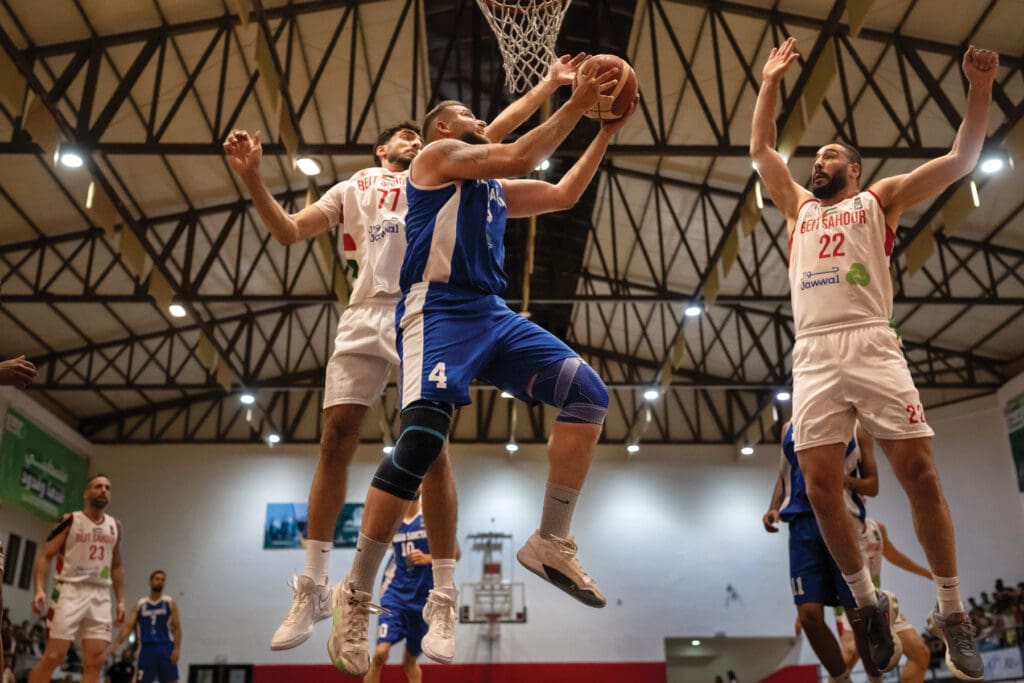
This year, CNEWA-Pontifical Mission started a three-year program aimed at strengthening ties between Christian and Muslim youth sports clubs in partnership with Bethlehem’s Evangelical Bible College.
“The only problem is ignorance, which leads to boycott, which leads to hatred,” Mr. Hazboun said. “These are the three factors that we’re trying to overcome.
“Because if I don’t know you, it’s easy for me to judge you, but when I meet with you and start working with you or playing with you … I rediscover that you are simply a human being, just like I am, and that we share the same challenges,” he said.
“This is what we’re aiming for: rediscovering the human face of the other.”
In Nazareth, northern Israel, CNEWA-Pontifical Mission plans to support a similar initiative for Christian and Muslim elementary school students in partnership with the Interreligious Coordinating Council in Israel (I.C.C.I.), which is affiliated with the Middle East Council of Churches, a longtime partner of CNEWA-Pontifical Mission.
Hiba Abu Khadra, a project manager at I.C.C.I., said Christians and Muslims live largely in the same towns, but the children rarely interact because they attend different schools. This sports program will give them opportunities to interact and discuss religious and cultural differences, she said.
Shireen Awwad Hilal, director of outreach at Bethlehem Bible College, noted the importance of addressing the “ghettoization” of Christian and Muslim communities in Bethlehem, where she lives. Although daily life is lived side-by-side, social activities tend to be segregated, fostering stereotypes.
She realized the urgency for such a program to start at younger ages when, during a meeting with Muslim university students after COVID-19, Christian Palestinians were referred to as “guests” in Palestine and even “crusaders.”
Amid growing political and religious fundamentalism, sports offer a common, accessible ground for interaction and relationship-building, she said. The goal is to move beyond mere coexistence to a genuine mutual understanding and shared identity as Palestinians, she added.
Ms. Awwad Hilal said she cannot guarantee the sports project will impact the entire Palestinian community, but she believes “it can make a change in my small community.”
“This is the center of Christians and Muslims living together,” she said of Bethlehem. “Yet they’re not living together as they should be living together.”
The CNEWA Connection
CNEWA’s presence in what is today Israel and Palestine dates to the agency’s earliest days. Although Christians are a minority, the church’s social programs care for all segments of society. These include investing in and participating in dialogues with the larger Jewish and Muslim communities, with the idea that stronger trust and understanding can lay the foundation for broader engagement and, ultimately, contribute to a more lasting peace in the region, said Joseph Hazboun, director of the Jerusalem regional office for CNEWA-Pontifical Mission.
To support this crucial work, call 1-866-322-4441 (Canada) or 1-800-442-6392 (United States) or visit cnewa.org/donate.
Read this article in our digital print format here.