Palestinian journalist Jirias Azar believed Taybeh, in the West Bank, was a haven — “a quiet rural area with fewer people and more nature; a place where you can live a calm and pleasant life,” he said.
In 2022, after three years of renovating a house in the ancient Palestinian Christian village, he and his wife, Celina, settled in, hoping to build a family and a peaceful life together. Their son, Sharbel, was born the next year.
However, their sense of calm began to dissipate after 7 October 2023, when Israel launched a full-scale assault on Gaza in response to Hamas attacks on Israeli border communities. As Israel’s war on Gaza intensified, so did Israeli military violence and settler attacks across the West Bank.
According to the United Nations, more than 1,800 settler attacks were recorded across the Palestinian West Bank last year. From January to September 2025, about 60 percent were in the governorates of Nablus, Hebron and Ramallah, where Taybeh is situated.
“I started to feel scared,” said Mr. Azar, 36. “It made me think that maybe life in Taybeh could become like those other places.”
Last summer, the couple’s sense of safety collapsed. On 28 July, just after 2 a.m., they were awakened by a series of bangs. Mr. Azar saw flames outside their kitchen window. Their car was on fire.
They grabbed Sharbel and ran into the dark, their neighbor shouting: “Settlers! There are settlers!” They fled to Mr. Azar’s family home in Ramallah.
Their car and everything in it — work equipment, documents and personal belongings — had been destroyed. Graffiti in Hebrew on a neighbor’s wall declared revenge for the neighboring village, Al-Mughayyir, which has been the site of ongoing violence between Israeli settlers and Palestinian land owners for many years.
After his brother’s car was burned in another attack on their property in Taybeh three months later, the couple put their house up for sale.
“I worked for 13 years to buy a car, build a house and obtain equipment for my work, and then I lost everything in less than a minute,” he said.
Ms. Azar said she never imagined such an incident would happen to them. “We are still living that night. I still dream about it,” she said. “I can’t go back to the house. I can’t imagine living there again.”
The Azars are part of a quiet exodus reshaping the ancient village of Taybeh. With a population of about 1,200, it is the West Bank’s last entirely Christian village and one of the oldest continuously inhabited communities in the Holy Land. In the Gospel of John, Jesus seeks refuge in Taybeh after the resurrection of Lazarus.
The Rev. Bashar Fawadleh, the priest at Christ the Redeemer Catholic Church in Taybeh, said 15 families — roughly 4 percent of the population — moved out in the past two years. People are leaving because of the Israeli occupation, said the priest, who is often first to run to the aid of community members who have suffered settler violence.
“People are tired,” he explained. “People are without rights — rights to live, rights to move, rights to pray, rights to learn, rights to travel.”
As well, since 2023, settler violence and Israeli military restrictions displaced almost 3,000 Palestinians across the West Bank, including 636 in the first six months of 2025 alone, OCHA reports.
Roland Bassir has run a stone-and-concrete factory on the edge of Taybeh for 20 years; he once employed 37 people. After the war in Gaza began, settlers known as the Hilltop Youth blocked his quarry road and grazed cattle through the site daily, until his employees were too frightened to come to work.
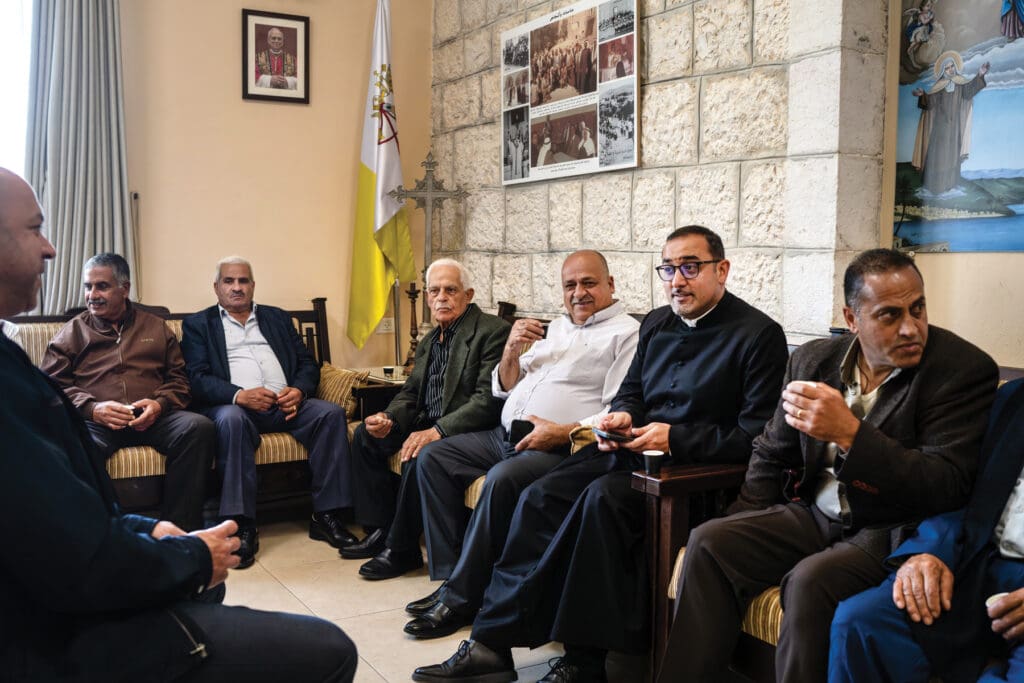
In mid-March, between 30 and 40 settlers stormed the site, raised Israeli flags and “prayed Talmudic prayers and rituals,” Father Fawadleh said. “That means they want to occupy the area. That’s the end.”
“I called the Israeli police. They did not respond,” Mr. Bassir said. “We called the Coordination and Liaison Office. After three days, the army came, stayed for 15 minutes, and left. Then the settlers returned.”
Mr. Bassir’s experience reflects a documented pattern. According to the Israeli human rights organization Yesh Din, since 2005 only 3 percent of police investigations into settler violence against Palestinians have resulted in convictions, and 94 percent of cases close without an indictment.
In mid-May, Mr. Bassir’s employees had dropped to 15, and often none were able to work.
“I have spent 20 years building this place and investing in it,” he said. “Now I can’t work there.”
While church groups are unable to stop settler attacks, they continue to provide services and support. The Latin Patriarchate of Jerusalem and other Catholic organizations operate a school, a medical center, an elder care home, guesthouses and cultural programs in Taybeh. Eighty percent of those employed are Christian and 20 percent are Muslim. Working locally in Taybeh also spares people the unpredictable, hours-long commutes, caused by Israeli military checkpoints and barriers across the West Bank.
The Catholic school has served the eastern Ramallah region since 1860 and currently draws students from surrounding villages; 70 percent of the students are Muslim. It has graduated generations of doctors, engineers and lawyers, with nearly 100 percent pass rates in the national high school exit exam for seven consecutive years, said a school administrator, who asked to be identified only as Mary for safety reasons.
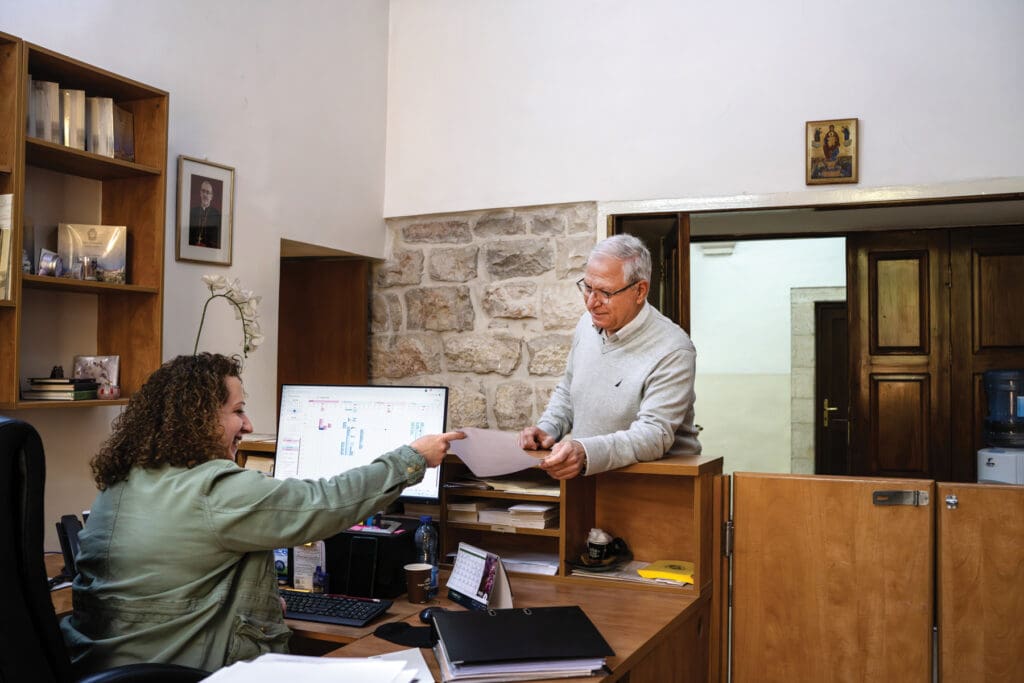
The patriarchate’s network of 44 Catholic schools in Israel, Palestine and Jordan has a student enrollment of 19,500, said Sami El-Yousef, the chief executive officer of the Latin Patriarchate of Jerusalem, who previously served as the regional director for CNEWA-Pontifical Mission in Jerusalem. Of these schools, five are in Israel and 12 are in the Palestinian territories. Tuition does not cover all the costs, so the patriarchate absorbs the difference, offering additional support for teachers’ families and students most in need. Last year, in the spirit of the Jubilee, the patriarchate forgave $11 million in accumulated tuition debt, despite heavy pastoral and humanitarian demands.
“But it was truly appreciated at a time when people were suffering,” Mr. El-Yousef said.
Despite strong schools, the region’s economic collapse translates into poor employment prospects for graduates. More than 25 percent of Palestinians are unemployed; the rate climbs to 37.5 percent for university graduates, aged 19-29, according to the Palestinian Central Bureau of Statistics.
Since October 2023, about 120,000 Palestinians lost their Israeli work permits, and only 10,000-20,000 have been restored, Mr. El-Yousef said. Tourism, small businesses and private investment have bottomed out in successive waves since the COVID-19 lockdowns, leaving entire sectors without reliable income for years.
The public sector, including civil servants, make up about 28 percent of the West Bank workforce. However, many have not received their full salaries for several years, due to Israel’s withholding of tax revenue owed to the Palestinian Authority, a crisis that has worsened since October 2023.
“They’re getting 20 percent of their salary, 50 percent in a good month,” Mr. El-Yousef said.
To encourage families to stay, the Latin Patriarchate has created 100 permanent jobs in Taybeh. It also reopened a ceramics workshop as a women’s employment project and provided families with below-market housing. In addition, CNEWA’s $94,000 flagship project supports up to 35 farming families with greenhouses and 700 olive and fruit tree seedlings, as well as temporary work for unemployed residents.
Rodolf Saadeh, projects manager for CNEWA-Pontifical Mission’s Jerusalem office, explained the approach is less about relief and more about partnership.
“It’s protecting the land, but also we are trying to support the families,” he said. “We’re not there as donors only. We think with Father Fawadleh, with the community.”
Currently, Palestinian Christians make up only about 1 percent of the West Bank population, but they operate 297 Christian institutions across the territory, including schools, hospitals and social services. These institutions serve an estimated 45 percent of Palestinian society, which is majority Muslim, Mr. El-Yousef said.
“You’re not talking about mere statistics of a Christian presence that is dwindling,” he said. “You’re talking about the potential risk to institutions that provide services to the whole community.”
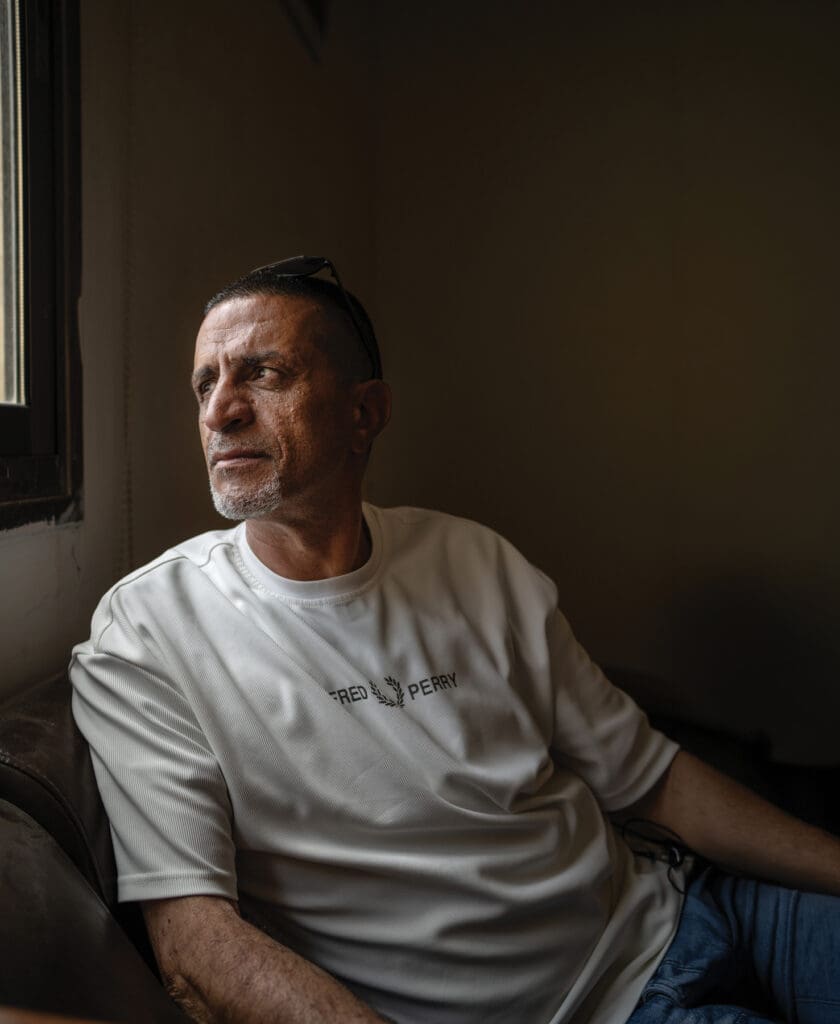
These institutions continue because of those who are committed to the land. Ramez Al Khoury, 38, returned to Taybeh from the United Arab Emirates in 2019, so his children could grow up in the church and with the local traditions.
In February, the Israeli army held him for a week until an allegation that he attacked Israeli settlers was determined to be baseless. He thought about leaving Taybeh again but has decided against it.
“I love that my son is growing up here,” he said. “Here in Taybeh, we are all relatives. Even during holidays, the celebration sometimes feels stronger than at the Church of the Holy Sepulchre.”
However, he is concerned that the margin has become thin and “many people will leave if things stay like this.”
Christians abroad must understand that “we are protecting holy lands,” he said, and they must reciprocate “through the media, [and] humanitarian, moral, psychological and financial support, create projects that help people here remain steadfast.”
“Our very presence here is a form of resistance,” he said. “Peace is the message of Christ. So, our staying here is itself a Christian message, because we are rooted in this land.”
The CNEWA Connection
CNEWA-Pontifical Mission has worked with residents of Taybeh and other Palestinian communities across the West Bank to build a framework for survival amid the rise of Israeli settler attacks and tightening military restrictions. It has helped sustain institutions, livelihoods and pastoral life, keeping families rooted.
“Since the escalation of violence from the settlers and the continuous attacks, it has turned into a hot spot,” says Rodolf Saadeh, projects manager for CNEWA’s Jerusalem office.
To support the mission of CNEWA/PMP in the West Bank, call 1-866-322-4441 (Canada) or 1-800-442-6392 (United States) or visit cnewa.org/donate.
Read this article in our digital print format here.