Religious leaders in Lebanon must be “builders of peace,” Pope Leo XIV said during an ecumenical and interreligious gathering in Martyrs’ Square in central Beirut, where he pointed out that many minarets and church bell towers were in easy view.
To build peace is to “confront intolerance, overcome violence, and banish exclusion, illuminating the path toward justice and concord for all, through the witness of your faith,” he said.
“The people of Lebanon, while embracing different religions, stand as a powerful reminder that fear, distrust and prejudice do not have the final word, and that unity, reconciliation, and peace are possible,” he said.
Amid the region’s ongoing conflicts, “hope emerges when we look to what unites us: our shared humanity and our faith in a God of love and mercy.”
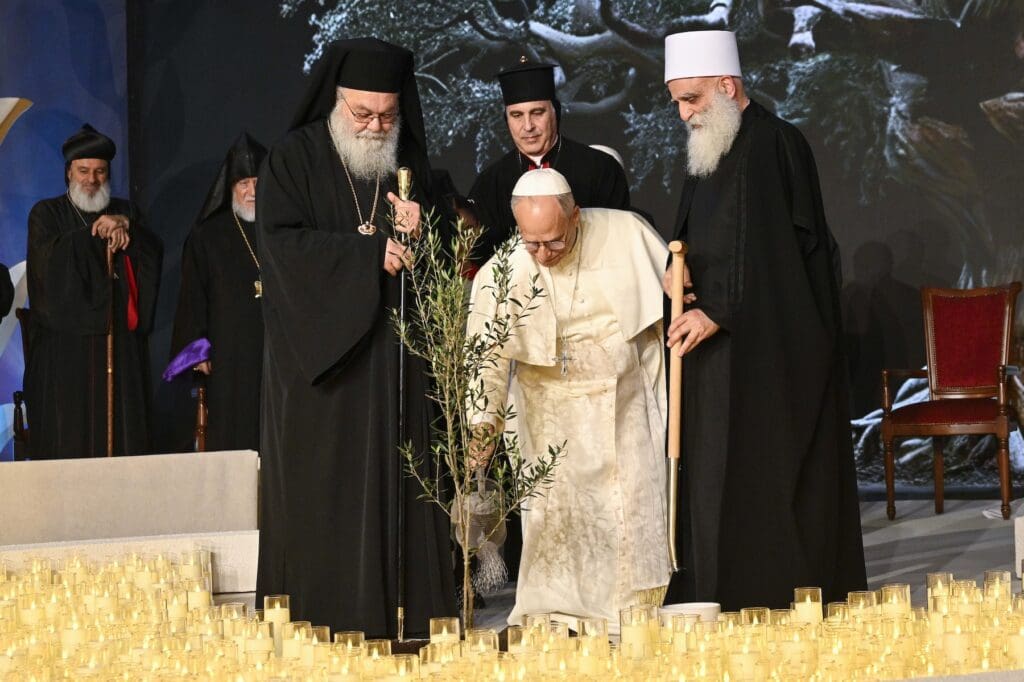
Syriac Catholic Patriarch Ignatius Youssef III Younan welcomed the pope to the 1 December gathering, which he noted coincided with two important anniversaries: the 1,700th anniversary of the First Ecumenical Council of Nicaea and the 60th anniversary of the Second Vatican Council’s declaration “Nostra Aetate” on interreligious dialogue.
Religious leaders who attended included those from Lebanon’s various Eastern-rite Catholic churches, as well as from the Sunni and Shiite Muslim communities, the Druze, the Greek Orthodox, Syriac Orthodox and Armenian Orthodox churches, and the Evangelical Christian community.
In his remarks, the pope compared the “roots of the cedars and olive trees” with the Lebanese people, “scattered throughout the world yet bound together by the enduring strength and timeless heritage of their homeland.”
Nayla Tabbara, who works to promote interreligious dialogue in Lebanon, said the comparison was meaningful within Lebanese culture, since both trees are national symbols of Lebanon.
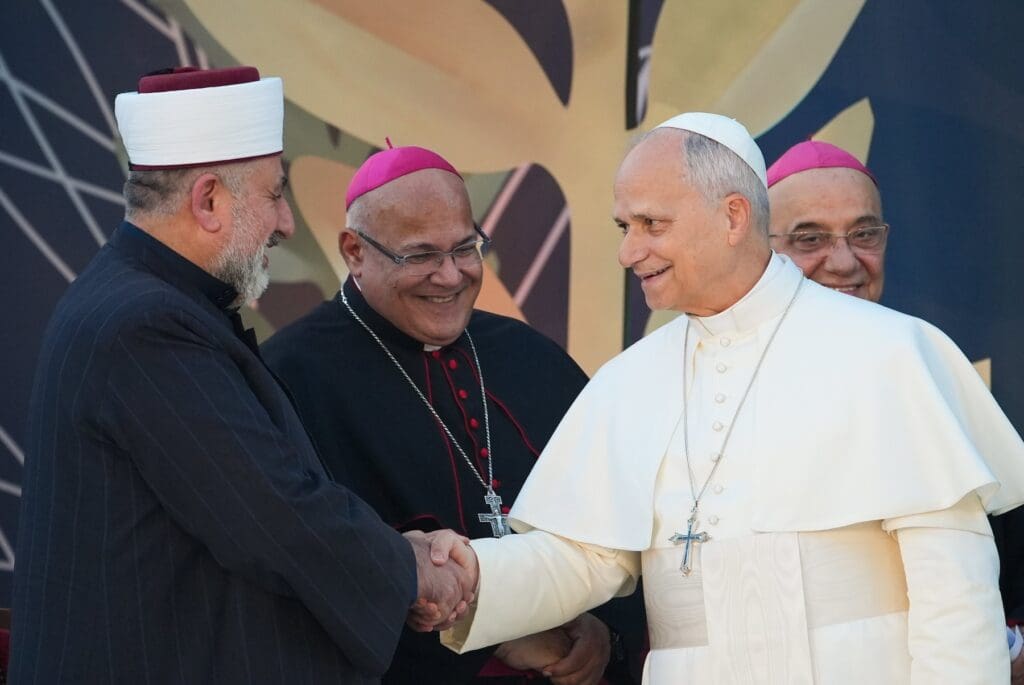
“It was especially moving because Pope Leo linked the olive tree to light, which is a reference to a Quranic verse,” said Ms. Tabbara, co-founder of the Adyan Foundation, which promotes social harmony and cultural understanding in the region.
In mid-November, Ms. Tabbara had hoped the pope’s visit would allow the Lebanese to showcase their “entire history of living together, which, despite the civil war continues to this day.”
She said her wish was granted, as Pope Leo emphasized the importance of interfaith dialogue, referring to the apostolic exhortation “Ecclesia in Medio Oriente,” which Pope Benedict XVI signed and promulgated in Beirut in 2012.
Msgr. Peter I. Vaccari, CNEWA president, who was in Lebanon for the apostolic trip, said Pope Leo “took the opportunity of this meeting in Martyrs’ Square to intentionally highlight the invaluable role of Lebanon.”
“The pope, as an international figure, not just as a Catholic figure, recognizes the importance of Lebanon on the international stage, because of its history and its current composition, multiple cultures, multiple faiths, multiple forms of politics, and he has seen in Lebanon a way in which they can hopefully go forward,” he said.
He underlined how CNEWA “plays an important role in interfaith dialogue.”
“Wherever we work, we never ask about people’s culture or faith,” he continued. “We are there to promote a mission that transcends the divides between people and hopefully brings them together.”
Since August, CNEWA has partnered with the Adyan Foundation on a project promoting interreligious dialogue in 30 schools in Lebanon.
After Pope Leo’s remarks, various religious leaders made statements stressing the necessity for peace. Many referred to St. John Paul II’s famous declaration that “Lebanon is more than a country; it is a message of freedom and an example of pluralism for East and West.”
Syriac Orthodox Patriarch Ignatius Aphrem II said the pope’s visit “comes at a sensitive moment in the history of this region, witnessing major upheavals and profound transformations.”
“The people of this land yearn for a peace founded on justice, which must safeguard human dignity and freedom under a state governed by law and equality in rights and duties,” he said.
Referring to the war between Israel and Hezbollah and its impact on Lebanon, Sheikh Ali Al-Khatib, vice president of the Higher Islamic Shiite Council, told Pope Leo: “We place the cause of Lebanon in your hands in the hope that the world may assist our country in overcoming its accumulated crises.”
“We are not seekers of conflict, nor do we take up arms out of desire or inclination, nor do we willingly sacrifice our sons,” he continued, referring to Hezbollah, a Muslim Shiite militia and political party that is refusing to disarm as part of the ceasefire agreement with Israel.
Linda Ghaddar, who participates in Muslim-Christian dialogue and collaborates with the Adyan Foundation, said “since 2023, the war has deepened social and political divisions and increased sectarian tensions due to economic and security pressures.”
“The dialogue has become more fragile in the face of political polarization,” she said. “Interfaith dialogue is now an existential necessity for ensuring national stability.”