Catholic clergy called for prayer and peace following U.S.-Israel strikes on Iran on 28 February that killed supreme leader Ayatollah Ali Khamenei as well as senior leaders and civilians.
“We pray that there be a return to dialogue, diplomacy, justice and peace,” said Msgr. Peter I. Vaccari, president of Catholic Near East Welfare Association (CNEWA) and Pontifical Mission for Palestine, in a statement to OSV News.
Msgr. Vaccari said he had spoken to each of CNEWA/Pontifical Mission for Palestine’s regional directors in Jerusalem, Beirut and Amman.
“And I assured them, their families, and the families of all our staff, of our prayers at this very difficult hour,” he said, adding that the “highest immediate priority is the safety of our staff and their families.”
He described the regional teams’ works as “great and heroic,” and “extraordinary testaments” to the organization’s mission.
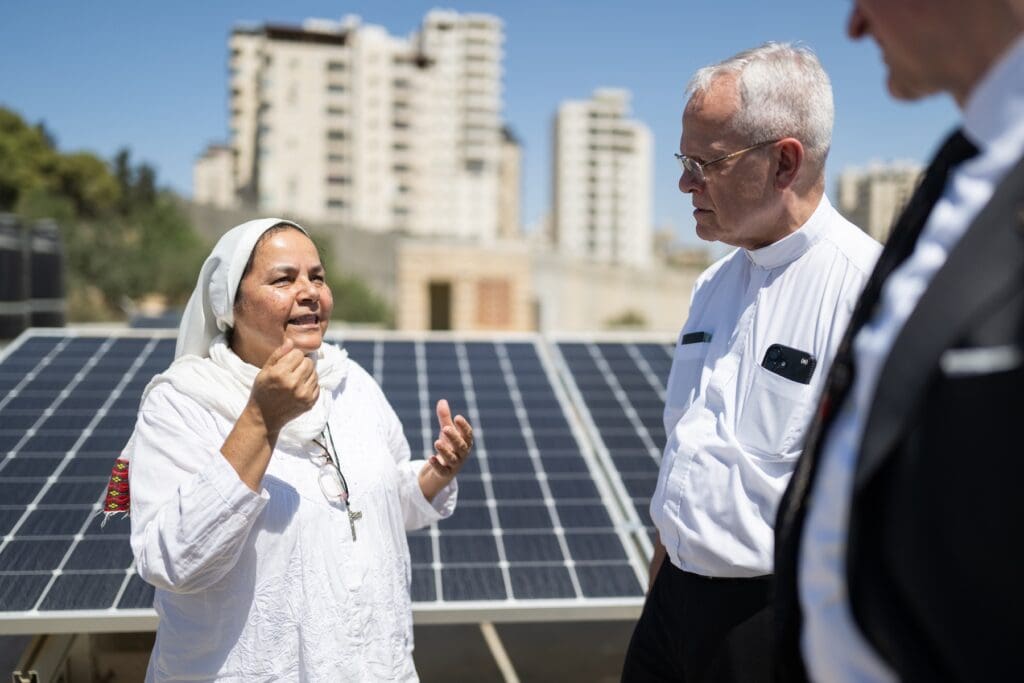
“Our teams throughout the region work long hours on behalf of the churches and peoples whom we are committed to serve,” said Msgr. Vaccari. “Their lives and schedules are the living translation of the Gospel question ‘Who is my neighbor?’ as they are there for everyone!”
After the strikes 28 February, Iran and Iranian-backed militias retaliated, attacking U.S. allies and bases in the Middle East as well as in Israel and Arab states. The fighting spread, including an escalation of airstrikes between the Lebanese militant group Hezbollah and Israel. News reports showed streams of cars as people tried to evacuate southern Lebanon, including the southern suburbs of Beirut.
At the Vatican on Sunday, 1 March, Pope Leo XIV told pilgrims gathered for his Angelus address he was “following with deep concern what is happening in the Middle East and in Iran during this tumultuous time.”
“Faced with the possibility of a tragedy of immense proportions, I make a heartfelt appeal to all the parties involved to assume the moral responsibility of halting the spiral of violence before it becomes an unbridgeable chasm,” he said.
“May diplomacy regain its proper role, and may the well-being of peoples, who yearn for peaceful existence founded on justice, be upheld. And let us continue to pray for peace.”
In a statement to OSV News, Chaldean Catholic Archbishop Bashar M. Warda of Irbil, Iraq, referenced the 2003 U.S-led invasion of Iraq in retaliation for the 9/11 terror attacks. Archbishop Warda said he “witnessed the years of violence, displacement and bombings that shook Iraq after 2003.”
“These are not chapters in a book for us. They are memories we still carry,” Archbishop Warda stressed. “We know what sirens sound like in the middle of the night. We know what it means for a child to fall asleep, afraid. We know the silence of empty streets, the fear in a mother’s eyes, the pain of families who leave their homes not knowing if they will ever return.”
For that reason, said Archbishop Warda, “When we see tensions rising again in our region, we do not see it as distant news. We feel it in our hearts.
“Every new escalation reopens wounds that have not fully healed,” he said. “Our people are still recovering, emotionally, economically, spiritually, from the wars of the past.”
“The Middle East does not need another war,” Archbishop Warda said. “Our children deserve stability. Our families deserve peace. Ordinary people have already paid too high a price for conflicts they did not choose.”