Born with developmental and intellectual disabilities, Vipin Valiyannukaran has required round-the-clock care his entire life. His grandmother served as his primary caretaker while his mother, Mary, worked in a convent as a cook. When his grandmother died four years ago, Mary became Vipin’s sole caretaker. Despite the challenges, Mary has persevered, until diagnosed with Parkinson’s and depression two years ago.
Mary’s daughter invited them to live with her, her husband, four sons and parents-in-law, but the situation deteriorated quickly, with arguments an almost daily occurrence. A relative then suggested Vipin, 37, and Mary, 64, live at Damien Institute.
Damien Institute is situated in the hills of Mulayam in Kerala’s Thrissur district, southern India. Its 185 acres are planted with pineapple, banana and coconut trees, and rice grows in low-lying areas.
The institute, founded in 1953, is an apostolate of the Syro-Malabar Catholic Archeparchy of Trichur and named for St. Damien de Veuster, a Belgian priest who cared for those suffering with Hansen’s disease — commonly known as leprosy — banished to the Hawaiian island of Molokai. Eventually, he contracted the disease and died at age 49 in 1889.
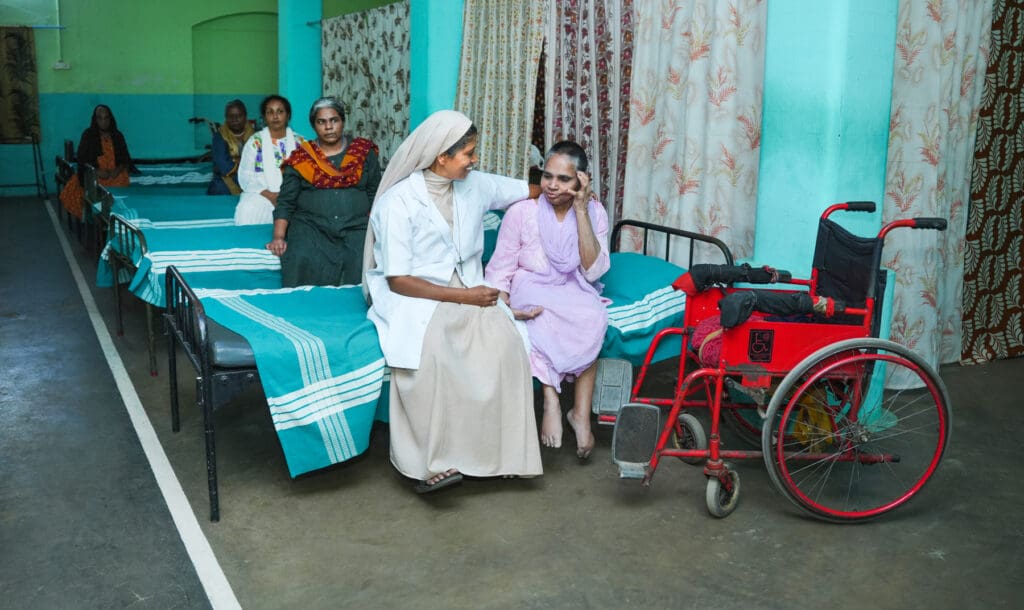
Sister Lissy Valloppally runs Damien Institute. Before arriving three years ago, she worked at a leprosy hospital in Hyderabad, India.
“We have 42 patients here altogether,” she says. “Most of them suffer from mental health conditions, such as schizophrenia, mania, etc.
“There are also four leprosy patients who have been in the clear for years now, but there’s nowhere for them to go, so they stay here. There are also some patients who show up on out-patient days.”
Pathu Muthu, 92, has deformity in her hands and feet from leprosy.
“She has been here 38 years,” Sister Lissy says. “She’s been given the all-clear, but her hands and feet still need dressing twice a week or it gets smelly.”
A doctor visits the institute twice a month, and a psychiatrist visits monthly. Residents can receive physiotherapy weekly; they receive blood tests monthly. The 10-member staff includes nurses, caregivers and administrators.
Improvements in public health globally have nearly eradicated the disease worldwide —about 95 percent of the world’s population is not susceptible — and it is not a communicable disease spread through sexual activity or pregnancy.
India declared leprosy eradicated in 2005, under its National Leprosy Eradication Program. Government figures show India’s leprosy prevalence rate fell from 57.2 per 10,000 people in 1981 to just 0.57 in 2025. However, between 120,000 and 130,000 new cases of leprosy are reported every year in India, representing nearly 60 percent of new cases globally.
“When you put love together with care, it gives them a sense of belonging.”
Damien Institute had 350 leprosy patients at its peak in 1962. When the government declared leprosy eradicated, the institute shifted its mission to care primarily for people with mental health issues.
“After COVID in 2020, we also took in some patients who had nowhere to go,” says the Rev. Simson Chiramel, institute director.
In 2020, just before COVID-19 hit, Jaison Johnson, 29, graduated with a degree in economics and was holding down a job at a pharmacy while managing his schizophrenia.
During the pandemic, however, Mr. Johnson, his mother and brother, who also have mental health issues, roamed the streets all day and night. A relative took them to Jubilee Mission Hospital, also part of the Archeparchy of Trichur’s health care network, but they refused to take the prescribed medication. When Mr. Johnson’s mental health declined further, he was admitted to the hospital for a two-month stay. His doctor referred him to Damien Institute, where he has been living for the past two years.
“We work together with the residents here to make them more independent,” Father Chiramel says. “When you put love together with care, it gives them a sense of belonging.”
Ayyappan Kutty, 80, is fit for his age, a benefit of a life climbing coconut trees and picking the fruit. He lives in Karalam, where he cares for his sister Shantha, 54, who was diagnosed with metastatic breast cancer. His other sisters, Kochumol and Valleyamma, have mental health needs.
The four siblings are supported by Hrudaya Palliative Care Program, a social action initiative of the Syro-Malabar Catholic Eparchy of Irinjalakuda. The eparchy includes 260,000 Syro-Malabar Catholics and about 140 parishes. The program’s staff of 30 provides care for 1,500 families.
“We offer free, comprehensive care to people who are bedridden with conditions such as cancer, strokes, spinal cord injuries and other complex illnesses that are difficult to fully recover from,” says the director, the Rev. Shaju Chirayath.
“We provide medicines absolutely free to people receiving palliative care,” he says. “We make sure that those in greatest need have access to essential medication that can help improve their quality of life.”
In the village of Vellani, Jewel Mary Jijoy, 6, lives with a rare condition that can cause seizures and defects in limbs.
Jewel Mary’s mother, Dhanya Jijoy, is her primary caretaker. “It is difficult to look after her because she needs 24-hour care,” says Mrs. Jijoy. Jewel Mary’s brother, 14, and sister, 9, help as much as they can, she adds.
Jewel Mary’s father drives a taxi in another city and returns home every weekend. His earnings are not enough to support the family, nor Jewel Mary’s specific health needs.
“A Hrudaya coordinator told us about the condition of this family,” Father Chirayath says. “We came and saw how we could help them. Hrudaya pays for Jewel Mary’s medication, which costs almost $250 a month.”
“We make sure that those in greatest need have access to essential medication that can help improve their quality of life.”
“If it wasn’t for Hrudaya, I don’t know how we would have managed,” says Mrs. Jijoy, a daily churchgoer. “Jesus works in mysterious ways.”
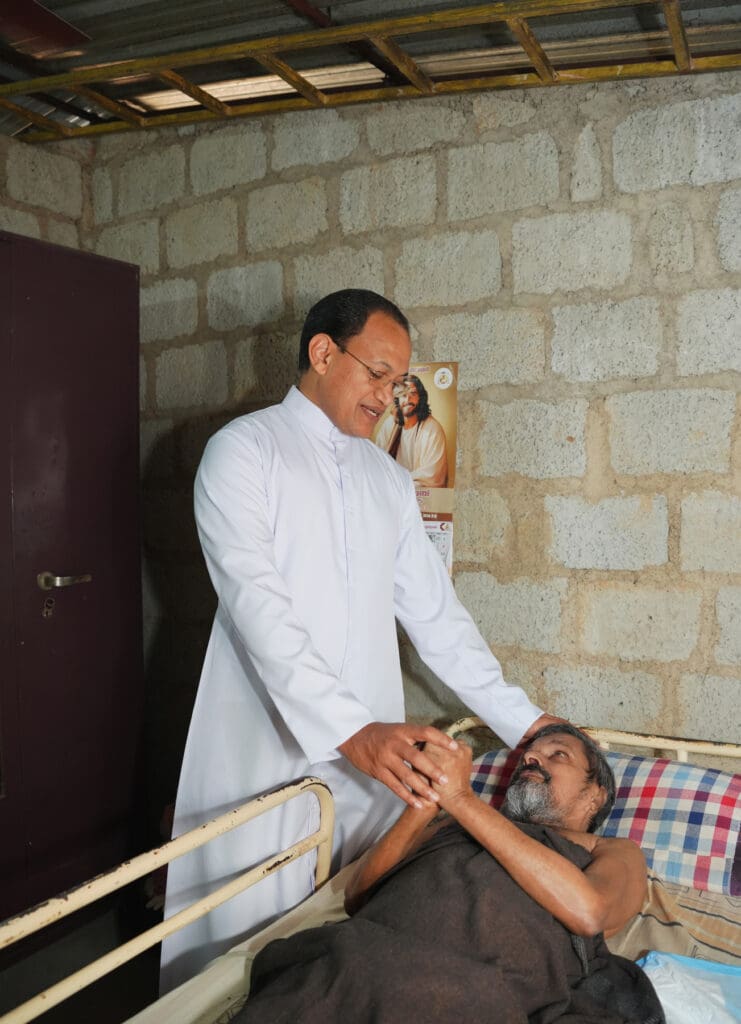
Joy Thaliyan, 56, in Thumbakode earned a living for his family as a woodcutter until a fall from a rubber tree seven years ago left him paralyzed.
“Things are difficult,” says his wife, Annie Joy. “But Hrudaya is helpful. Father Shaju visits regularly, and that gives us a lot of support and solace.”
Father Chirayath says Hrudaya also provides doctor and nurse visits and helps people with health-related needs, like providing diapers. “It’s important we stay connected with people and not leave them to be socially isolated,” he says. “Emotional, spiritual and religious support is very important for human beings.”
Hrudaya Hospice Center helps those who require end-of-life care.
“We want people to have dignity in both life and death. That’s why programs such as Hrudaya are necessary,” Father Chirayath says.
Since the 1970s, Kerala transitioned into one of India’s most affluent and developed states. Life expectancy is 73 for men and 79 for women, driven largely by professional health care facilities, high literacy and improved sanitation.
More than 5 million people from Kerala work abroad, mostly in the Persian Gulf states, contributing significantly to wealth in the state. The economy is largely service driven, relying heavily on tourism, health care, IT and trade rather than manufacturing.
The average per capita income in Kerala is $1,950, according to 2024-2025 government statistics, yet, despite socioeconomic and technological growth, the state continues to rely on its churches for poverty alleviation — more than a quarter of Kerala’s population is Christian, and the churches’ networks of schools, health care and social service programs impact Christians and non-Christians alike.
“If it wasn’t for Hrudaya, I don’t know how we would have managed.”
In addition to care for the marginalized, church-run organizations provide employment training and significant funding toward community development. They also manage an extensive network of educational institutions and hospitals, particularly in remote or under-served areas, soup kitchens and welfare programs for families facing economic hardship or loss.
In addition, the church is a major support to the government for crisis intervention, such as during natural disasters, floods and landslides, filling the gaps in government aid with immediate support, including food, medicine, safe drinking water and makeshift camps.
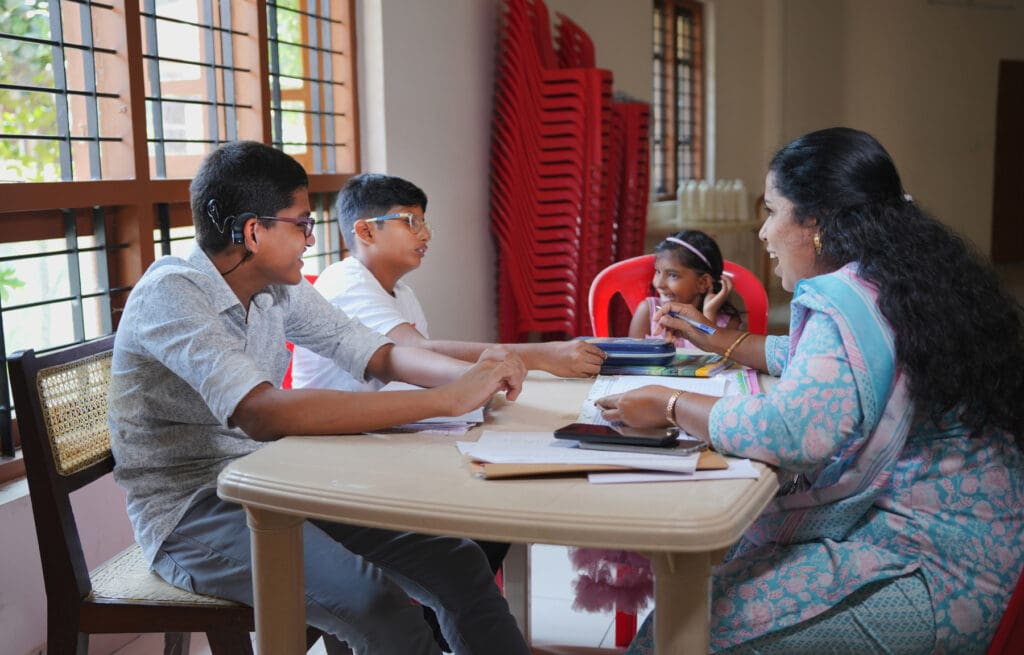
Dhiya R.V. plays with her friends at the community center of the Malankara Social Service Society (M.S.S.S.) in Thiruvananthapuram, Kerala’s capital city. M.S.S.S. is the social ministry arm of the Syro-Malankara Catholic Archeparchy of Trivandrum.
Dhiya, 9, was born with Triple X syndrome — a random genetic condition that occurs in about 1 in 1,000 females who are born with three X chromosomes instead of two. The syndrome is often mild, and many cases go undiagnosed. However, it can cause developmental delays, learning disabilities, speech, hearing and language issues.
Dhiya’s mother left with another man after Dhiya’s diagnosis, so Dhiya’s paternal grandmother has raised her.
Dhiya has a severe hearing impairment, a learning disability and displays hyperactive behavior.
“But coming here has helped her,” says the Rev. Varghese Kizahakkekara, M.S.S.S. director. “She is able to play and mix with other children who are like her.”
These children are part of the organization’s Sparsh program. “We support them through education, counseling, therapy and communication classes,” Father Kizahakkekara says.
Sparsh’s 15 staff serve 76 children. Its teachers also go into public schools that have partnered with M.S.S.S. to provide learning support to children with special needs.
Sparsh has been running a lunch program, from Monday to Saturday, at the M.S.S.S. compound for more than 100 people since 2020. Beneficiaries include people of all ages, students and laborers.
“Anyone can come here to eat,” Father Kizahakkekara says. “The meal is healthy and, while considering the menu, we keep in mind that it gives you everything — protein, carbohydrates, vitamins and minerals.”
M.S.S.S. received special consultative status from the United Nations in 2016, which identifies the church organization as a reputable receiver of foreign grants.
“We have been serving the poor, needy, marginalized and unorganized sections of people irrespective of their caste, religion or gender,” Father Kizahakkekara says, noting the ministry serves the entire Indian subcontinent.
“Jesus works in mysterious ways.”
Among other marginalized groups in Kerala, M.S.S.S. assists widows, through the Sneha Suraksha program, as well as Dalit children. Sneha Suraksha, which relies mostly on donations from parishioners and benefactors, supports 130 single mothers with a monthly $11 stipend.
“We’re trying, in our small way, to improve the socioeconomic structures of widows who are also single mothers,” Father Kizahakkekara says.
M.S.S.S. provides scholarships for children of the marginalized Dalit community. The scholarships are used for books, school fees and tuition, and student loan repayment.
“There are many poor families in our parishes,” Father Kizahakkekara says, citing support from donors.
“Education is by far the best gift you can give someone.”
The CNEWA Connection
CNEWA accompanies India’s Syro-Malabar and Syro-Malankara Catholic churches in their social and health care ministries serving the most vulnerable and marginalized populations, including the works featured here. CNEWA’s decades-long support of Damien Institute includes funds for its operations, patient medication and food. A CNEWA grant to Hrudaya Palliative Care Program provides airbeds for the prevention of sores; oxygen cylinders for respiratory support; wheelchairs for mobility and accessibility; mobile freezers for storing temperature-sensitive medicines and ambulances for emergency transportation. CNEWA also funds the scholarship program of Malankara Social Service Society for Dalit children.
To support CNEWA’s work in India, call 1-866-322-4441 (Canada) or 1-800-442-6392 (United States) or visit cnewa.org/donate.
Read this article in our digital print format here.