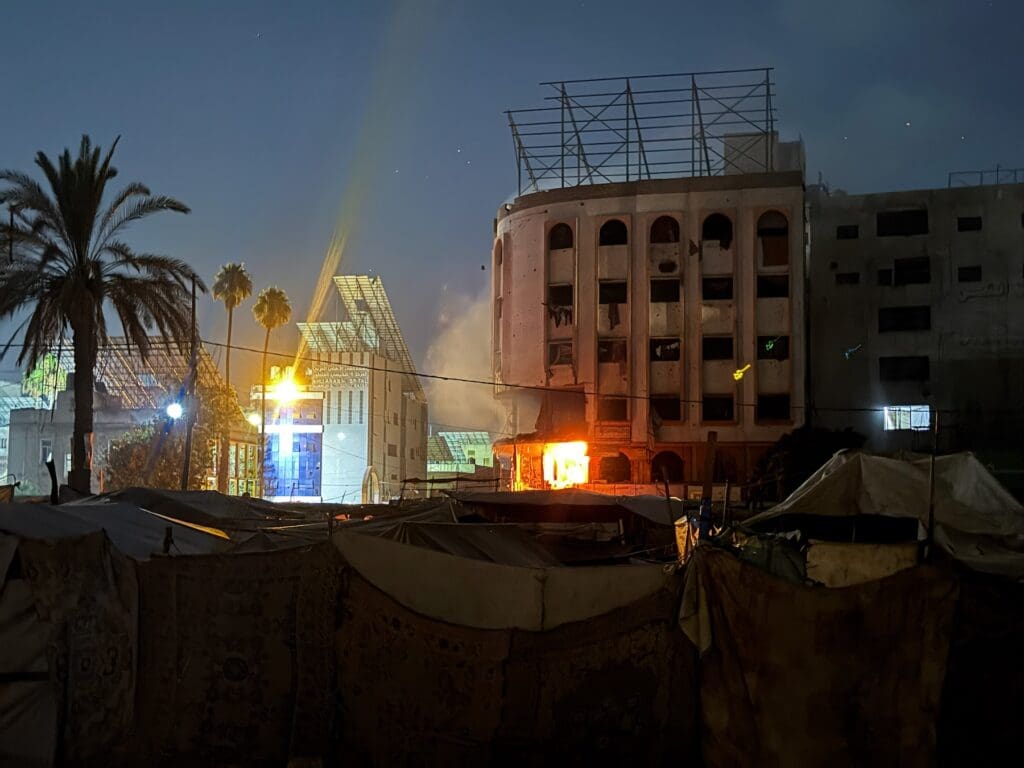
An Israeli airstrike on a residential apartment directly adjacent to CNEWA-supported Al-Ahli Arab Hospital in the center of Gaza City damaged hospital facilities late on 29 July.
The strike shattered windows and doors inside the hospital and damaged an elevator serving the diagnostic center. Although the hospital was not directly hit, staff said the strike caused fear among patients and medical workers.
“There was also a significant psychological impact on our medical teams,” said Mousa Ayad, a manager at Al-Ahli Arab Hospital.
Mr. Ayad said the hospital is located less than a mile from the so-called “Yellow Line,” the Israeli-controlled area inside Gaza established after the ceasefire last October.
“The repeated explosions create confusion among medical staff and place additional psychological pressure on patients,” he said.
Asked whether the hospital could become a target, Mr. Ayad said no one can anticipate where the next strike will fall.
“This is war, and no one knows where the next danger will be. But given the hospital’s humanitarian and medical role, we do not believe that the hospital is the intended target.”
Mr. Ayad said despite the ceasefire, Gaza’s health sector has seen little recovery.
“The situation has not improved significantly. Hospitals continue to face shortages of medical supplies, equipment and essential consumables,” he said. “Thousands of patients remain on waiting lists for surgery, while many others still need to travel outside Gaza for specialized treatment.”
The Israeli military has been ordering residents to leave entire residential areas before airstrikes, without Gazans being told which building will be targeted. The warnings often cover neighborhoods containing dozens of residential buildings and displacement shelters, leaving residents uncertain about where the strike will occur and creating widespread fear and panic.
Mahmoud Basal, spokesman for Gaza’s Civil Defense, told CNEWA “the policy forces entire communities to flee without knowing whether their own homes are at risk.”
“When entire residential blocks receive evacuation orders, people leave in fear without knowing which building will be targeted. In many cases, a single strike destroys not only the intended building but also neighboring homes as a result of Israel’s use of high-explosive missiles, leaving dozens of families without shelter,” Mr. Basal said.
The strike near Al-Ahli Arab Hospital comes as local emergency officials report a noticeable increase in attacks on multistory residential buildings.
Mr. Basal said the 29 July strike was especially dangerous because it occurred next to both a functioning hospital and a site sheltering displaced people.
He said Civil Defense crews were unable to immediately reach the location because responders feared a second strike.
“The fire burned for more than 15 minutes before our crews could move in,” Mr. Basal said. “We continue to work with severe shortages of firefighting vehicles, water tankers and fuel, making every emergency response more difficult.”
According to the Gaza Ministry of Health, nearly 1,200 Palestinians have been killed, and about 3,900 injured since the ceasefire came into effect in October 2025.
Meanwhile, Israel has continued expanding the area under its military control inside Gaza. Reuters recently reported that Israeli forces now control roughly 64 percent of the territory, compared with what was arranged at the time of the ceasefire, then about 53 percent. Israeli Prime Minister Benjamin Netanyahu has said Israel intends to expand its control to about 70 percent of the strip.
Separately, satellite imagery analyzed by The Associated Press shows Israeli forces have constructed an extensive system of sand barriers and military positions stretching more than 14 miles inside Gaza along parts of the buffer zone, reinforcing what analysts describe as a deeper and more permanent military presence.
For many health workers, the immediate concern remains much closer to home.
“The sound of the explosion brought back memories of the darkest days of the war,” Mr. Ayad said. “Even after more than nine months of the ceasefire, the war’s impact is still present in every part of daily life.”