Donors and benefactors of Catholic Near East Welfare Association are “partners in a mission of mercy, instruments of God’s compassion, and builders of hope,” said Cardinal Gérald C. Lacroix of Quebec. The cardinal addressed more than 125 people who had gathered to celebrate the centenary of CNEWA at St. Elias Banquet Centre in Ottawa.
“In a world wounded, so wounded by war, poverty, displacement and so much human suffering, CNEWA helps us answer the question, ‘And who is my neighbor?’ ” the cardinal said.
“Your commitment is a powerful testimony to the Gospel in action,” he said.
Cardinal Lacroix was among the special guests at the 6 November gala, which also featured Larissa Habib, project coordinator for CNEWA-Pontifical Mission in Beirut, who as a child benefitted from CNEWA assistance. Father John O’Brien, S.J., director of the Martyrs’ Shrine in Midland, Ontario, was keynote speaker.
Leaders of Eastern churches in Canada joined Archbishop Ivan Jurkovič, apostolic nuncio to Canada, and Archbishop Marcel Damphousse of Ottawa-Cornwall, chair of CNEWA’s board of directors in Canada, among others.
Father O’Brien drew a parallel between the shrine and CNEWA, both of which were established in 1926: “One was founded to reach across continents, sustaining Christian communities suffering from the consequences of war, poverty, persecution and displacement. And the other was founded to honor the men, the saints, the martyrs who had crossed an ocean centuries earlier, leaving behind familiar shores to bring the Gospel to the peoples of this land.
“One sought to bring material assistance and spiritual solidarity to those in need, and the other sought to preserve the memory of Christian courage and sacrifice, and to inspire new generations of missionary disciples,” he said.
“Both testify to a church whose very nature is missionary,” he said, as he reflected on what it means to unite hearts in mission.
Father O’Brien spoke of responding “to the love of the living Christ, who continues to meet us in the faces of those who suffer. So, let’s consider what that might mean for us tonight. Somewhere in Lebanon, a mother is wondering how she’ll feed her children tomorrow.
“Or somewhere in Ukraine, a family has been forced to leave a home which perhaps sheltered several generations of their family. Or somewhere in the Holy Land, a child is growing up amid fear and uncertainty without the peace and security that every child deserves. Somewhere in Ethiopia, a religious sister is caring for those who have no one else to care for.
“These are not merely distant humanitarian concerns,” he said. “These are the encounters with Christ, and they pose a question to each one of us: Will we recognize him? Will we respond? Or will we allow that distance or the sheer immensity of the world’s sufferings to persuade us that there’s nothing we can do? But the Christian answer is quite clear. Distance does not diminish our responsibility to love and to serve.”
He challenged those present by saying they were not only at the gala to honor CNEWA’s work, but to sustain it.
“So tonight here’s a question I invite everyone to reflect upon: What has God entrusted to me that is intended not only for me, but for the good of others?”
Ms. Habib told the audience she was a Palestinian refugee, born and raised in a Palestinian refugee camp in Lebanon. People in the camps grew up with dreams and ambitions, she said, but “having the ambition and having the opportunity are two different things. As Palestinian refugees, we face many barriers and challenges. We do not have the same rights or the same access to opportunities as other citizens.”
She explained that almost all the houses in the camp are made of corrugated metal sheets, and water reaches the camp only once a week. Lebanon’s health care system “is already under enormous pressure, and already the Lebanese people are struggling to afford treatment.”
Palestinians do not have access to state-funded health care and must rely on charitable organizations and philanthropy.
Much of this contributes to questions of identity, too, Ms. Habib said.
“How would you understand your place in the world when the country you were born in, your parents were born in, considers you a refugee and you struggle to live there in dignity? As you grow up speaking the dialect, sharing the culture, and feeling Lebanese in so many ways, yet you are labeled as refugee forever?”
Yet CNEWA-Pontifical Mission volunteers have supported youth, poor, elders and families, said Ms. Habib, who started as a volunteer and joined Pontifical Mission four years ago.
“CNEWA brought in the Little Sisters of Nazareth, who have stood with the poorest since 1986, and with a joyful simplicity in helping people with immediate needs and giving them opportunities to grow,” she said.
Ms. Habib said she understood what the support of volunteers and donors could mean to people, because she saw how it affected her life.
“I always say that I am so blessed that I got the chance to give back as I was given and contribute to the community that I was supported through,” she said.
“Support cannot remove every restriction or resolve every difficulty, but it can help make a real difference to what someone is able to do within those circumstances,” she said.
“We may never know the full meaning of a contribution in someone else’s life. And the people who supported the programs I attended as a child perhaps did not know that one day I would be standing here helping carry this mission forward,” Ms. Habib said. She asked guests at the gala “to keep these communities close in your prayers, in your heart, and through your continued support.”
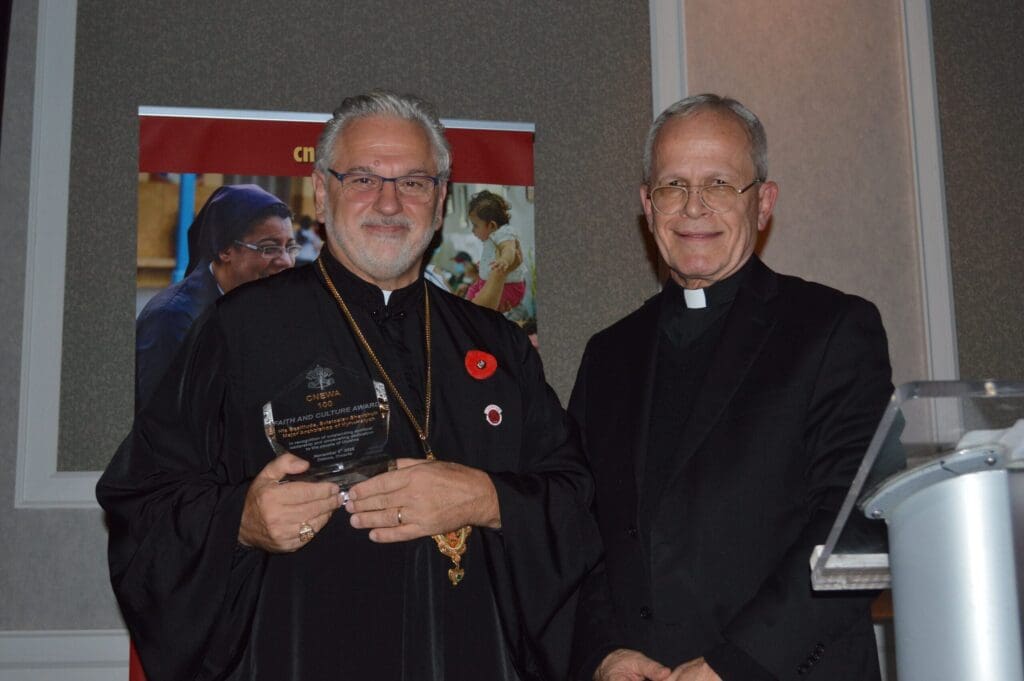
Later in the evening, Msgr. Peter I. Vaccari, president of CNEWA, bestowed the papal agency’s Faith & Culture Award on Major Archbishop Sviatoslav Shevchuk of the Ukrainian Greek Catholic Church for his leadership, unwavering witness to the Christian faith, and steadfast commitment to preserving the spiritual and cultural heritage of the Ukrainian people. Ukrainian Bishop Bryan Bayda of the Eparchy of Toronto and Eastern Canada accepted the award on Archbishop Shevchuk’s behalf.
Archbishop Shevchuk sent a prerecorded video congratulating CNEWA on the centenary, noting that “CNEWA has accompanied the Eastern churches with compassion, solidarity and hope.” He added that CNEWA’s mission was not just to provide assistance, “but to stand beside those who suffer, to strengthen local churches in their mission and to remind people ever in the darkest moments that they are not forgotten.”
Adriana Bara, national director of CNEWA in Canada, said the organization received donations of approximately CA$255,000, about USD$178,300, including from people who were unable to attend the gala.
“CNEWA Canada’s contribution to this century of mission is to bring the generosity of Canadians into a living relationship with the Eastern churches and the communities they serve,” she said.
“At CNEWA, we know that God is with us when we stand with the poor and vulnerable,” she added.
“That conviction connects our Canadian office to CNEWA’s entire century of mission.”