Seated on a sofa in an apartment in the Beirut suburbs, 6-year-old Maya flipped through her book while her brother Marc, 9, played the piano. They were surrounded by smiling portraits of their father, Elie Atallah, who was killed in an Israeli airstrike, along with two colleagues, on 12 March while installing a satellite dish in Ain Ebel, a village in southern Lebanon.
The three men are among the more than 4,300 people who have been killed in Lebanon since the start of the renewed all-out war on 2 March between Israel and the Iranian-allied Shiite Muslim movement, Hezbollah, which dominates the country’s south.
“Israel says they strike Hezbollah, but they were civilians,” said Zeinab Karout, his widow.
“Israel has not given us any explanation. I want them to acknowledge their crime,” she added. Ms. Karout demands an international investigation into her husband’s death.
Ain Ebel is one of three predominantly Christian villages in the south whose residents remain in defiance of the Israeli-declared “no-go zone,” which systematically levels entire neighborhoods and cemeteries and burns agricultural land. In June, this zone encompassed 240 square miles of land and sea and sits within a larger zone that was forcibly evacuated, spanning 19 percent of Lebanese territory, according to L’Orient-Today.
On 31 March, the Lebanese army retreated from these three villages in the face of the Israeli invasion. The war and the isolation have brought the local economy, largely sustained by agriculture, to a halt.
At the time of writing, and despite several aid convoys that have kept these villages supplied with basic food and medicine, residents have no access to emergency health care.
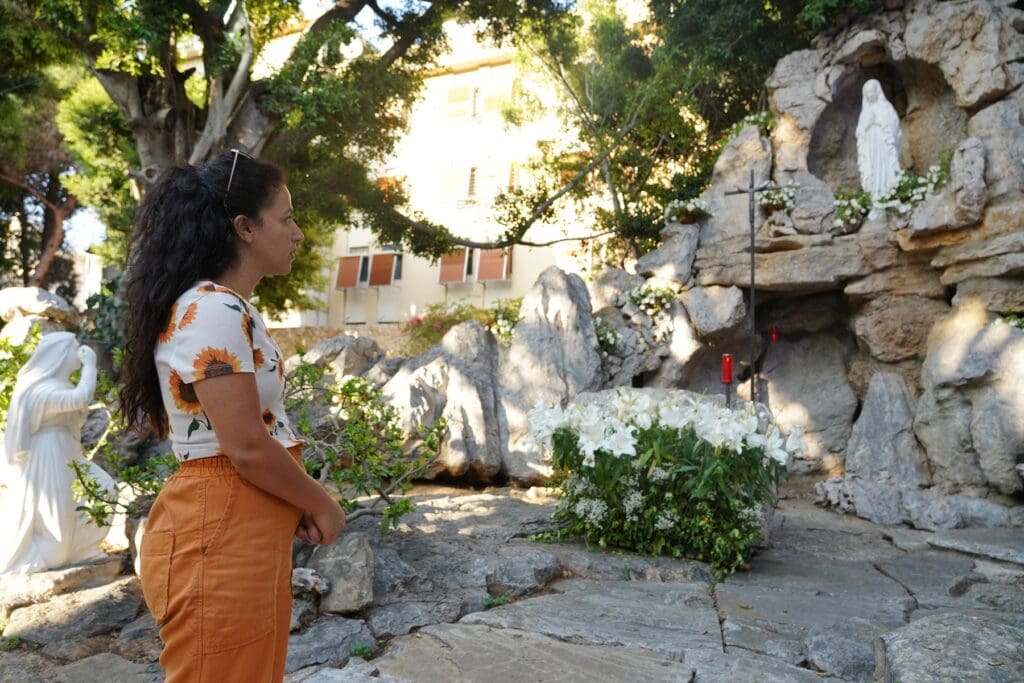
A dispensary was set up in Ain Ebel, where1,050 inhabitants have chosen to remain.
“We have food and water, but the children are very stressed and they need help,” said the mayor, Ayoub Khreich.
Rmeish, where 7,000 people remain, has three health care facilities.
Dr. Matar Matar, who works with Caritas Lebanon in Rmeish, said staffers cannot respond to life-threatening situations. The process to take a patient to Beirut includes going through the ceasefire monitoring committee, established in 2024, and then Israel must grant clearance.
“It can take up to six hours. Meanwhile, the patient could die,” Dr. Matar said.
Mayor Hanna al-Amil of Rmeish expressed concern about emergency medical situations.
“It is urgent to open a humanitarian corridor between Rmeish and Beirut,” he said. The roads leading to the three villages are “cut because of fighting and destruction. …
“We hear a lot of bombardments that come from both sides,” he said, referring to battles between Hezbollah and Israel. He said the Israelis established a demarcation line around the village.
“If we attempt to cross it, the drone launches stun grenades.”
Mr. Amil said residents of Rmeish have been unable to harvest their olive and tobacco crops since 2023 because of the ongoing fighting. Their farms are located beyond the demarcation line enforced by the Israeli army. As a result, “many cattle have died, and people have lost their jobs,” he said.
In Debel, the third village, the remaining 1,600 residents live under a stricter siege. At the time of writing, the road leading from Debel to Rmeish was controlled by the Israeli army and was open only from 7 a.m. to 4 p.m., said the mayor, Akl Naddaf.
Ain Ebel and Debel have suffered the destruction of entire neighborhoods due to partial occupation. The mayor of Ain Ebel said 60 housing units were damaged due to the occupation.
Debel attracted international attention in April, when Israeli soldiers vandalized a statue of the crucified Jesus.
“That sin made us safe: Suddenly, all eyes were on Israel’s doings,” said Milia Louka, who moved from Debel to Beirut.
After the 2024 escalation of fighting, Taleen Simonian of Ain Ebel was able to finance repairs to her home. However, on 2 April, tanks destroyed one side of her house. Footage of her home shows all her belongings turned into debris. “Our family pictures have disappeared in the rubble,” she said.
She now earns only $100 per month from working at a restaurant that has seen few customers since the siege began; she does other odd jobs to earn income.
“This is why we need the food relief” provided by humanitarian convoys, said Mr. Amil, stressing the impact of being barred from farming the land.
Since March, more than 17 convoys spearheaded by the pope’s representative to Lebanon, Archbishop Paolo Borgia, have delivered food supplies and fuel to the three villages. On 11 June, 45 vehicles were caught in the crossfire while en route.
“There was bombardment and shooting around us,” said Michel Constantin, regional director of CNEWA-Pontifical Mission in Beirut. He underlined the danger, as some of the trucks were carrying flammable supplies, such as fuel and gas canisters.
“Then we were turned back by the Israeli army,” he said. After a long detour on unsafe roads, part of the convoy was able to reach the villages. There, the CNEWA-Pontifical Mission team distributed $75 food coupons to 2,000 families.
“These convoys have a positive financial and psychological impact on the residents, they alleviate the feeling of being besieged,” said Mr. Amil.
Despite the dire living conditions, residents were intent on remaining in their villages.
“If we leave the village, we will lose it forever,” said Mr. Amil. “The Israelis will enter it, we will lose our houses, and Hezbollah could also enter,” turning the village into a battlefield.
In early July, Israeli Prime Minister Benjamin Netanyahu claimed these Christian villages in the south had “asked to be annexed to Israel,” claiming that “we protect them against Hezbollah.”
Representatives of 15 villages across the south of Lebanon, including Rmeish, Ain Ebel and Debel, rejected this claim and issued a statement on 3 July, stating the residents in these municipalities “hold fast to Lebanon as their final homeland (…) and they reject all attempts to distort their national positions.”
To help the church respond to crises in the Middle East and beyond, please visit Where Hope Persists.