Despite Ethiopia’s marked economic growth in recent years, humanitarian needs remain significant, with alarming food insecurity caused by internal ethnic-based conflicts and external geopolitical pressures.
The World Food Program reported in June that “conflict has become one of the main drivers of hunger and malnutrition in Ethiopia” and has “severely disrupted farming, trade and humanitarian access, leaving millions without reliable food sources. Fighting has displaced communities and destroyed crops and infrastructure.”
For a person reading this news from far away, the situation may seem of little significance. Or else the news from Ethiopia is not circulated widely enough to create awareness for the global community. But for a person on the ground encountering this situation daily, it is more acute and painful than any news article can relate.
For the people on the ground, facing the daily challenge of survival is a concrete reality.
The Catholic Church in Ethiopia experiences and shares in the daily challenges and suffering of the people who ask for help at the doorsteps of its institutions. When I think of the religious sisters and priests serving in such realities, I feel the steadfastness of their dedication and their lifelong commitment to stand always with those who suffer.
They truly deny themselves and carry their lifelong crosses (cf. Mt 16:24).
As director of CNEWA’s regional office in Ethiopia, I have the privilege to visit remote villages where the church stands with those who suffer. It is a privilege to be close to religious women and clergy who dedicate their lives without reservation to the service of those in need. Through these visits, I genuinely have learned what true church means.
When I hear of suffering in different areas of the country, I immediately call the sisters and priests who are present there and ask them about the situation. And when the challenges become severe, these servants of the church will call my office or appear at my door unannounced. How painful it is to hear their stories! How painful it is hearing of their inability to respond to the needs of those who suffer due to their lack of financial resources!
Msgr. Peter I. Vaccari, president of CNEWA, asked me to write an update about the current food insecurity in Ethiopia. My report led to the launch of an emergency campaign in May and the release of emergency funds, initially $100,000, aimed at sharing the burden of the church in those remote areas and bringing hope for survival to food-insecure people.
I felt privileged to respond on behalf of CNEWA to the dire needs in at least three places in northern Ethiopia affected by conflict, drought and economic hardship.
These servants, who have committed to be with and among those who suffer after everyone else has gone, are the reality of the church.
The church is well-established in these areas, providing education and health services for more than 50 years. However, a hunger crisis caused by unexpected wars and ethnic conflict, displacement, climate shock and economic hardship has stunted these developmental initiatives of the church.
Once the emergency funds were secured in May, religious women in those respective places in no time determined the most-affected families, purchased food and nonfood items, and arranged emergency food distribution.
They invited me to take part in this distribution, and I listened to stories about these families. They were heartbreaking.
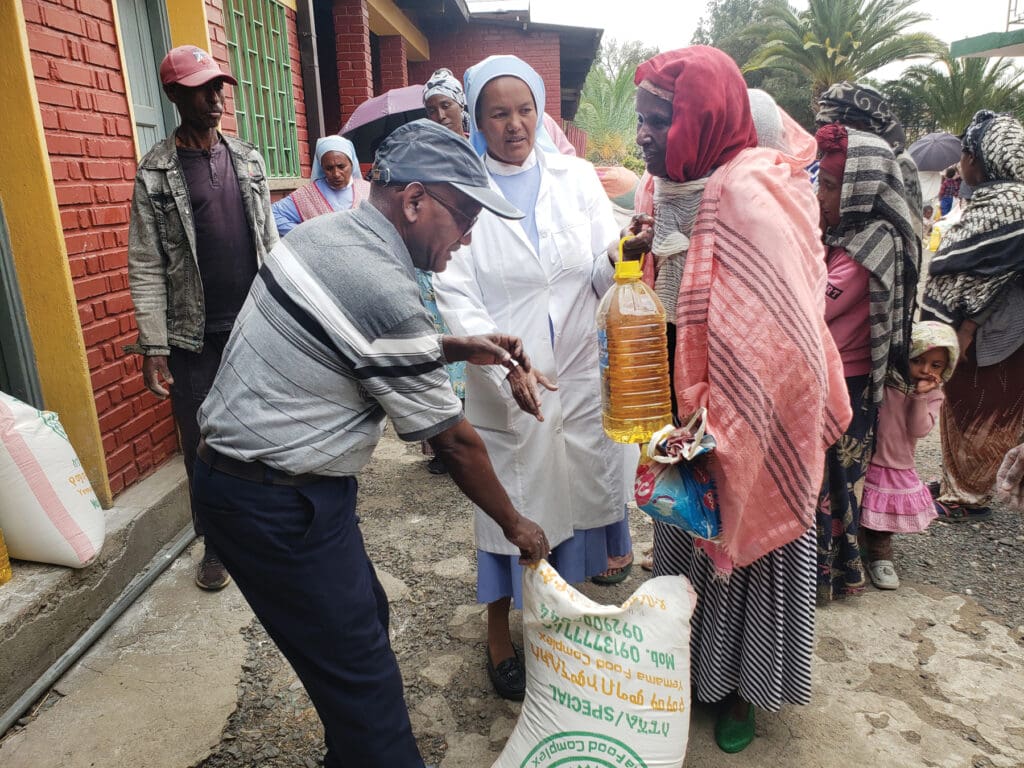
In Mendida, Sister Dinknesh Getachew told me about a mother of three, including a baby 5 months old, who spent several evenings with no food at home and no one to ask for support.
“I hurried to reach this poor lady, knocked at the door and asked her to open,” Sister Dinknesh said. “The response from the inside was, ‘Who is that? Are you coming to kill me and my baby?’ ”
Tearful, Sister Dinknesh replied: “I am a sister. Please open your door and come to receive some food items from our clinic.” How touching is such a story!
The Medium Clinic in Mendida is currently offering multiple services, feeding 80 malnourished children daily, providing medical treatment to the sick, and running emergency food distribution for acutely affected people. Thanks to CNEWA’s support, more than 1,750 people will benefit from these efforts.
In Arbaba, Cistercian Father Tamiru Adugna collaborated with the sisters in determining needy families and delivering food items. A widow and her five children, now displaced and with no income, are on the verge of starvation. Her husband, the family’s breadwinner, died in the two-year war in Tigray. Support from the Daughters of St. Anne has given her the hope to sustain for the next three months. The sisters are helping 30 acutely affected families with this support.
However, I observe that the need is more than expected, and the burden of the requests for food has fallen on the sisters’ shoulders.
In Edaga Hamus, where the sisters’ school and health center compounds were occupied by the military during the Tigray war, 400 female-headed families come to benefit from the emergency food distribution program. Almost all beneficiaries are young mothers suffering the trauma of war and the current severe food shortage.
During these visits, a painful thought clicked in my mind: “Argaw! You are here today for a short visit; the sisters’ daily encounter is to be close to the suffering people with meager resources or at times with no resources. They are there, always, in good times and bad times. They don’t abandon these people.”
This is a difficult thought for me. The next question is: How we can be closer to these sisters and to the priests who encounter and suffer with those who suffer? These servants, who have committed to be with and among those who suffer after everyone else has gone, are the reality of the church.
CNEWA’s initial emergency food response was intended to reach 6,180 people. According to the World Food Program update of June, “over 10 million people are facing acute hunger in Ethiopia.”
My recent visits testify to the increasing number of people suffering. And thanks to the generosity of friends and donors, we will be able to address multiple needs, including helping the church to remain faithful to its mission of being with and among those who suffer. For on the final day, I am reminded, God will ask us, “How did you respond when I was hungry?”
The CNEWA Connection
In May, CNEWA released an initial $100,000 for emergency aid to Ethiopia, where more than 10 million people face high levels of acute malnutrition or need immediate intervention to save lives.
In Mendida, a church-run feeding and medical treatment program for children is expected to help more than 1,750 people. In Gondar, 30 families totaling 150 people receive food monthly, and in Edaga Hamus, an emergency nutrition and maternity care project is helping 1,750 people as well.
To help CNEWA expand its program to feed the hungry in Ethiopia, call 1-866-322-4441 (Canada) or 1-800-442-6392 (United States) or visit cnewa.org/donate.
Read this article in our digital print format here.