Every parent knows how quickly children can grow. A new pair of sneakers, a dress or jeans become too small almost as soon as they are purchased.
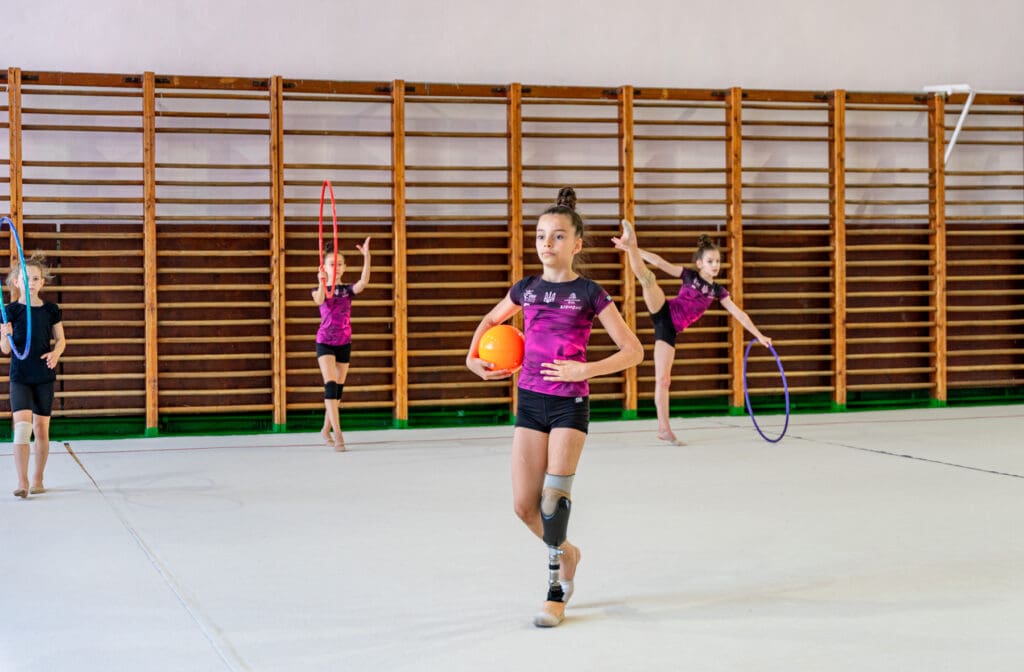
For Oleksandra “Sasha” Paskal, 10, growing also means getting the socket for her prosthesis adjusted or replaced every three months and securing a new artificial foot twice a year to match the growth of her right foot.
In 2022, when Oleksandra was 6 years old, she lost her leg in a Russian missile strike in the Odesa region of Ukraine. She also lost a finger and sustained multiple injuries to her head and torso. She survived, underwent rehabilitation and received a bionic prosthesis.
Now Oleksandra, a gymnast, is training again in Chornomorsk, southern Ukraine.
Her mother, Maria Paskal, remembers when her daughter was pulled from the rubble of their home. The family thought only about keeping her alive. At first, her parents did not know amputation would be necessary. Only later did doctors tell them Oleksandra’s leg could not be saved.
After treatment and rehabilitation in Austria, the family returned home. About a month later, Oleksandra wanted to train again.
“Sasha herself wanted to return to gymnastics,” said Ms. Paskal, “and we supported her.”
Oleksandra’s coach, Inga Kovalchuk, decided the young gymnast would train with the same girls as before her injury — four hours a day, five days a week — and represent Ukraine at international competitions. Recently, Oleksandra won a gold medal at a competition in Romania.
“I clearly understood that I had to offer her support and, at the same time, not make Oleksandra ‘a separate category’ within her own team,” said Ms. Kovalchuk, a renowned rhythmic gymnastics coach in Ukraine.
“She works with everyone. Some elements must be adapted to her abilities, but she receives praise and corrections just like everyone else. We do not divide the children.
“I always tell Oleksandra: We have to make people proud of you, inspired by you — not sorry for you,” Ms. Kovalchuk said.
“The most important thing is that she is alive, that she is back in the gym, that she smiles and inspires others,” she added. “The real victory is her resilience.”
Asked what rhythmic gymnastics means to her, Oleksandra replied: “Rhythmic gymnastics is my life. I love gymnastics very much.”
Oleksandra’s story shows one of war’s most visible consequences for children: a wounded body.
The United Nations reported in July that more than 800 Ukrainian children have been killed and more than 2,950 children injured since Russia’s invasion in 2022. These numbers only detail the confirmed dead or wounded; the U.N. notes it is difficult to verify numbers in active war zones, and the fear is the numbers may be much higher.
However, tens of thousands of children in Ukraine have been impacted in less visible ways, namely by parental loss. As of 1 January, more than 59,000 children were registered officially as orphans or as children deprived of parental care, according to Ukraine’s Ministry of Social Policy. The majority — 95 percent — were being raised in family-based forms of care.
“The real victory is her resilience.”
At the same time, institutional care remains a major issue. Government records indicate that of nearly 25,000 children living or studying full time in residential institutions in Ukraine in 2025, only about 4,000 children had no parents, which meant the majority were not orphans but were separated from family for social or economic reasons.
In 2025, the government purchased housing to create 124 family-style children’s homes as part of its broader effort to move children away from institutional care toward family-based support.
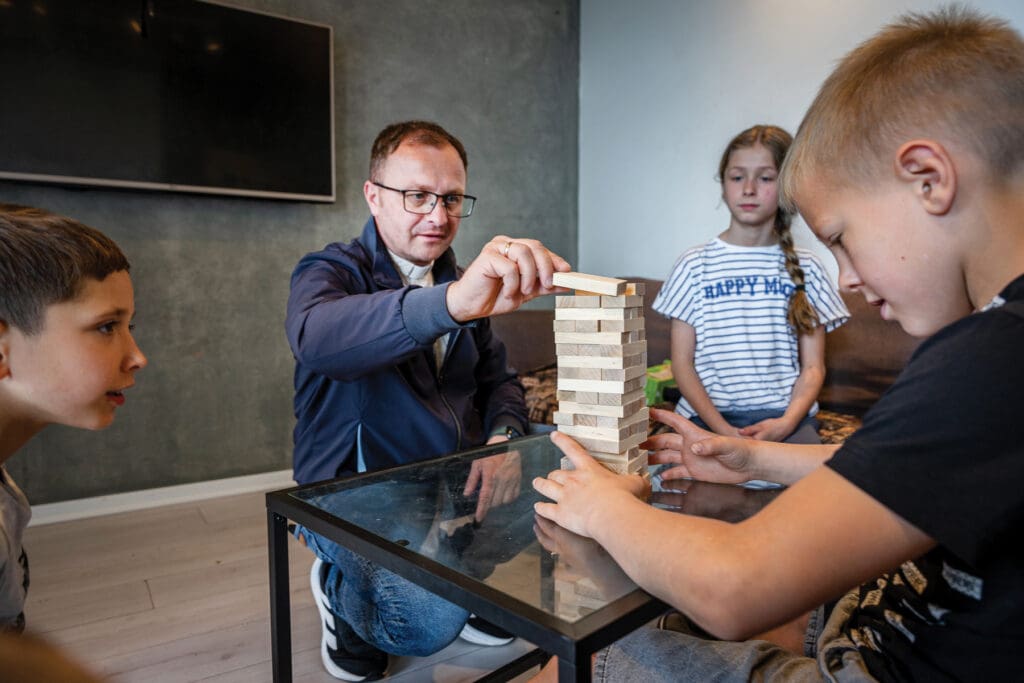
In Lviv, the Orphan Care Center of the Ukrainian Greek Catholic Archeparchy of Lviv has been supporting orphans and abandoned children in institutional housing, family-style children’s homes and foster families since 2009. The center provides these children with pastoral care, as well as caregiver and material support, including food, hygiene items or laptops for learning. The center also operates the House of Mercy of St. Nicholas, which serves as a shelter for children and others in need.
Before 2022, the center reached more than 1,000 children a year through a variety of projects, daily activities, outreach programs and volunteer initiatives. Since then, the center has expanded day care facilities, providing psychosocial support and increasing its distribution of food and essential items.
In 2026, the center is reaching some 1,200 children and young people, including about 200 children in 20 family-style children’s homes, 500 children in nine institutional care facilities, and 80 children under the care of social services. The center’s chaplains also minister to the children enrolled at a kindergarten and elementary school of the Ukrainian Greek Catholic Church and to some 300 children from families in difficult circumstances.
“We stay close,” said the Rev. Roman Prokopets, director of the Orphan Care Center. “That is one of the most important mottos of our organization — to be close to those who need it.”
Father Prokopets said the center’s work is built on the continuity and stability of the church’s ongoing presence, regardless of the frequency with which the child’s life is disrupted with moves between institutions, schools or caregivers.
Father Nazariy Pryshlyak, a center chaplain, said the war “adds even more tragedy” to children already wounded by orphanhood or institutional life. Yet when asked what they want to pray for, “they speak about supporting our soldiers,” he said.
The center’s programming includes camps, catechesis, workshops, sports and outings. Its soccer team, FC KOPA, is for children who have lost one or both parents, are in foster care or displaced by the war. The team has competed internationally, including in Poland in 2025 and the Magic Cup in the United States in 2026.
Yuliia Ilchyshyn, head of the center’s sports program, said soccer has become “an instrument of acceptance” for these children. “We wanted to help them see a future,” she said.
Brother Andriy Kharkiv, a chaplain who works with family-style children’s homes and foster families, said activities are meant to keep children active and to give them a sense of community.
War forces children to grow up too soon, he added. Brother Andriy said he believes what children need most is to be heard and to know they are loved.
“I remember myself at their age: I prayed for a dog, for good weather, for friends. These children pray for soldiers, for victory, for missiles to stop,” he said.
The center also facilitates adoption. Deacon Taras Kotlinsky assists adults who are considering adoption, guardianship, patronage care or fostering. In general, Ukrainians have become more hesitant to foster or adopt with the uncertainties of the war, he said. Only 770 children were adopted legally in Ukraine between January and August last year.
“I personally urge people not to put off until tomorrow, or some distant future, what we can give today,” he said.
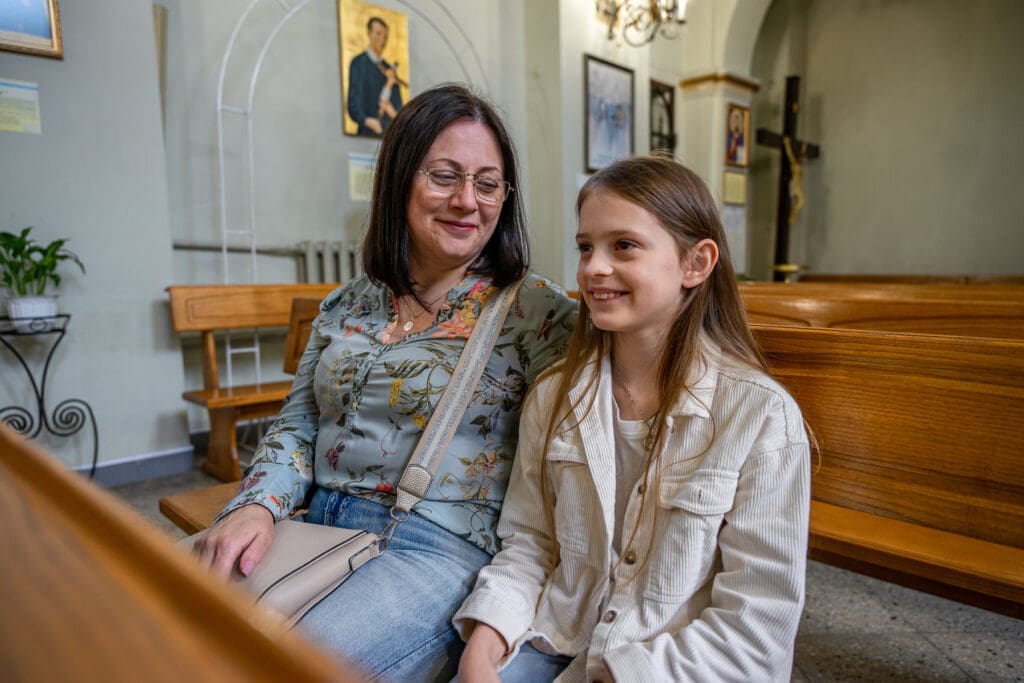
Oksana Dolynska and her husband, parishioners of the Church of the Mother of God of Perpetual Help in Lviv, had been thinking about adoption for years, but doubted whether they had enough strength, experience or space in their home to be good adoptive parents.
The center’s chaplains gave them the encouragement they needed and, in early 2025, they welcomed Ivan and Valeria. The fraternal twins were displaced from the Donbas region, eastern Ukraine, to Lviv, where they were in institutional care after their father died and their mother was unable to provide care.
Ms. Dolynska does not romanticize foster care or adoption — she said she knows Ivan and Valeria, now 11 years old, will likely experience trauma for many years — but she has seen improvements after 18 months of being a family together.
“Ivan and Valeria have become calm at home with us,” she said. “They have become our children.”
The church, too, has become a place of trust. Father Prokopets invited Ivan to serve at the altar. At first, Ivan was afraid of fire and incense, but before long he was handling a candle and thurible with confidence. Valeria has become active in parish life, singing, praying during the Divine Liturgy and helping to lead the rosary.
Kateryna Dolhova, who has raised 15 children in a family-style group home supported by the Orphan Care Center in Lviv, said family does not only provide a roof overhead.
“Family is a community, and community is strength,” she said. Family can hold a child when the world around them is falling apart, she added.
“We wanted to help them see a future.”
In Sumy, northeastern Ukraine, children who have a home and parents can appear more withdrawn and anxious than those farther from the front in Lviv, who have lost parents but are surrounded by support.
Air-raid alerts, explosions, shelters and waiting on bad news have become routine in Sumy. Parents are near but often exhausted by fear for their children and for family in the military. Families still offer love, but they cannot always offer safety.
Children have spent years between shelters and online classes, with rare opportunities to play with friends and classmates. In response, the Sumy Regional Center for Extracurricular Education and Work With Talented Youth organized a summer wellness hub with workshops, games, crafts, sports and time with peers.
“Children enjoy doing creative work,” said Lyudmyla Gayeva, who leads the arts and crafts club. “But most importantly, they communicate — because that is what they lack so much now.”
Over time, the trauma of war can settle into the body.
“Even if it is not an explosion, just some sharp sound, a child still flinches,” said Yevheniia Kozyr. Her sons miss their father, who serves in the military. When he can call from the front or check his phone, they send him photos of drawings and crafts they made at school.
Nataliia Sosnovenko is a psychologist and the director of the Center for Psychological Expertise and Methodology at Voices of Children, a nationwide Ukrainian charitable foundation with 15 centers across the country that provide psychological and social support to children and families.
She said the consequences of war on children extend beyond individual trauma to include forced emigration, displacement, deportation, family separation, life under occupation, disrupted education, broken socialization and child death. Together, they present a challenge of grave proportions the country will feel for years, she said.
“The demographic crisis is not only a question of population numbers. It is a question of human potential,” she said.
Some children may not return from abroad. In February, UNICEF reported nearly 1.8 million Ukrainian children are living as refugees outside the country. Others will return needing long-term support, while still others are growing up under chronic stress, with their mental and emotional resources directed not toward development, but survival.
However, Ms. Sosnovenko cautioned against calling them a “lost generation.”
Should children have stable adults nearby and access to education, psychological support and a safe environment, she said, they will have a great capacity to recover.
The CNEWA Connection
CNEWA has been assisting Ukrainian children in need for decades. Long before Ukraine achieved its independence from the Soviet Union, CNEWA supported child care programs of Ukrainian Greek Catholic women religious in Argentina and Brazil, where Ukrainian communities in exile put down roots. Support for the activities of the Catholic churches in Ukraine have grown significantly, especially after Russia’s full-scale invasion in 2022, with CNEWA deploying more than $10 million in support of humanitarian and pastoral aid, focusing on the most vulnerable, including children, the displaced and homeless, those with special needs and the elderly.
To support CNEWA’s work in Ukraine, call 1-866-322-4441 (Canada) or 1-800-442-6392 (United States) or visit cnewa.org/donate.