Joseph Hazboun was standing with Palestinians on a farm near Taybeh, West Bank, when a man drove his tractor toward them at high speed, “attempting to intimidate and chase the group,” he said.
Mr. Hazboun, who directs CNEWA-Pontifical Mission for Palestine operations in Palestine and Israel, was visiting with Palestinians in the area threatened and harassed by Israeli extremists. He said in many cases, settlers had cut through protective fencing to allow their sheep to graze on privately owned Palestinian farmland.
“The confrontation escalated rapidly when the settler operating in the area learned of our presence,” he said in a report in early August. “The situation was deeply tense and overwhelming, diffused only when two Israeli peace activists present in the area intervened to block and confront him.”
Ongoing settler intimidation of West Bank residents includes several tactics, including cutting fences to allow animals to graze on Palestinian farms, newly planted fields and in olive groves. In some cases, blockades and settler outposts keep Palestinian farmers from reaching their ancestral lands.
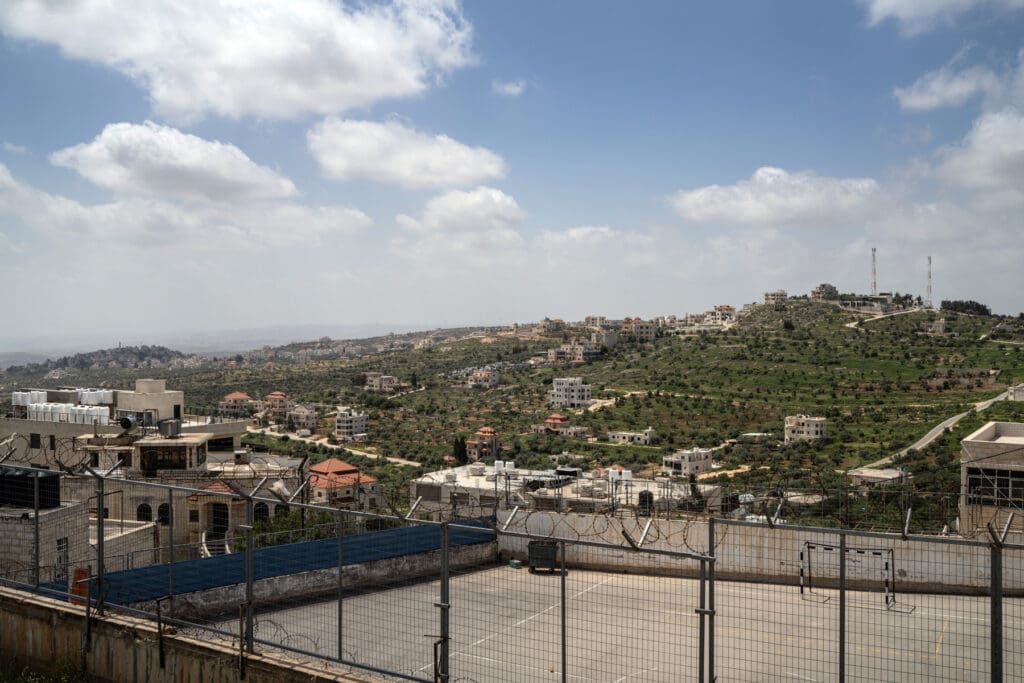
“Standing on that contested hillside, the human cost of the West Bank’s expanding outposts became starkly evident — leaving families stranded away from the very homes they built, caught in a cycle of displacement and daily intimidation,” Mr. Hazboun said.
In June, independent investigators appointed by the U.N. Human Rights Council reported settler violence “functions as a means of implementing Israeli State policy, with both the state and violent settler groups working toward the same strategic objectives: entrenchment of Israeli settlements, annexation of Palestinian territory and displacement of Palestinians from their land.”
The investigators reported that seven Palestinians were killed in the West Bank and more than 830 were injured in 2025. The U.N. reported more than 1,800 settler attacks across the West Bank last year.
Bethlehem and surrounding towns are “heavily impacted by an array of military checkpoints, earth mounds and dozens of iron gates installed on main and secondary roads,” Mr. Hazboun reported. This has isolated communities and resulted in a drop in tourism and the virtual collapse of the hospitality sector, “leaving thousands of families without stable incomes, independent livelihoods or domestic economic lifelines.”
Mr. Hazboun said communities like Taybeh, known as the West Bank’s last all-Christian village, have faced repeated assaults, such as settlers setting fire to land near the village border.
“Local volunteer firefighters and residents attempting to put out blazes have frequently been obstructed, targeted with live fire, or physically beaten,” he reported. “Vehicles are torched, and hateful graffiti is sprayed on community walls to instill psychological terror.”
Across the West Bank, groups of settlers “smash windows, set cars and homes ablaze and attack residents with stones and live ammunition. These incidents often occur while Israeli military forces are either standing by or intervening in a manner that local monitors report offers de facto protection or impunity to the aggressors.”
On 9 August, the Israeli military closed Taybeh to nonresidents. The military said the move was to protect residents from settler attacks, although at least one Israeli peace activist said he feared the move was to keep peace activists from protecting the Palestinians.
Despite the military closure, Cardinal Pierbattista Pizzaballa, Latin patriarch of Jerusalem, traveled to Taybeh to celebrate Mass for the feast of the Assumption on Saturday, 15 August. He urged residents to keep hope even when the situation is very difficult, advising them to “learn from the Virgin Mary how to guard our hearts, because this situation can contaminate our hearts. And if our hearts become contaminated, the ‘dragon’ has won.”
“We want to remain a community that gives birth to life, without giving up or abandoning our rights, our right to life. So be courageous. Do not be afraid,” he told them.
Mr. Hazboun reported that, despite the difficulties, “the Taybeh community remains steadfastly committed to building a future defined by peace, dignity and prosperity.”
“Rather than allowing fear to restrict their vision, local leadership and residents continue to invest in constructive projects that offer safety, hope and normal life for the next generation,” he said, citing the example of the construction of a new soccer field that will serve children from surrounding villages, where there are no athletic or recreational facilities.
It’s a sign of “a resilient community that refuses to surrender its youth’s future to conflict and fear,” he said.
However powerful evil may appear, the Latin patriarch reminded the faithful during his homily, its power is not absolute.