Christian leaders in the Holy Land condemned attacks by Israeli settlers in the West Bank against Palestinians and European diplomats during an annual olive harvest.
In a statement released 20 October by the Latin Patriarchate of Jerusalem, the “Patriarchs and Heads of Churches in Jerusalem” say the “wild attack” in Taybeh, the last remaining Christian village in the West Bank, was “not an isolated incident.”
“In the past weeks, the Palestinian villages of the West Bank have been exposed to a wide-scale terror by settlers, which is reaching a peak during this time of the olive harvest, when families go to their lands to collect what they need to live and renew their generations-long bond with their lands,” the statement reads.
The attack on 17 October occurred when a convoy of European diplomats from Belgium, Poland and France, as well as Palestinian civilians, were ambushed by masked settlers, international news agencies reported. Among those attacked was Bernard Baudoux, the mayor of the French commune of Aulnoye-Aymeries, who told Reuters he was “violently attacked” and “thrown to the ground” by the assailants.
The attack occurred just one day after settlers committed a similar attack against Palestinians during the olive harvest on 16 October, setting fire to olive trees and throwing rocks, leaving several injured, including Heidi Levine, an American photographer for The Washington Post.
Israeli media reported police are looking into a complaint against Rabbi Dov Lior, a religious Zionist who on 16 October issued a religious ruling that allowed Jews to harvest olive trees on Palestinian property “in order to show to the public our ownership of the land, and in so doing one fulfills the [religious] commandment of conquering the land.”
The complaint was filed by Rabbis for Human Rights, an Israeli-based organization composed of rabbis, as well as rabbinical students and leaders who advocate for civil and human rights in Israel and the Palestinian territories.
In their statement, the patriarchs and heads of churches describe the religious ruling “as unfounded, very worrying and dangerous, and absolutely unacceptable” and express appreciation to the “rabbis and Jewish voices” who “have publicly rejected it.”
While expressing their gratitude to Israeli President Isaac Herzog for condemning the attack, the church leaders stressed that verbal denunciations are not enough without legal consequences.
“Unfortunately, the facts on the ground show that these attacks continue because of the impunity enjoyed by those who commit them,” the statement says.
While acknowledging subsequent arrests made by Israeli police, the church leaders called on authorities to ensure law enforcement can be carried out “in a serious and consistent manner.”
“We call upon the competent authorities to bring those responsible to justice, and we urge the international community to intensify its efforts to ensure the protection of the people of Taybeh and the West Bank, as well as all those who visit these areas to express their solidarity,” the Christian leaders say.
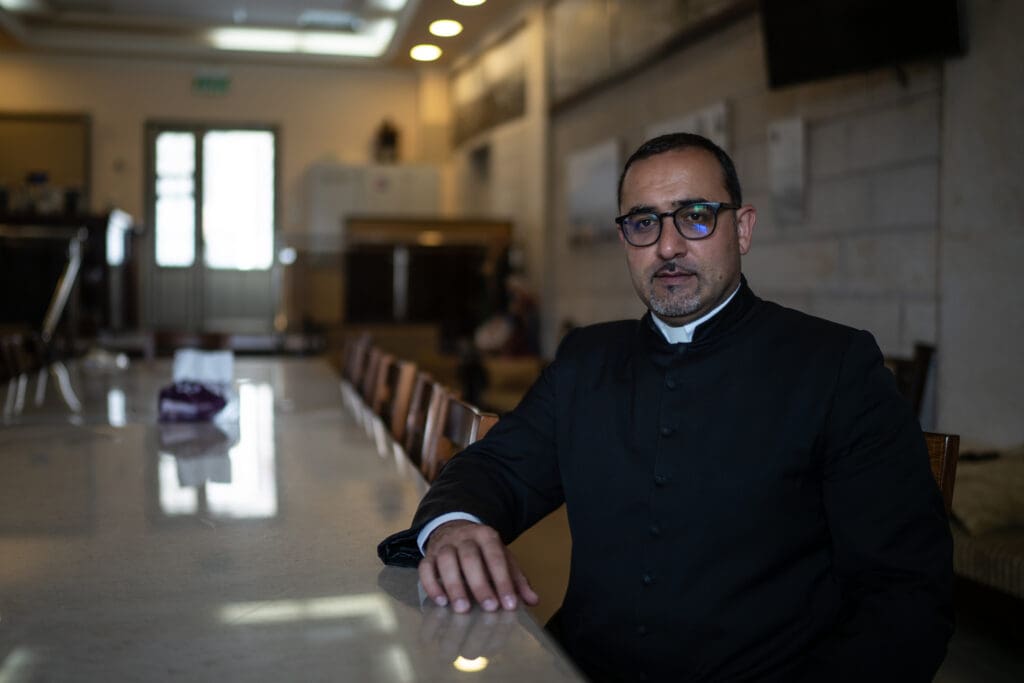
Jospeh Hazboun, CNEWA’s regional director for Palestine and Israel, said the “recent attack in Taybeh — and the religious ruling that declared the taking of Palestinian farmers’ olives permissible — reveals a profound moral crisis. It is difficult to reconcile any claim of divine sanction with an act that so clearly violates a foundational commandment: ‘Thou shalt not steal.’ ”
“The gravity of this attack is deepened by its targets: not only peaceful residents during the olive harvest, but also foreign guests, including diplomats and European officials who had come in solidarity,” he continued. “That settlers would assault members of the diplomatic corps is a stark measure of the impunity that has taken root.
“True faith, as the church leaders remind us, cannot be a shield for lawlessness or a weapon for dispossession,” he said.
Military violence and settler attacks in the West Bank began to pick up during the Israeli-Hamas war in Gaza, when Israel launched a full-scale assault on Gaza in response to the October 2023 Hamas attacks on Israeli border communities. Between January and September 2025, the United Nations reported more than 1,800 settler attacks across the West Bank. It reported that from 2023 to 2025, settler violence and Israeli military restrictions displaced almost 3,000 Palestinians across the West Bank, including 636 in the first six months of 2025 alone.
On 15 October, Farhan Haq, United Nations deputy spokesman, said since 1 September, the U.N. had recorded more than 200 Israeli attacks on Palestinian farmers. Noting that a month remained in the harvest season, he compared this to 185 attacks throughout the entire 2025 olive harvest.
The Rev. Bashar Fawadleh, the pastor of Christ the Redeemer Catholic Church in Taybeh, said people are leaving because of the violence.
“People are tired,” he told ONE magazine. “People are without rights — rights to live, rights to move, rights to pray, rights to learn, rights to travel.”