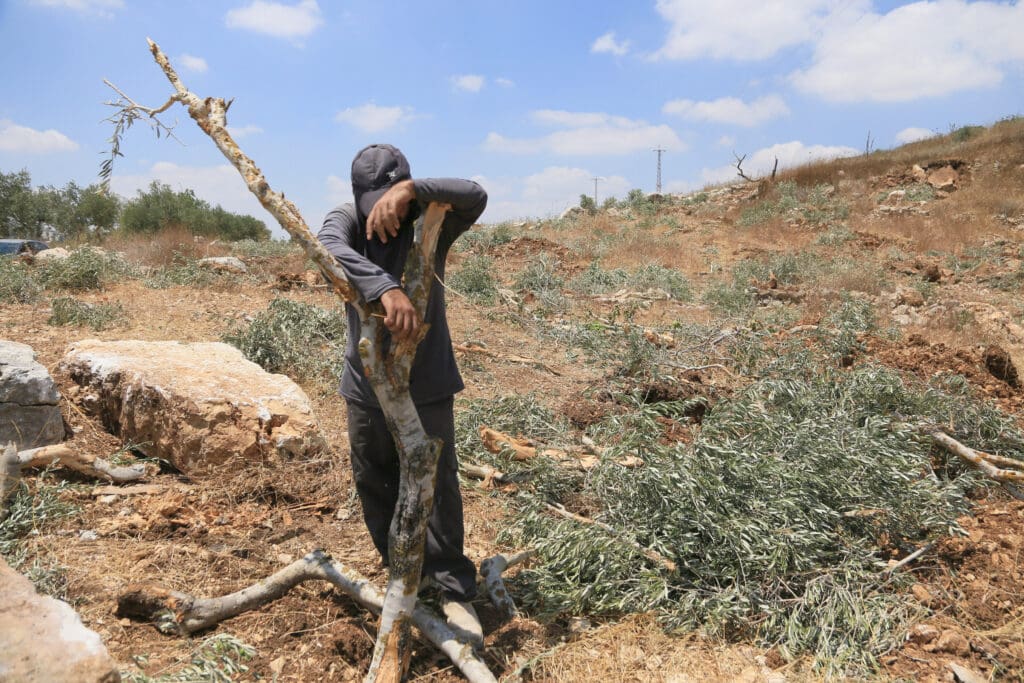
Hundreds of uprooted olive trees line the highways of the occupied West Bank, their ancient trunks and roots ripped up by Israeli military bulldozers.
Stretches of privately owned olive groves — cultivated, inherited and passed down through generations of Palestinian families — have been reduced to bare earth.
“All of Israel’s colonial practices and policies concerning the land have been and continue to be destructive to the environment and the agricultural sector,” said the Rev. Munther Isaac, pastor of the Evangelical Lutheran Church of Hope in Ramallah and director of the Bethlehem Institute for Peace and Justice.
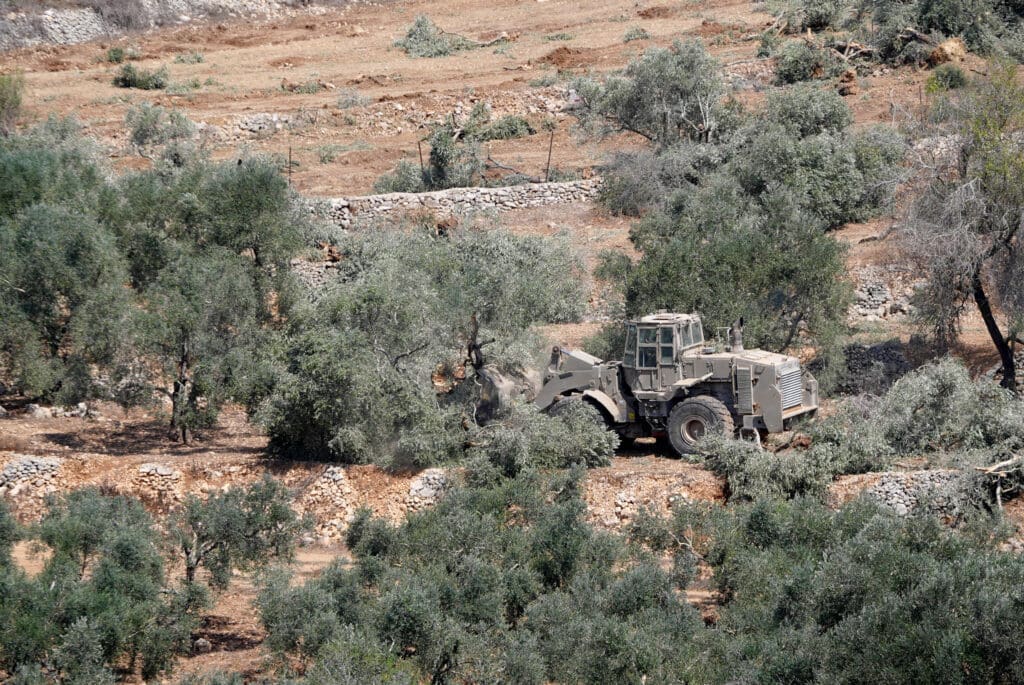
“The environment is suffering greatly,” said Father Ibrahim Faltas, O.F.M., of the Custody of the Holy Land, who noted how St. Francis of Assisi, the founder of his religious community, “taught us a lot about love for the environment.”
“There is burning of agricultural fields and trees, and many other types of attacks,” he said of the situation in the West Bank. “The attacks are not just on the environment but also on people, which is making people afraid.”
“People are unable to harvest their olives, work their lands, or do anything,” he said. “Look at Aboud, Taybeh and Zababdeh villages in the West Bank and many others. This is affecting people’s livelihoods.”
Since Israel’s occupation of the West Bank, East Jerusalem and the Gaza Strip in 1967, it is estimated that between 600,000 and 800,000 Palestinian-owned olive trees and 2.5 million fruit trees have been uprooted.
“Our responsibility as Christians is to speak the truth and resist any system that destroys the components of life.”
The uprooting of mature trees has caused significant long-term environmental and economic loss. An olive tree can take five to eight years to produce a good crop and 15-20 years to reach full productivity. Some olive trees in the West Bank have stood for more than 1,000 years.
Attacks by armed illegal settlers and the military have intensified in recent years. During last year’s olive harvest, from 1 October and 30 November, settlers damaged more than 6,000 Palestinian-owned trees and saplings in 70 West Bank villages — the highest level recorded in the past six years — according to the United Nations Office for the Coordination of Humanitarian Affairs (UNOCHA).
However, the damage extends beyond orchards to agricultural land, water resources, wildlife and the broader ecosystems on which Palestinian cities and villages depend.
“Today, there is a clear attack on all the components of Palestinian life and on the environment,” said Rev. Isaac.
The mass land seizures, illegal settlements, military infrastructure and checkpoints, and the separation wall collectively have had a devastating impact, restricting access to important natural resources, including water and groundwater, as well as to agricultural and grazing land, nature reserves, forests and mineral and quarry resources.
“Settler attacks have reached unprecedented levels — we have never witnessed these levels before,” said Father Faltas.
“In terms of initiatives, we aren’t able to do much to help people to access their lands — it’s very difficult. What can the church do?” he added.
A joint UNRWA-ARIJ assessment found construction of the separation wall caused widespread soil erosion and compaction, ecosystem fragmentation, the uprooting of vegetation and the degradation of agricultural land.
More than 100,000 Palestinian-owned trees were uprooted, and more than 18 miles of irrigation network and water pipelines were destroyed for its construction, which remains ongoing. The wall’s construction has caused the destruction or isolation of wells, cisterns and springs, and flooding due to blocked surface-water drainage. It also has disrupted the contiguity of the natural flow of streams and springs, affecting the diversity and existence of local flora and fauna.
The wall has disrupted wildlife movement and habitats as well. In 2010, only eight years after the construction of the wall began, Palestine’s Environment Quality Authority identified 16 wild animals were endangered in the area, and almost all the amphibians were endangered by habitat destruction due to the related loss and degradation of water sources.
A year later, farmers in areas isolated by the wall reported 50-60 percent declines in annual harvests, while restricted grazing contributed to livestock losses of up to 60 percent in some villages, not including livestock that was stolen, harmed or killed by settlers.
According to OCHA, Palestinian farmers must navigate approximately 62 Israeli military gates to reach land isolated by the wall; at least 20 percent of documented movement closures in the West Bank obstruct access to agricultural land.
In 2023, nearly 24,000 acres of olive-cultivated land across the West Bank went unharvested because of access restrictions, causing land degradation, soil erosion, declining vegetation cover and increasing pressure on remaining agricultural land, in addition to a $10 million financial loss.
An olive tree can take five to eight years to produce a good crop and 15-20 years to reach full productivity.
In the first half of 2026, more than 190 water and sanitation structures in Palestinian communities — including pipelines, irrigation systems and water tanks — were damaged or destroyed in more than 100 attacks involving demolitions by the Israeli military or settler violence.
The destruction has disrupted water supplies and irrigation, reducing water available to crops, trees, livestock and vegetation, and increasing the risk of soil and water contamination. Prolonged loss of irrigation has led to crop loss, declining vegetation cover and soil degradation, and has further reduced the productivity and ecological resilience of agricultural land.
Because many Israeli settlements are built uphill from Palestinian villages, wastewater and industrial runoff, including hazardous materials, such as medical waste, metals, batteries and industrial byproducts, flow directly into Palestinian villages and agricultural land. Industrial pollutants and pesticides further contaminate nearby air, soil and water, causing respiratory and other ailments among residents. Research around industrial areas in Tulkarem and Salfit has documented an unusually high number of reported rates of cancer and among the highest rates of asthma, eye and respiratory anomalies compared with other districts.
This environmental destruction contradicts church teaching, said Rev. Isaac.
“From its very beginning, the Christian faith has taught that creation is good, created by God, and that human beings are called to care for it. This is part of Christian theology and something entrusted to us,” he said. “Our responsibility as Christians is to speak the truth and resist any system that destroys the components of life.”
Environmental destruction and degradation are among the factors that have led to a decline in the Christian population. According to recent estimates, the Christian population in the West Bank is roughly 40,000 to 45,000, or just over one percent of the population — down from approximately five percent in the 1967 census.
Taybeh, northeast of Ramallah, known as the last Christian Palestinian village in the West Bank, has some 1,300 residents, according to local officials, compared with 3,000 people some 40 years ago. It is among the most-targeted villages by illegal settlers, including the burning of agricultural land.
“The settlers tried to burn the village church, and they let their livestock enter the church,” said the mayor, Suleiman Elias Khouriyeh.
A statement by the Priests of the Churches of Taybeh said the village is “now at serious risk of erosion and displacement due to the systematic targeting of land, sacred places and the local community.”
Taybeh occupies approximately 5,930 acres of mostly agricultural land, said the mayor. He said settlers and the military prevent citizens from reaching nearly 4,000 acres of their land.
Mr. Khouriyeh owns plots of land that have been taken over by settlers and the Israeli military. “I had planted 100 citrus tree saplings. The settlers uprooted them, stole them and planted them in the nearby illegal settlement outpost,” he said.
As Palestinians brace for the olive harvest in mid-October, residents wonder whether they will be able to reach or access their lands.
“Israel presents itself to the West as having turned the desert into the Garden of Eden with the establishment of the State of Israel,” said Rev. Isaac. “But the reality before us is the complete opposite.”